|
By David F. Dawes
A much-anticipated apology was the centre of attention
in Ottawa June 11, as Prime Minister Stephen Harper acknowledged the damage
done to Aboriginal Canadians by the notorious residential schools system.
The apology was well-received by many Natives –
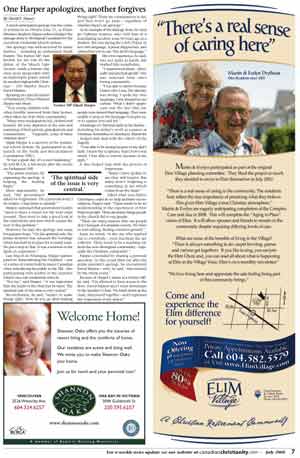
including an enthusiastic Elijah Harper. The former MP, best known
for his role in the defeat of the Meech Lake Accord, made a historic
day even more memorable with an impromptu prayer, joined by another
high-profile Christian – 100 Huntley
Street’s David Mainse.
Speaking at a special session of Parliament, Prime
Minister Harper was blunt.
“Very young children were often forcibly removed
from their homes, often taken far from their communities.
“Many were inadequately fed, clothed and housed.
All were deprived of the care and nurturing of their parents, grandparents
and communities . . . Tragically, some of these children died.”
Elijah Harper is a survivor of the residential school
system. He participated in the launch of the Truth and Reconciliation
Commission (TRC).
“It was a great day; it’s a new
beginning,” he told BCCN, a few hours after the events on Parliament Hill.
“The prime minister, by expressing the apology,
is helping the healing begin.”
Most importantly, he said, “the government asked
for forgiveness. On a personal level, I do forgive. I had done so
already.”
Harper cautioned that government leaders “need to
have a vision for the next steps forward. They need to take a good look at
the institutions and laws which caused the root of this problem.”
However, he said, the apology was cause for genuine
hope. “On the spiritual side, the prime minister has released the
bondage which has held us in place for so many years. He put a stop to
this. It was a renewal of the spirit of cooperation.”
Last March in Winnipeg, Harper participated in
‘Remembering the Children’ – one of a series of events
held in major Canadian cities, introducing the public to the TRC. Also
participating were leaders of the churches which once ran residential
schools.
“For me,” said Harper, “ it was
important that the heads of the churches be there. The spiritual side of
the issue is very central.”
Reconciliation, he said, “means ‘to make
things right.’ How do you go abut making things right? There are
consequences to sin, and they won’t go away – regardless of
whether there’s an apology.”
As an example of the damage done, he cited an Ojibway
women, who told him of a humiliating incident some 60 years ago as a
student. She was saying the Lord’s Prayer in her own language. A
priest slapped her, and ordered her not to use “the devil’s
language.”
Continue article >>
|
His own experience, he said, was not quite as harsh,
but marked him nonetheless.
“I experienced abuse – physically and
psychologically. One was removed from one’s loving community . . .
“I was able to survive because I knew who I was.
My identity was strong. I spoke my own language; I was steeped in my
culture. What I didn’t appreciate was the fact that our people were
denied their language. They were unable to pray in the language God gave
us, or to express love and joy.”
A heritage of Christian faith in his family –
including his father’s work as a pastor at Christian Assemblies in
Steinbach, Manitoba – helped him deal with the effects of the
tragedy.
“I was able to be strong because of my
dad’s faith. I knew the scriptures; that’s how I was raised. I
was able to survive because of my faith.”
It also helped him with the process of forgiveness.
“Many I have spoken to say they will forgive. But
many won’t. Forgiving is something in me which comes from the
heart.”
Asked what non-Native Christians could do to help
facilitate reconciliation, Harper said: “There needs to be an
understanding of the experiences of First Nations people. There are many
things people in the church did to our people.
“There are many reasons why our people
don’t feel part of Canadian society. We have to start talking,
finding common ground.”
Jesus, he noted, “is the one who reached out to
everybody – even Zaccheus the tax collector. There needs to be a
reaching out from the non-Aboriginal community – especially the
Christian community.”
Harper concluded by sharing a personal anecdote. As the
crowd filed out after the prime minister’s apology, he encountered
David Mainse – who, he said, “was touched by the whole
event.”
Because of Harper’s status as a former MP, he
said, “I’m allowed to have access to the floor. David Mainse
and I went downstairs to the Speaker’s Chair. We knelt down at the
chair, and prayed together – and I expressed my forgiveness in my
prayer.”
July 2008
|