|
This is the third in a series marking the 150th
anniversary of B.C.’s founding. Author and pastor Ed Hird profiles a leader
whose name is remembered, but whose deeds are largely forgotten.
TO have Mount Seymour Provincial Park right in my
backyard is such a blessing. My wife and I, along with our three boys, have
whiled away many pleasant hours hiking along the mountain’s trails. I
often wondered just who it was named after.
After being given a fascinating book entitled British Columbia Place Names, I
discovered Mount Seymour is named after the first governor of the united
British Columbia colony, Frederick Seymour.
Even though Seymour has been described as the forgotten
governor, his name is found scattered throughout the Lower Mainland.
Examples are Mt. Seymour United Church, Seymour Golf
& Country Club, Seymour Heights Elementary School, Seymour Creek and
Seymour Street.
The more I learned about the Seymour connection, the
more curious I became about just who Frederick Seymour was and why so many
things were named after him.
I discovered Seymour was born in Belfast, Ireland on
September 6, 1820 to a formerly wealthy family that had just lost its
properties, position and paycheck.
Through a family friendship with Prince Albert, Seymour
was appointed as assistant colonial secretary of Tasmania. Seymour also
served in Antigua, Nevis – and as lieutenant governor of British
Honduras for 16 years.
He was appointed governor of the mainland colony of
British Columbia in 1864. The Duke of Newcastle chose Seymour for B.C.
because he saw him as “a man of much ability and energy.”
Seymour was thrilled at the “prospect of a change
from the swamps of Honduras to a fine country.”
Frederick Seymour got along well with the citizens of
New Westminster, the capital city. He upgraded their school, made personal
gifts of books and magazines to their library, built a 200-seat ballroom,
and encouraged the growth of cricket, tennis and amateur theatre.
He also ambitiously attempted to complete Sir James
Douglas’ great highway to the interior of B.C., but the financial
costs of construction were staggering.
Seymour hosted 3,500 First Nations people at New
Westminster for a weeklong celebration of Queen Victoria’s birthday.
He also gained the support of a Chilcotin chief in
ending a violent interracial dispute at Bute Inlet.
Seymour later reported that his “great object was
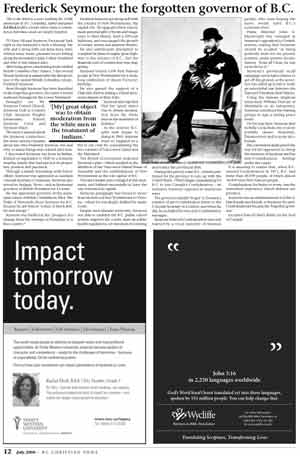
to obtain moderation from the white men in the treatment of
Indians.”
As the interior B.C. gold rush began to slump in 1865,
Seymour went to England in a bid to cut costs by consolidating the two
colonies of Vancouver Island and the Mainland.
The British Government endorsed Seymour’s plan
– which resulted in the abolition of the Vancouver Island House of
Assembly and the establishment of New Westminster as the sole capital of
B.C.
Victoria’s leaders were outraged at this
treatment, and lobbied successfully to have the city reinstated as capital.
Continue article >>
|
Seymour grudgingly was forced to move from his beloved
New Westminster to Victoria – where he was deeply disliked by many
locals.
Despite such Islander animosity, Seymour was able to
establish the B.C. public school system, improve the courts, draw up public
health regulations, set standards for mining and reduce the provincial
debt.
During this period, some B.C. citizens petitioned for
the province to join up with the United States. Others began campaigning
for B.C. to join Canada’s Confederation – an initiative Seymour
opposed in numerous ways.
The governor initially ‘forgot’ to forward
a number of pro-Confederation letters to the Colonial Secretary in London;
and when he did, he included his own anti-Confederation messages.
Seymour believed Confederation was only wanted by a
vocal minority of business people, who were hoping the move would solve
B.C.’s economic woes.
Prime Minister John A. Macdonald was outraged at
Seymour’s opposition to Confederation, stating that Seymour should be
recalled “as being perfectly unfit for his present position, under
present circumstances. From all I hear, he was never fit for
it.”
Seymour’s provincial recall campaign never had a
chance to get off the ground, as the governor was called up north to settle
an inter-tribal war between the Nass and Tsimshian First Nations.
Using the famous Anglican missionary William Duncan of
Metlakatla as an interpreter, Seymour convinced the warring groups to sign
a lasting peace treaty.
On his way back, Seymour died in Bella Coola from one
or more possible causes: dysentery, Panama Fever and/or acute alcoholism.
His convenient death paved the way for his opponents to
sweep the memory of Seymour and his anti-Confederation feelings under the
carpet.
It is amazing to realize that, when B.C. entered
Confederation in 1871, B.C. had fewer than 40,000 people, of which almost
30,000 were First Nations people.
Confederation, for better or worse, was the watershed
experience which defined our province.
Seymour was an embarrassment to John A. Macdonald and
friends, so Seymour the anti-Confederationist became the ‘forgotten
governor.’
Excerpted from Ed Hird’s Battle for the Soul of Canada.
July 2008
|