|
By Peter Biggs
God lives in Downtown Eastside
DESCRIBING ‘church and mission’ –
God’s response to the diverse human needs in this community –
in a few words, is a challenge. There are so many expressions of
God’s love and grace evident in the Downtown Eastside –
ranging from large, high profile agencies to many less visible initiatives,
working through simple acts of servanthood.
Servanthood and changes
For 16 years, Gloria Kieler has single-handedly run Living Waters Mission, a
storefront at East Hastings and Hawks. The former schoolteacher provides
weekly Christian services for some 45 people – along with food,
counselling and prayer.
Asked to describe her biggest challenges, she is
emphatic. “In the 80s, we saw mainly alcoholics. In the 90s, it was
injectable cocaine. Then came crack-cocaine; there was an immediate change,
along with an increase in prostitution.”
Nancy McConnell, who has worked in the Salvation Army’s Cordova
detox for many years, agrees with Kieler.
“I noticed in the early 90s, when crack came to
the Downtown Eastside. The behaviour was completely different – the
obsession stronger. It gives a much shorter high, and the cravings are far
stronger – leading to an immediate psychological addiction.
“It is this intensity that leads to so much
prostitution and crime. Crack and crystal meth can be addictive after one
use. Crystal meth users often have open self inflicted sores; they scratch
and pick obsessively.”
While there are centers that treat crack addiction, the mission adds a spiritual component to the process.
Mental illness and addiction
Many residents of the Downtown Eastside suffer from
mental illness (diagnosed and undiagnosed); many deal with substance abuse
and addictions, as well – a combination termed ‘concurrent
disorder.’ Almost all agencies trace the increase of such street
needs to the closing of hospitals for the mentally ill.
Jacob’s Wellis a
storefront ‘friendship centre’ situated under the well-known
SRO (Single Room Occupancy) Jubilee Hotel, which houses around 75. Staff
member Beth Malena tells BCCN: “We visit people, many in the Jubilee, also people in
hospital, jails or nursing homes – and do a lot of praying with, and
for, people. We also receive prayer and much more in our connecting with
people here.”
Asked how they measure success, Malena laughs,
then responds: “It’s something we don’t talk about here!
We seek to love people the way Christ loves them, and can’t measure
progress the way the world might. We don’t often see dramatic
changes, but simply keep loving people – and keep allowing
ourselves to receive love, as well.”
Jacob’s Well facilitates ‘Colleagues
Lunch,’ a weekly gathering of workers from other local ministries.
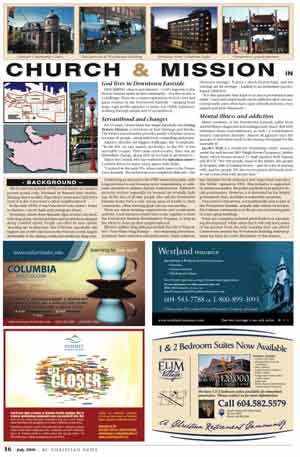
The organization also sponsors community gardens (pictured above).
Beauty behind roughness
The Ivanhoe, an SRO Hotel
for 80 residents, is run by Claudia Launhardt – who is also an
anthropology professor at Trinity Western University. She brings her
students to the Downtown Eastside to experience the community.
She observes: “Behind the roughest person –
addicted, dirty, smelly – there are so many stories that are
beautiful. There is heart and love underneath it all.”
Chris Fox runs the Ivanhoe front desk. He has
known life on the street, and confirms the caring nature of many –
although he is not sentimental. “People here often seem to understand
everyone – except themselves. Co-dependence is quite common.”
Sleeping on pews
Ric Matthews, minister of mission and community life at
First United Church,
is new to the area.
“We see some 300 – 500 come through the
building every day, with 100 sleeping on pews in the sanctuary,” he
says. The mission is hosting Loaves & Fishes – a time for
different agencies to gather together on Canada Day, at Crabb Park.
Mark Greenaway-Robbins, rector at St. James Anglican Church, came to the
neighbourhood from one of the wealthiest parishes in Wales two years ago.
He observes: “It took me years, in my last
parish, to get beyond the veneer in people’s lives; here, it is the
exact opposite. For me, the brokenness of people is so ‘on the
surface.’ The community is a sign – that when we are
honest about our brokenness, God’s power is made real.”
Robbins elaborates, characterizing the neighbourhood as
a kind of “gospel sign of the importance of living into our
brokenness,” and offering it to God for healing.
Gospel Mission, located at
331 Carrall Street, has been going since the 1940s. Along with worship
services, meals and movies nights, the ministry has installed four shower
units for the locals, which they call ‘The Lord’s
Rain.’
Continue article >>
|
- BACKGROUND –
The Downtown Eastside (DTES) is well known as
Canada’s poorest postal code. Bordered by Burrard Inlet (north),
Hastings Street (south), Main Street (west) and Clark Drive (east) it is
also Vancouver’s oldest neighbourhood.
In the early 1900s, it was Vancouver’s city
centre – home to theatres, concert halls and prestigious shops.
Nowadays, streets show dramatic signs of inner city
need, with drug abuse, mental problems and prostitution rampant along
crowded streets. People can often be seen openly ‘shooting up’
in alleyways. The DTES has, reportedly, the highest rate of HIV infection
in the Western world, largely attributable to the sharing of infected
needles by drug users.
Underlying social need in the DTES seems intractable,
with long-promised social housing never materializing in sufficient amounts
to address chronic homelessness. Addiction recovery services (especially
for women) are woefully lacking. In the face of all this, people who call
the Downtown Eastside home have a very strong sense of loyalty to their
community, often showing great care for one another.
There are many helping organizations and community
activists. Local business owners have come together to form the Downtown
Eastside Revitalization Program, to help in the effort to clean up their
neighbourhood.
Efforts to address drug addiction include the City of
Vancouver’s ‘Four Pillars Drug Strategy’
– encompassing prevention, treatment, harm reduction and
enforcement. Harm reduction has included North America’s first
Supervised Injection Site ‘InSite,’ opened in 2003. This
initiative is supported by numerous studies, the police and both local and
provincial governments. However, it is distrusted by the federal
government; thus, its future is somewhat uncertain.
Vancouver’s Chinatown, not traditionally seen as
part of the Downtown Eastside, actually falls within its borders. The
Chinese community is in the process of restoring parts of some aging
buildings.
Some see a creeping eastward gentrification as a
promising development, while others feel it will only force many of the
poorest from the only housing they can afford. Controversy around the
Woodwards building redevelopment has been an iconic illustration of this
tension.
The Sally Ann
The Salvation Army is the largest direct
non-governmental social service provider in B.C. It had its first ministry
on the edge of Chinatown in 1887. Major Brian
Venables outlines some of the extensive
services it offers.
“Harbour Light is a six-storey multi-service
centre on East Cordova, that includes a warming centre, emergency shelter,
dorm rooms and independent living suites – along with a range of
addiction and treatment programs.”
Indeed, with a total of 359 beds – including
shelter, some caseworker support and a Residential Addictions Program
– the centre is busy. Belkin House has an additional 219 beds for
shelter, transition and corrections, and Grace Mansion provides
transitional housing for 85 – with support services.
The Salvation Army also serves food to some 800 people
every day of the year. In addition, ‘614’ is a special division
of Army outreach workers, who connect with people on the street (www.614network.com/vancouver
)
Union Gospel Mission
With more than 120 staff, and 11 facilities ranging in
location from Vancouver to Mission, UGM has grown. Maurice McElrea Place
provides affordable housing for men and women in the Downtown Eastside,
many of whom have come through UGM's Alcohol & Drug Recovery
Program.
UGM has more than 5,000 volunteers. It sponsors summer
camp for up to 800 kids, many from the Downtown Eastside.
As he retires from the ministry, president Maurice McElrea (see page 3)
reflects on the changes he has seen.
“There has been an increase in youth, moms
– in fact, people from every strata of life. Twenty years ago,
clients were more ‘the older alcoholic.’”
McElrea notes that closer relationships with other
agencies have developed, because of the increasing need.
“We work with every agency that wants to make a
difference,” he says. McElrea adds that UGM doesn’t take any
operational funding from the government. www.ugm.ca
July 2008
|