|
By Phil Callaway
A WHILE back, we celebrated a family reunion. Now, you must understand these
have never been my thing. In fact, I briefly considered skipping this one. I
told my wife Ramona that I had other plans. Plans to go fishing. Plans for
peace, tranquility and trout.
She said, “I grew up with these people. You go fishing, and you might as well just take
your parka and stay the winter.”
So, after a long walk and much prayer, I decided to take her advice.
On Thursday night, the relatives began arriving. They came by the carload,
carrying large photo albums. There was hugging. Laughing. Picture-taking. And .
. . did I mention the hugging? We guys stood around talking about golf and the
rainy weather. The ladies took more pictures, planned our Friday, then hugged
each other repeatedly.
Late that night, as darkness came down, the dreary drizzle picked up. “Maybe we should call off the reunion,” I suggested, standing at a window squinting at the sky. “I think I hear someone building an ark.”
“Very funny,” said Ramona, putting an arm around me.
I looked down. And noticed that there were tears in her eyes. “Was it something I said?”
“No,” she replied, “I’d just like to . . . Can we pray together? I need to talk to God.”
Staring at the clouds, she reminded me of some things we’d been trying to forget. Expensive tickets for tomorrow night’s Passion Play – an outdoor performance that a week of rain was washing away.
“I’ve been looking forward to this for months,” she said. “I want my family to see this play so badly . . . the story of Jesus . . . his
miracles . . . his resurrection.”
I didn’t need to ask why.
Huntington’s disease is a daily reality in her family now. Death is a certain way of life.
The skies, once bright and blue, were clouded with uncertainty now. One after
another, three siblings had been diagnosed.
“Only God knows how many reunions we have left . . . down here,” she said, taking my hand. “I want this one to be memorable.”
Then she prayed aloud for her brother Dennis, who lay in a nursing home, curled
up in the fetal position. And for her two dear sisters who had come to the
reunion.
Ramona prayed that their bright personalities would keep shining past the
ravages of this awful genetic disease.
And she prayed for sunny skies.
I listened. But, I must admit, my faith was smaller than those drops of rain
pelting the window.
Friday morning dawned warm and hot and sunny. In Florida. But here in Alberta
where we live, the rain was now a torrent. Four inches in two days. A record,
someone said.
Ramona prayed again at breakfast and at lunch. The skies only opened wider.
That afternoon, we piled into our canoes (I’m exaggerating here) and drove to the nearby town of Drumheller.
“I guess this is what they mean by a car pool,” I told my wife. She didn’t say anything.
So I decided I’d lighten the atmosphere with a good joke. “People here don’t suntan,” I said. “They rust.” No one laughed. Not a soul.
I turned the windshield wipers higher and tried some others.
“At least we won’t have to water our lawn this year. We’ll just drain it.” Nary a snicker.
“We have a water shortage. It’s only up to our knees.” Not a sound. “We had a short summer this year. It came on June 8.” Again, no one laughed.
Continue article >>
|
We finally docked our canoes at the Royal Tyrell Museum, known worldwide for its
huge collection of dead dinosaurs. For 20 bucks, the whole family can view the
remains and listen to lifeless speeches. After an hour, this is about as
exciting as watching cheese mold.
So I gathered the younger cousins around, and made up a speech of my own: “Sixty kajillion years ago (give or take a few months), this Thingasaurus used to
roam the hills, eating insects and tomatoes and small children. In fact, that’s how they achieved extinction. They kept eating their kids.”
Then I made frightening noises and chased the children with my claws
outstretched.
At six o’clock, we exited the museum through the gift shop (convenient isn’t it?), and I couldn’t believe my eyes.
The sun had poked through.
Ramona didn’t seem so surprised. “I thought so,” she said, grinning.
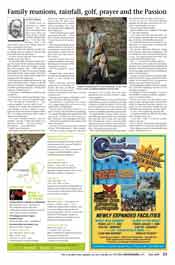
A few miles from the dinosaur bones, we sat in a natural amphitheatre, the sun
warming our backs, our umbrellas unopened.
For only three hours that weekend, the sky held back. For three hours, we
watched the story of Jesus unfold.
We saw him offend the Pharisees. Laugh with children. Heal Mary Magdalene. And
we watched in horror as they bolted him to a cross. The angels turned their
backs. The crowd jeered and walked away.
Then . . . he took the world by surprise.
On either side of me sat my wife’s two sisters. Women, who, along with their husbands and children, desperately
long for healing. But it hit me that night that they had something far better.
They had hope.
A hope you will not find in a museum filled with bones, but in a place where the
tomb is empty. In the simple story of a passionate Saviour who died to heal the
world.
In the parking lot, Jeffrey noticed my solemn face. “I saw Peter backstage,” he said. “He was smoking a cigarette.”
We laughed out loud together. “If any of the disciples would be smoking a cigarette,” I said, “it would be Peter.”
On the way home, the sky opened once again, and the rain descended. But we didn’t mind. As I punched the cruise control, a car passed us, its license plate
bearing the one word that best summed up our day: HOPE.
“Look,” I said to Ramona. And she did.
“You glad you didn’t go fishing?” she asked, with a twinkle in her eye.
“I sure am,” I said. “I’d choose a family reunion any day.”
Then I added, “Would you mind praying about tomorrow? I’d sure like to go golfing.”
Phil Callaway is an award-winning author and speaker. philcallaway.ab.ca
July 2009
|