|
By Peter T. Chattaway
 FOR YEARS, the people who write the Batman comics and movies have been
drawn to the theme of insanity. FOR YEARS, the people who write the Batman comics and movies have been
drawn to the theme of insanity.
The Joker is wild, of course, and so are many of the
other villains; and it is often suggested that a billionaire like Bruce
Wayne must be crazy on some level too, if he feels compelled to wear a
bat-shaped costume every night just so he can prowl the streets looking for
criminals to terrorize.
Thankfully, the two Batman films directed by Christopher Nolan have so far avoided
this cliche.
Instead of dwelling on the inner psychology of Batman,
they have explored the social implications of the character, using him as a lens through
which to raise profound questions about the nature of authority, the value
of myths and the lengths to which any civilization should go in protecting
itself from evil.
Batman Begins, which came
out three years ago, was largely about fear: both the need to overcome it,
and the possibility of inflicting it on those who are not yet afraid of
judgment or punishment but probably should be.
And now, The Dark Knight is about order and chaos, and how the gap between those
two things is often filled by people who sacrifice themselves and their
reputations for the greater good.
As the story begins, things are looking fairly good in
Gotham City. Batman (Christian Bale) has struck terror into the hearts of
the city’s criminals; and, without meaning to, he has also inspired a
number of civilians to put on costumes and strike back against crime
themselves – though he does not always approve of their methods,
which leads some of them to ask what makes him all that different from
them.
Most significantly, Gotham City has a new district
attorney, a ‘white knight’ named Harvey Dent (Aaron Eckhart)
– who is determined to crack down on crime, and who seems to have the
confidence of the citizenry. He also has Bruce Wayne’s sort-of
ex-girlfriend, Rachel Dawes (Maggie Gyllenhaal), at his side, and has asked
her to marry him.
 All these factors prompt Bruce to wonder if he should
hang up the cowl and retire from crimefighting. Maybe, just maybe, Harvey
can do – within the law – what Batman has been doing outside
the law. And maybe, just maybe, Rachel will come back to Bruce and be his
wife instead of Harvey’s, once he quits being Batman.
All these factors prompt Bruce to wonder if he should
hang up the cowl and retire from crimefighting. Maybe, just maybe, Harvey
can do – within the law – what Batman has been doing outside
the law. And maybe, just maybe, Rachel will come back to Bruce and be his
wife instead of Harvey’s, once he quits being Batman.
But before Bruce can say ‘mission
accomplished,’ things get worse – a lot worse. A new criminal
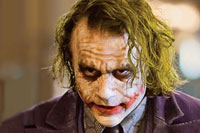
called the Joker (a dynamic performance by the late Heath Ledger) arrives
in Gotham and begins stirring things up: robbing banks, assassinating city
officials and threatening to do a whole lot more damage unless Batman
reveals his secret identity.
The cops are sick of seeing their fellow officers
killed in the line of duty, and they demand that Batman give himself up.
But Harvey insists that, no matter how legitimate the complaints about
Batman’s methods might be, the city dare not give in to a
“terrorist” like the Joker by giving up its nocturnal hero.
Continue article >>
|
And so the stage is set for a fascinating – and
ultimately tragic – look at the nature of heroism and villainy and
how these things are present in all people, to varying degrees.
The heroes succeed to the extent they do partly by
scaring people into thinking they are capable of criminal deeds themselves,
even though they have no intention of actually doing anything quite so bad
– but one of the questions that lingers over the film is whether,
deep down, these heroes might really be capable of such things if push
comes to shove.
For his part, the Joker believes that few, if any,
people are really all that good – they are only good to the extent
that the world lets them be good, he says – and his various crimes
are increasingly designed not for personal gain nor even to defeat Batman,
as such, but to prove his point, that in a world without rules, everyone is
capable of becoming a selfish, murdering monster just like him.
This is heady stuff for a comic-book movie, and it has
already prompted a handful of critics to complain The Dark Knight is an exercise in
nihilism. But there is heroism here, too, and it sometimes comes from the
most unlikely of places.
Bruce Wayne’s butler, Alfred Pennyworth (Michael
Caine), remains a source of courage to him; and his gadgets expert, Lucius
Fox (Morgan Freeman), becomes his conscience.
And, thankfully, the film’s complex view of human
nature allows for bold, principled displays of self-sacrifice, even as it
acknowledges that people are fallen and weak and capable of tolerating
great evil when it is done in their name.
It is a moral lesson reminiscent of Ratatouille: just as that film suggested
not everyone could be a great chef, but that great talent could come from
anywhere, so too The Dark Knight proposes that not everyone may be a hero, but heroism can
come from anywhere. That is a very inspiring message – and it comes
in this film when you least expect it.
There is a lot more which could be said about this
film, but it would mean getting into all sorts of plot details the viewer
should experience for the first time in a proper movie theatre.
So for now, suffice it to say The Dark Knight is easily one of the
best superhero movies ever made, and it is one you may want to talk about
for quite some time after the credits have rolled.
– filmchatblog.blogspot.com
August 2008
|