|
By Len Hjalmarson
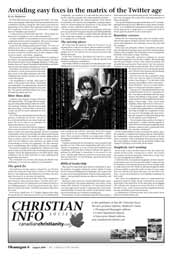
IN 1999, film lovers first encountered The Matrix . The stop-action photography, bleak dual world and martial arts moves combined
to produce a huge hit. But it wasn’t just what was happening on the surface that captivated audiences; it was the
complexity of the movie, the interweave of multiple levels of metaphor and
narrative.
Co-director Larry Wachowski told Time : “Every studio we showed it to thought no one would understand it.”
I’ve had a number of conversations in recent weeks around complexity and the need
for simplicity. The focus has ranged from church governance structures to the
Trinity.
In general, the feeling among pastors is this: “Let’s get on with the work. Do we have to get bogged down in complexity when the
gospel is so simple?” Like the Hollywood moguls, we have convinced ourselves that, in this complex
world, everyone wants – and needs – simplicity.
The question has also cropped up in relation to teaching in the church. The
general feeling is: “Keep it simple.” We have short attention spans in the blogging/ MySpace/ Twitter age. Besides,
there isn’t much theological sophistication out there, and we have immediate and practical
concerns.
Sometimes this question is framed in terms of narrative versus propositional
theology. Since most of the Bible and half of the New Testament just consists
of stories, let’s not get overly theological.
I am sympathetic to all this. After years of study of the gospel and culture,
leadership and spirituality, I’m still learning. And all of that study has had limited impact on my own life.
The greater spiritual impact has come through friendship and love.
More than data
I embrace the wisdom of James Houston ( The Mentored Life ): “We forget that the nurturing and caring relationship is inherent in effective
teaching. Wisdom, after all, is more than data processing. Activism that is
devoted to a cause can also be a poor substitute for relationships.”
Yet, to divorce relationships from truth and practice, would also be an error.
We are to love God with all that we are: mind, body and spirit. We are to take
as our example the church described in Acts 2:41-47.
Key factors we must deal with are fragmentation and information overload.
Fragmentation results from pursuing multiple goods in multiple communities,
when we’re not really sure where we belong and to what we are called. This results in
endless debates about what we believe and how we should live. In those debates,
each of us can reference some experience or expert or body of knowledge to
bolster our arguments. All that information is overwhelming. The ‘solution’ advanced is to simplify.
The push for simplicity is amplified by cultural forces that push us away from
the hard work of wrestling through issues together. Given the fragmentation of
our faith culture, what confidence can we have that there is some rallying
point greater than ‘just Jesus’?
The constraints on our time and energy are already overwhelming. So we seek our
solultions in sound-bytes.
The quick fix
Our preference for this option is shaped by our Western media: the sound and
video bytes of news on CNN; the text bytes on our cell phones; the limitations
of Twitter. However much we decry it, we all want the quick fix.
I’m not immune from all of this. One of the complaints I have heard too often from
my wife is: “You like short cuts.” I have paid the price for taking short cuts numerous times in my building
projects. I have learned the hard way, that a short cut saves time today – but will come back to bite me in two years.
In his book, Justification, N.T. Wright suggests that when the puzzle has too many pieces and we are
overwhelmed by complexity, our tendency is to put half the pieces back in the
box. But this actually only compounds the problem.
In part, this explains the cultural captivity of the church in modernity. We
have become pragmatists. Lacking a framework for understanding the interaction
of the gospel and culture, we have embraced ‘whatever works.’
We have measured success by secular standards, and in the process sacrificed
theological integrity and biblical faithfulness. We’ve lost the ability to remain biblically faithful and at the same time engage
our culture, because that task was too complex for us to handle.
The missing pieces
All of this begs the question: What are the pieces we are missing? If we could
recover them, what would we look like?
The answers are there in our collective memories, as the people of God. We need
to recover ancient practices and biblical functions.
In the New Testament, Paul likens the church to a great building composed of
living stones, with the apostles and prophets forming the foundation.
Any builder will tell you that the most important part of any building project
is the foundation. Get the foundation right, and everything else will flow
smoothly. But if the foundation is weak or out of square, the building will be
a nightmare. There are places a builder can compromise without damaging the
integrity of a structure, but that place is not the foundation.
Continue article >>
|
Prophets and apostles lay foundations. Since prophets and apostles are two of
the most marginalized gift mixes in the church of modernity, is it any wonder
the foundations are crumbling? If we slow down, refuse to embrace the quick
fix, perhaps we will begin to remember, to reconnect to our roots – and the days when we existed as a movement, more than an institution. It’s that dynamic, apostolic genius that we need to recover.
Biblical leadership
There are five leadership types outline in Ephesians 4: apostle, prophet,
evangelist, shepherd, teacher. Maybe it’s time to recover the good biblical word ‘shepherd,’ since ‘pastor’ has become such a catch-all label that it has become nearly meaningless – and generally denotes an office in a hierarchy, and not a gift.
Missional orders stress two crucial leadership types: apostle and shepherd. This
plural leadership, even where it may retain some elements of hierarchy, is a
vast improvement over the single pastor model. It empowers the most fundamental
rhythm of church life, which is both inward (cleansing and nurturing) and
outward (evangelizing).
In modernity, we have marginalized apostles and prophets, those innovative and
questioning people. The challenges we face now necessitate the rediscovery and
empowerment of these critical gifts.
Can apostle/shepherd/prophet leadership work? Certainly, although this may be
more difficult in young church communities – or in established communities that have used a traditional framework (a single
pastor or a hierarchy, both of which generate passivity in the community).
Boundary crossers
Within the five leadership types, there are certain combinations that appear
uniquely suited to times requiring innovation and adaptation: the boundary
crosser, the poet and the synergist.
These types are primarily a blend of prophetic and apostolic, though the
boundary crosser may add a strong element of pastor and evangelist. The
boundary crosser is a prophetic networker with pastor-at-large overtones.
The poet is especially oriented to helping us recover missional imagination. In The Sky is Falling , Alan Roxburgh says the poet shapes words so that what was hidden and invisible
becomes known. Poets remove the veil, and give language to what people are
experiencing. This is only possible when the poet lives among the people and “listens to the rhythms and meanings occurring beneath the surface.”
But the poet also has a prophetic bent: Poets not only see what is beneath the
surface, but critique it “on the basis of the memory and tradition of the community.” Poets, therefore, “are not so much advice-givers as image and metaphor framers.”
They are not “entrepreneurial leaders with wonderful plans for their congregation’s life,” but rather individuals with the imagination and gifting to help people “again understand how their traditional narratives apply to them today.” Thus, “poets make available a future that does not exist as yet.”
The synergist is also a role we need again, to counter the fragmentation of
modernity and help us bridge the complexity we face at every level. Roxburgh
writes that synergists are necessary to help leadership groups “work together across tribal lines.”
The synergist is like an abbot, the head of a monastery, a “leader with the capacity to unify diverse and divergent leadership styles around
a common sense of missional vision for a specific community.”
In this ‘Twitter/Matrix’ world, we need poets, pastors, apostles, prophets, evangelists and teachers who
are embedded in the community, empowering all of God’s people to do the work of ministry. If these leadership functions are
invisible, like yeast hidden in dough, and are powerfully influencing change by
birthing a new world, all the better.
Simplicity isn’t working
Every week, I meet another believer who has exited the church-on-the-corner,
vowing not to return. The reasons vary widely, but those leaving are rarely naïve; in fact, they are often thoughtful and reflective.
Could it be that, in our push for simplicity, we have demonstrated that we are
out of touch with reality? Could it be that we intuitively sense that the
answers are more complex than we make them out to be? While we all acknowledge
the limits of human ability to grasp the truth, we have become aware that easy
answers and quick fixes have not provided solutions – or moved us forward as God’s faithful community in this world.
The voices we marginalized, when we compromised the gospel for ‘whatever works,’ are the voices that are now pushing us back to the sacred text. At the same
time, we are digging into cultural texts, trying to reconnect the dots, to
remember who we are – and to look beyond the simplicity that has become unsatisfying and unconvincing.
Len Hjalmarson is a Kelowna writer. More of his articles can be found at
NextReformation.com.
September 2009
|