|
By Steve Rabey
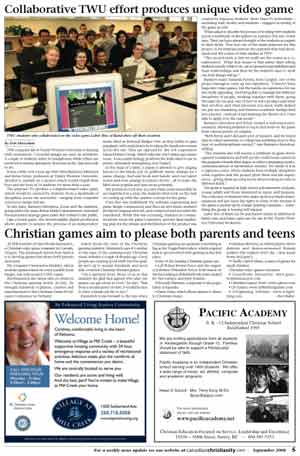
VIDEO GAMES made their debut in arcades across America
in the 1970s. Soon, millions of people were plugging quarters into massive
consoles to play favorites such as Pong, Space Invaders and Pac-Man.
Like the rest of the computer industry, gaming has
undergone a technological revolution in the past few decades. Today’s
home game consoles – like Microsoft’s Xbox, the Sony
PlayStation and Nintendo’s Wii – pack big computing power into
small devices, allowing gamers to enjoy powerful graphics, booming audio
and amazingly lifelike simulations.
Such thrills and chills have made games as popular as
movies or music with many young people. Studies say 86 percent of kids
between the ages of eight and 16 play video games at home.
But it’s the controversial themes and gory
violence at the heart of some games that raise questions for parents and
other adults who care for kids.
On April 29 Grand Theft Auto
4, the latest installment of the popular and
controversial computer game, debuted with 3.6 million copies sold in 24
hours. Before the week was out gamers had spent more than $500 million on GT4 – breaking the record
set in 2007 by Halo 3,
which had first-week sales of $300 million.
Thrills and questions
The game delivers the kinds of thrills teenage boys
love, with plenty of high-speed chase scenes, noisy shoot-’em-ups and
risqué sexuality. But questions about the game’s violence and
the ability of some gamers to unlock explicit sex scenes in an earlier
version of the game have led to complaints and a class action lawsuit
against GT4’s
manufacturer, Rockstar Games.
Others raise questions about the social impact of
role-playing games like World of Warcraft. More than 8 million people around the world make
significant sacrifices of time and treasure to play the game with others in
real-time, online matches that cost $15 a month in fees to participate.
Further, a study done by the Palo Alto Research Center
showed that it takes the average World of
Warcraft player about 372 hours of gameplay
to reach level 60 in the game. That’s more than two months’
worth of eight-hour workdays.
The companies that create games are increasingly
focusing on younger children, says Paul Asay, a writer who covers games and
pop culture for Focus on the Family and publications like YouthWorker Journal.
“There are virtual worlds for children, such as
clubpenguin.com and subeta.org, that charge kids or their parents for
virtual doodads with which they can decorate their virtual pads,”
says Asay. “In other words, they’re shelling out real cash for
imaginary products.”
The gaming industry has created games for every kind of
player, both young and old. There are constructive ones like the Sim City games, in which
gamers literally build cities and worlds. There are multiplayer live action
games that allow players to compete with each other in digital versions of
golf, ping-pong and baseball.
There are games that are just plain fun, like Guitar Hero – which has
allowed millions of kids to play along with some of the rock era’s
best-known solos. And there are destructive games like Manhunt 2, a grisly gore fest that
features executions, electrocution and strangulation.
Evaluating the impact
But how are parents supposed to know the difference
between the good and the bad? And what are the long-term emotional and
social impacts of gaming?
Pastor Kody Kirchhoff has been observing “video
game culture” for years, and he is concerned by what he sees.
“Aside from the violence, obscenity and negative
themes, the larger and greater problem lies in the fact that video games
control many people’s hearts and minds, creating a monotonous,
zoned-out new reality,” says Kirchhoff, who leads LiveWire Youth
Ministries at Calvary Lutheran Church in Omaha, Nebraska.
For Kirchhoff, one of the problems with games is the
many activities they replace in kids’ lives.
“God, family and friends do not exist in many
games,” he says. “Activities like camping, playing catch with
dad, swimming, or just being a kid have vanished.”
Continue article >>
|
It is equally hard to assess the long-term impact of
game violence.
Some researchers are convinced that repetitive play of
violent games instructs kids in violence, making violent acts more likely.
But others argue that video violence is a cathartic replacement for real
violent crime, which has gone down since the advent of video games.
After the 1999 killings at Colorado’s Columbine
High School, some parents sued the makers of Doom, a violent game that was one of the killers’
favorites. But such lawsuits have been no more successful than earlier
efforts to link teen violence to heavy metal music. There may be a link,
but the social science research remains ambiguous.
Playing alone
While many kids game, most of them do so alone and
without any supervision or interaction with adults. That concerns Al
Menconi, who has spent more than two decades studying culture and
entertainment from a biblical perspective.
Menconi says some leaders in the mental health field
speak of gaming as an addiction. He says one treatment centre in Peoria,
Illinois specializes in video game addictions; several online sites also
offer 12-step programs and other support; and the American Psychiatric
Association has been asked to add video game addiction to its American
Diagnostic and Statistical Manual of Mental Disorders.
“It’s a very big epidemic,” said
Menconi, who operates his Al Menconi Ministries from Carlsbad, California.
“Withdrawal is very similar to drug withdrawal.”
Menconi says parents ought to get involved, limiting
kids to no more than two hours of daily use, or 15 hours a week.
Getting involved
Meanwhile, one Alabama mother and grandmother wishes
parents would get involved in helping kids choose healthy games.
“While shopping for a new video game recently
with my 13 year old grandson, I previewed several of the latest
releases,” said Margie Tanner. “Most were filled with intense
violence, involving killing and torture. Others involved witches and
wizards.
“Many parents do not have a clue what kind of
gaming activity kids are participating in. Many don’t preview the
games their kids buy. I encourage parents to know what kind of games their
children are playing, and restrict the amount of time they spend playing
them.”
Carey Casey, CEO of the Kansas City-based National
Center for Fathering, agrees.
“Games are a way of life,” he says,
“devouring our children’s time, energy and
brainpower.”
Casey says games steal time from meaningful family time
and from other activities such as reading. The answer is for parents to get
involved.
“Parents should place limits on children’s
media use, including when, where and how much they can participate. And we
should be ready to address common myths that are often portrayed in the
media: such as the myths that to be worthwhile you have to be beautiful,
that money buys happiness, that sex is merely recreation and has no
consequences, and that violence solves problems.”
Millions of kids are very serious about gaming, as are
the game companies that are part of this nearly $10 billion industry.
And now, Christian experts say, parents should be
getting serious, too.
Steve Rabey is an award-winning writer from Colorado.
September 2008
|