|
In the fifth installment of our series marking
B.C.’s 150th anniversary, author and pastor Ed Hird profiles a man whose famous
nickname belied his true nature.
CHIEF Justice Matthew Baillie Begbie – described
by some as a “swashbuckling judge,” and by others as “the
hanging judge” – profoundly shaped Canada’s future.
Matthew Begbie, like his friend, B.C. governor Sir
James Douglas, was a Scot born in the tropics, who became bilingual in
French while studying in England.
After five years at Cambridge and 14 years as a lawyer,
Begbie was sent to B.C. at age 39 in response to the 1858 influx of 30,000
American miners from San Francisco.
B.C. was literally birthed through gold-diggers, who
panned $543,000 of Fraser River gold in one year. Most stayed a year or
less, never putting down roots in B.C.’s ‘boom or bust’
beginnings. While a few struck it rich, most spent their gold on wine,
women and song. Without Begbie establishing order, all hell would have
broken loose.
Begbie showed unusual stamina, often travelling by foot
and sleeping in a tent so damp that his books became mildewed. Six
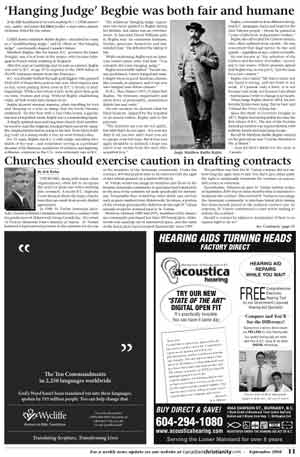
feet four with a Van Dyke beard, a gaucho hat and a long black cloak,
Begbie was a commanding figure.
A deeply spiritual man and long-time church choir
member, he loved to read the Anglican Evening Prayer service by campfire,
singing hymns before going to his tent. Even when holding court on a stump
under a tree, he wore formal robes.
For 12 years, Begbie was B.C.’s only judge,
travelling two-thirds of the year – and sometimes serving as a
postman! Because of his firmness, incidences of violence and highway
robberies, common in the U.S., were extremely rare in B.C.
The infamous ‘hanging judge’ expression was
never applied to Begbie during his lifetime, but rather was an
overstatement. As historian David Williams puts it, Begbie was “an
extremely humane, literate, generous, humorous and fair-minded man.”
He abhorred the taking of life.
While vacationing, Begbie met an American former
jurist, who told him: “You certainly did some hanging, judge.”
Begbie memorably replied: “Excuse me, my good
friend. I never hanged any man. I simply swore in good American
citizens, like yourself, as jurymen, and it was you who hanged your fellow
citizens.”
In B.C. Place Names (1997), it states that Begbie, “by firmness,
impartiality and sheer force of personality, maintained British law and
order.”
Continue article >>
|
On one occasion, he showed a flair for black humour.
Angered by the acquittal of an armed robber, Begbie said to the prisoner:
“The jurymen say you are not guilty, but with
that I do not agree. It is now my duty to set you free, and I warn you
not to pursue your evil ways. But if you ever again should be so inclined,
I hope you select your victim from the men who acquitted you.”
Begbie, conversant in four different aboriginal B.C.
languages, had a real heart for the First Nations people – whom he
praised as “a race of laborious, independent workers.”
Begbie also advocated for Chinese miners, who often
suffered from racism. He was concerned that legal justice be fair and
speedy – regardless of race, colour or wealth.
He was known as “the salvation of the Cariboo and
the terror of rowdies,” according to one source. Fellow pioneers
agreed that Begbie was, as one put it, “just the man for a new
country.”
Begbie once stated: “My hair is white, but my
hand is strong, and my heart is not weak. If I punish only a little,
it is not because I am weak, nor because I am afraid – but because I
wish to change your hearts.
When Judge Begbie died in 1894, his two favorite hymns
were sung: ‘Just as I am’ and ‘I Heard the Voice of Jesus
Say.’
Since the death of Governor Douglas in 1877, Begbie had
indisputably become the first citizen of B.C. The size of the Victoria
funeral procession was unprecedented, with military bands and marching
troops.
But all Sir Matthew Baillie Begbie wanted on his
gravestone was “Lord be Merciful to Me, a Sinner.”
– from Ed Hird’s Battle for the Soul of Canada.
September 2008
|