|
By Andrea Flexhaug
IT WAS 1990, and like many before them, the Simon
family had fled Burma to escape the violence inflicted by the ruling
military regime in their homeland.
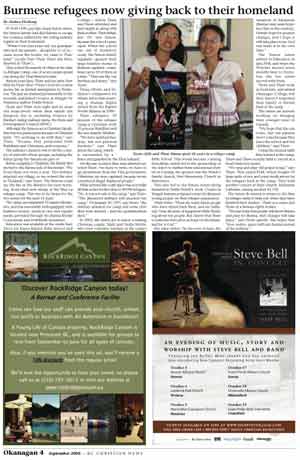
“When I was four years old, my grandparents and
my parents – altogether 13 of us – came across the border,
we came to Thailand,” recalls Naw Thaw Thaw Mu Htoo (known as
‘Thaw’).
They joined thousands of others at the Mae La Refugee
Camp, one of seven camps spread out along the Thai/Burma border.
Sixteen years later, Thaw and her sister Naw Hsar Ka
Nyaw Htoo (‘Nyaw’) now live a more secure life as landed
immigrants in Penticton. The pair are featured prominently in the recently
published Creative in Struggle by Penticton author Twilla Welch.
Nyaw and Thaw were eight and six years old respectively
when their family left Rangoon due to escalating violence by Burma’s
ruling military junta, the State and Development Council (SPDC).
Although the Simons are a Christian family, this was
not persecution because of Christian faith. “It’s nothing to do
with that,” says Thaw, “because they persecuted both Buddhists
and Christians, and everyone.”
The military’s mission was to rid the country of
minority ethnic groups, including the Karen group the Simons are part of.
Before escaping to Thailand, the family first moved to
the Burma side of the border. “We lived there not even a year. The
military attacked our village, so we crossed the river to Thailand,”
says Nyaw. The Simons could see the fire in the distance the next morning,
from their new refuge at the Mae La refugee camp. This was to be home for
the two sisters for the next 16 years.
The camp encompassed 10 square kilometres, and was
reasonably well equipped, with bamboo houses, medical care and regular
meals, provided through the Burma Border Consortium and worldwide
donations.
Education was available at the onsite Kaw Thoo Lei
Karen Baptist Bible School and College – which Thaw and Nyaw
attended and later taught at, along with their mother. Their father, Rev.
Dr. Saw Simon, became the school’s principal. When the school ran out
of dormitory room, the Simon family regularly opened their large bamboo
home to Burmese orphans – sometimes up to 50 of them at a time.
“They are like our brothers and sisters,” says Nyaw.
Those efforts, and Dr. Simon’s compassion for
others, led to him receiving a Human Rights Award from the Baptist World
Alliance in 2000.
Thaw estimates 50 percent of the refugee camp is
Christian, with 35 percent Buddhist and the rest mainly Muslim.
“We have spiritual freedom, but not physical
freedom,” says Thaw about the camp, which is surrounded by a fence
and guarded by the Thai military.
On the rare occasion they were allowed out, noted Thaw,
“we have to write, we have to get permission from the Thai
government. Otherwise, we were captured, because we are considered illegal
displaced people.”
What seemed like a safe place was not really all that
secure for the close to 40,000 refugees. “No, it was not safe in the
camp,” says Thaw. “The [Burmese] military still attacked our
camp.” On January 29, 1997, says Nyaw, “the military attacked
our camp and some children were injured – and two grandmothers
died.”
Continue article >>
|
In 2002, the sisters got to know a visiting Christian
couple, Mark and Twilla Welch, who were volunteer teachers at the
camp’s Bible School. This would become a lasting friendship, which
led to the sponsorship of the sisters to further their educational studies
in Canada; the sponsor was the Welch’s family church, First Mennonite
Church in Edmonton.
This also led to the Simon sisters being featured in
Twilla Welch’s book. Creative in
Struggle features poignant essays by
Burmese young people on their refugee experiences.
Thaw writes: “There are many Karen people who
have stayed back there, and are suffering. I lose all sense of happiness
while thinking about my people. But I know that there is someone who gives
us hope for the future, and he is God.”
Her sister writes: “In the eyes of men, the
situation in Myanmar (Burma) may seem hopeless. But on the contrary, I
firmly hope for positive changes, and I hope it will take place soon. God
can make it in his own time.”
The Simon sisters arrived in Edmonton in late 2006, and
when the Welches moved seven months later to Penticton, the two sisters
moved with them.
Nyaw and Thaw work at local jobs, and attend Okanagan
College; but they haven’t forgotten their family or friends back at
the camp.
The sisters are actively working on bringing their
younger sister to Canada.
“We hope that she can come, but our parents
won’t come because they have the school and the children,” says
Thaw.
Using the musical skills they learned at the camp, Nyaw
and Thaw recently held a concert at a local Penticton motel.
“We sing and play old gospel songs,” says
Thaw. They raised $348, which bought 10 large sacks of rice and some
medications for the refugees back at the camp. They held another concert at
their church, Redeemer Lutheran, raising another $1,726.
The sisters do intend to return to the Mae La refugee
camp to help out, when they have finished their studies – Thaw
as a nurse and Nyaw as a human rights worker.
“We just hope that people will know Burma and
pray for Burma, that changes will take place,” says Nyaw quietly. She
hopes that “love, justice, peace will rule Burma instead of the
military.”
September 2008
|