|
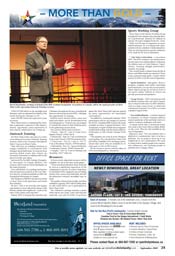
Best-selling author Donald Miller (Blue Like Jazz ), will be appearing September 15 at Tenth Church in Vancouver. Following is an
excerpt from his latest book – which, he notes, recounts “what I learned while editing my own life.”
I’M NOT exactly sure where the sense that life is supposed to be meaningful comes
from, except maybe the beauty of the landscape and the complexity of my body
tell me I am here for a reason and it’s not just to play video games.
As a writer of nonfiction, I’m supposed to know what life is about; but to be honest, I don’t. I write books about faith, which only makes the job harder.
When you write books about faith, people read them and expect to hear from God,
as though God calls me on the phone in the morning and says: “Write this down; I forgot to say this in the Bible.”
I know writers who actually approach their books this way, but none of them has
given God my phone number.
You can make a lot of cash telling people what to do with the scenes God gives
them.
If you’re a religious writer, all you have to do is tell people how to live and throw
in some scripture references, and people will believe you. It’s true.
That’s the thing people are always asking me the most: they’re always asking what they’re supposed to do with their lives. That’s why I’m not a pastor, I think, because I have no idea what people are supposed to do
with their lives . . .
Maybe that’s why we buy so many self-help books, because we want somebody to tell us what
to do, what to say.
It sounds terribly fatalistic, I know. It’s not the sort of thing you wanted to read about, I would imagine. Fatalism.
And I hate saying all this in writing because being a fatalist and a writer
rarely works out.
Nietzsche did it with some success, but he is one of the few. He didn’t have personal success, mind you, because he was a loser. But he was huge with
20-something intellectuals. He’s the Justin Timberlake of depressed Germans. And there are a lot of depressed
Germans.
Continue article >>
|
You’d think God would just come out and tell us what to do in the Bible. But he
doesn’t.
He mostly tells stories, and he rarely stops the story to say what the point is.
He just lets the characters and the conflict hang in the air like smoke. I don’t think we give stories enough credit.
Last year, my roommate Jordan and I moved into a condo above the library in
Sellwood. It’s a big brick building, and every few mornings when I take Lucy for a walk, I
see a man delivering crates of books through the back door.
He parks his truck behind the building by the dumpster; and the other day when
he was stacking crates next to his truck, I wondered if he ever got tempted to
drive the truck off the Sellwood bridge because he realized it’s full of a thousand books that contradict each other.
I bet if he drove his truck off the Sellwood Bridge, nobody would lament the
loss of the nonfiction.
We’d all grieve the loss of the novels. We’d all grieve the lost stories.
Reprinted by permission: from A Million Miles in a Thousand Years , Donald Miller, 2009, Thomas Nelson Inc. Nashville, Tennessee. All rights
reserved.
September 2009
|