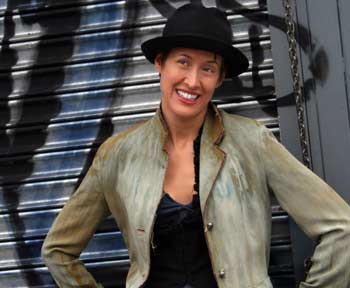
|
 A recently posted video on You Tube
features Michelle Shocked giving a riveting performance of the gospel standard
‘Yes, God Is Real.’ A recently posted video on You Tube
features Michelle Shocked giving a riveting performance of the gospel standard
‘Yes, God Is Real.’
The clip, according to one viewer, is “as convincing
an argument that God is real as you are ever likely to find on the face of the
earth.”
During the video’s brief introduction, her pastor
refers to Shocked as “a faithful, generous, supporting member of West
Angeles Church” who gives “gift after gift.”
How did she go from songs like ‘Campus Crusade’
(“I'm gonna jump headfirst into that lake of fire…I think hell is
gonna be just swell”) to outright praise music?
It’s been a long, fascinating ride, that’s for
sure. It’s a story of healing and forgiveness, and - for the past 16
years - a radical faith that informs every part of her life. It’s also
the story of an underappreciated artist.
Twenty years ago she was one of the most promising new faces
of folk scene.
Since then, she’s consistently explored new
directions, with albums of swing, bluegrass, gospel, Spanish - even a disc of
Disney songs - to her credit. Scratch the surface, and an overriding theme
emerges – they all fall under the banner of indigenous American music.
If it’s folk music, then it’s as Hank Williams
once described it: “music for the folks.”
Her solid musicianship – too often missed by those
more interested in her political stance – and eclectic sensibility
ensures that any project she’s involved in will be well worth
investigating.
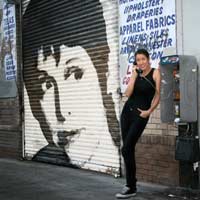 Such is the case with ToHeavenURide, her new, gospel-soaked live album. Such is the case with ToHeavenURide, her new, gospel-soaked live album.
In a wide-ranging, multi-part interview, I found her to be
opinionated, informed - and downright passionate regarding her Christian faith.
She was born Karen Michelle Johnston in Dallas, Texas in
1962. Her parents divorced when she was three years old, and her mother married
an enlisted Army Sergeant soon after. For the next few years, the family
traveled from base to base throughout the U.S. and Germany.
Her step-dad was a recent convert to Mormonism.
“That’s how my mom became a Mormon…He had been discharged to
Vietnam, and he met a Mormon missionary. I always asked myself, ‘What was a Mormon missionary
doing on a troop ship?” She laughs, and adds: “Shooting fish in a
barrel, is my answer!”
The change had a significant impact on their family life.
“I think they were probably on the road to being really irresponsible
with drinking and smoking and card playing - they just weren’t creating a
very good home atmosphere. My stepfather
had been married previously. He had three children from that marriage, and they
were all living in foster care. I suspect that there was a great deal of
alcoholism in the dynamic.”
She doesn’t recall much in the way of theological
training. “The emphasis was much more on the social than on the
spiritual. Maybe it’s because I was a kid - maybe the adults were having
a different experience - but my experience of it was kind of a closed community
where you only interacted with other Mormons. Your entire social life was built
around Mormon-ness.
“There was so much emphasis on being a model Mormon
family, as opposed to being model Christians. I don’t remember much of an
emphasis on Jesus Christ. It really felt kind of extracurricular if you got
into that stuff.”
It was a crowded household. The couple already had five kids
between them when they first met. “Then they had four kids after that.
Only two of his three came to live with us, then a foster child, a pregnant
unwed mother, came through Mormon Family Services …that made a total of
nine kids.
“My mom came from a small family, but her mother was
from a very large family, and I think she kind of idealized that. We watched The
Waltons…”
Mom might have romanticized TV’s favorite
depression-era family, but not Michelle; “I didn’t! [But] she did -
she thought that being poor made you virtuous.”
 If it had to be a blended family, she would have preferred
something more upscale, like The Brady Bunch. “From my middle-class aspirations, it was very frustrating. We
were always going to be dirt poor, always going to be hand-me-downs and
leftovers, and I just couldn’t understand the irresponsibility of it;
they couldn’t afford the kids they had, and then they brought in
more.” If it had to be a blended family, she would have preferred
something more upscale, like The Brady Bunch. “From my middle-class aspirations, it was very frustrating. We
were always going to be dirt poor, always going to be hand-me-downs and
leftovers, and I just couldn’t understand the irresponsibility of it;
they couldn’t afford the kids they had, and then they brought in
more.”
Biographical sketches on Shocked commonly paint a picture of
an unhappy home life. That’s not exactly true.
“I think of my mother and my stepfather as being
really good parents to young children. A lot of the qualities that I have now -
my playfulness, my creativity, my sense of fun - I think had a lot to do with
my mother and my stepfather’s own very unorthodox sense of being
grownups.
“They were kind of like kids in a candy store - except
for the caveat that my stepfather, being in the Army, had to go to a job each
day that really dumped on him. But when they were at home with the family,
while we were little, I think they poured a lot of creativity into being
parents.”
When she was fourteen, her step-father took early
retirement, and the family moved to East Texas. After being schooled on Army bases, it was a significant
adjustment.
“When he retired from the military, we were left at
the mercy of the public education system, and it was abysmal.” She
decided to take matters into her own hands; “I literally went to the
public library near my high school, and started in the ‘A’s.”
She laughs. “I can tell you everything you want to know about the Algonquin
Round Table…I started at the ‘A’s and I was working my way to
the ‘Z’s.
Each summer she would visit her birth father, a former
English teacher who worked as a contractor in Dallas. It was a considerable
change from Mormon life. She describes him as “a flaming liberal”
who started playing mandolin when he was 35 years old.
He introduced her to the music of a wide range of great
American songwriters - everyone from Leadbelly and Lightnin’ Hopkins to
Randy Newman and Guy Clark. He frequently took her and her younger brother to
bluegrass festivals - which inspired her to pick up the guitar. She started
writing songs almost immediately.
By then, things had begun to sour at home. “The real
problems only came when we started to have minds of our own; our own kind of
independence. They didn’t adapt very well to that.”
Difficulties weren’t confined to parenting; cracks had
begun to appear in her mom and stepfather’s marriage. The couple would
eventually divorce.
After repeated attempts at running away, she left for good
when she was 16 years old. Finishing High School in East Texas, and after four
semesters at Junior Colleges in Jacksonville and Dallas, she headed for Austin,
where, with single-minded determination, she put herself through the University
of Texas, receiving a Bachelor’s Degree in Oral Interpretation of
Literature in 1983.
After graduating, she hitched her way to the West Coast, where
she wound up playing guitar and mandolin in a street band. At one point she
suffered a bad trip on LSD, and ended up high for three days. Wandering around
in a paranoid daze, the police attempted to stop her for questioning. She
panicked and ran. After a harried chase, she was taken to a mental hospital and
subdued with Thorazine. A few days later her father arrived and took her home
to Dallas.
From there she headed to Austin, where an old friend let her
sleep in his bookstore. The shop hosted a songwriter’s group, and
Michelle began to participate. During her stay she experienced an LSD
flashback, and, unaware of what was happening, confused the hallucinations with
a spiritual vision in which she envisioned herself as a warrior in the midst of
battle. Concerned friends called her father, but this time he wasn’t
interested in helping out. After a short stay with her mother, it was decided
she would be committed to the psychiatric ward of Dallas' Baylor Hospital; the
same hospital she was born in. The decision would result in a mother/daughter
estrangement that would take decades to heal.
Throughout the stay she was heavily medicated, at times
unable to understand where she was or why she was even there. Under the guise
of occupational therapy, patients were instructed in such basic tasks as
weaving yarn around Popsicle sticks and gluing beads on paper.
At a hearing to determine whether she should remain
hospitalized long term, doctors diagnosed her as suffering from paranoid
schizophrenia. When a psychiatrist commented that she was “under the
influence of literature,” she readily agreed with the assessment.
“I had just recently graduated from University, where my major was Oral
Interpretation of Literature.” The comment smacked of
anti-intellectualism; she was reading the classics, not escapist or
fantasy-based stories.
A month into the stay, her mother’s hospital insurance
coverage ran out; “so I was ‘cured,’ and they released
me.”
The experience gave her an acute awareness of the plight of
those dealing with psychological issues, and the stigma attached. “Mental
illness is something that gets branded, and stigmatized, and it’s not something
to be ashamed of.” Rather than paint the entire psychiatric community
with a broad brush, she’s supportive of the profession. “I
certainly don’t endorse the premise that the mental health profession
doesn’t have some positive things to offer people.” She laughs,
“Some of my best friends are psychiatrists.”
Ironically, she was never a hard drug user. “I
didn’t do a lot of what I call ‘chemical’ drugs during my
drug use years, but there was a lot of psychedelics. I didn’t do peyote.
Mostly, it was mushrooms, which were fairly plentiful where I went to
college.”
She had imposed strict rules as to what was acceptable;
“I’ve never done cocaine; and I [made the decision] on a political
principal. My general principal was no chemicals.
So why did I made the exception for LSD?” She ponders
all these years later. “I must have bought into that mind expansion
concept.”
Returning to the West Coast, she became enamored with the
politically-charged San Francisco punk scene. Adorned with a Mohawk haircut, nose
piercing, and skateboard, she changed her name to Michelle Shocked - a play on
the term ‘shell-shocked.’
Her politics were radicalized, and she lived her
convictions. During a protest at the 1984 Democrat National Convention she was
restrained by riot police, and a photo of the incident appeared on the cover of
the San Francisco Examiner.
She became a fierce supporter of women’s reproductive
rights. Figuring detractors might accuse her of taking the stance out of guilt were
she to ever have an abortion herself, she made what she described as “the
ultimate sacrifice,” and underwent a tubal ligation.
The decision would have serious ramifications a few years
later.
Disillusioned by the political climate at home - Ronald
Reagan had been elected president for a second term – she traveled to
Europe, where she worked for various political causes. At a peace camp in Italy
she was raped by a fellow Green Party member, who offered her money afterwards.
She ended up in a woman’s separatist commune, where she fell under
intense pressure to adopt a lesbian life-style. “So I went from the
frying pan into the fire.” After refusing to sleep with another woman,
she was kicked out. Years later, she can laugh about the episode;
“Really, the title of that story should just be ‘Innocence
Abroad.’ Or; ‘An Innocent Broad.’”
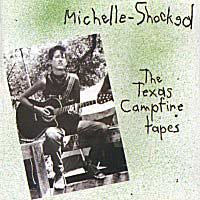 After returning to America, she visited the 1986 Kerrville
Folk Festival in Texas, where she volunteered for the trash crew. A visiting
British journalist heard her swapping songs with friends around the campfire
one night, and asked if he could record her on his Sony Walkman. Happy to
oblige, an impromptu performance was taped and - unbeknownst to Shocked –
subsequently released in England as The Texas Campfire Tapes. After returning to America, she visited the 1986 Kerrville
Folk Festival in Texas, where she volunteered for the trash crew. A visiting
British journalist heard her swapping songs with friends around the campfire
one night, and asked if he could record her on his Sony Walkman. Happy to
oblige, an impromptu performance was taped and - unbeknownst to Shocked –
subsequently released in England as The Texas Campfire Tapes.
It was about as low-fi as a record could get; similar to the
field recordings so treasured by musicologists, crickets chirp in the
background, and Shocked’s voice is pitched unnaturally high due to the
Walkman’s weak batteries. To the surprise of all concerned, the album
topped the independent charts in Britain.
She certainly wasn’t looking for a career in music;
she believed most performers lived lives of excess, and were out of touch with
the common people. Regardless, the album had generated a groundswell of
interest, and she traveled to Britain to perform at the prestigious Queen
Elizabeth Hall.
It was her first ever performance as a professional
musician.
She also got an introduction to the shadier side of the
music industry, when she was forced to sue for rights to the album, which she
later referred to as The Texas Campfire Thefts.
Meanwhile, a bidding war ensued in the U.S., and in late
’87 she signed a deal with Mercury Records. With nothing to lose, she
declined the customary industry practice of a large advance payment. Instead,
she chose to license her albums to the label for ten years, after which they
would revert back to her. The agreement was extremely artist friendly;
“It was on my terms, or not at all. I wasn’t asking for the
job.”
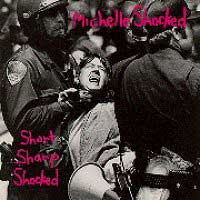 Her debut studio effort, Short Sharp Shocked came out in 1988 and signaled an already formidable
artist. Her debut studio effort, Short Sharp Shocked came out in 1988 and signaled an already formidable
artist.
She says the title was not – as commonly believed
– a play on a phrase from Gilbert and Sullivan’s The Mikado, but instead, a reference to a behavioral psychology
treatment, one also alluded to in A Clockwork Orange.
The album’s cover used the photo from the San
Francisco protest from four years earlier. Potential listeners could be excused
for expecting a hardcore punk album.
It was an intentional paradox. “Yep; you should always
judge a book by it’s cover.” She laughs, “Welcome to my world
of sardonicism. It’s a commercial package. I mean, what’s not to
love about rebellion, right? The fact that the package has everything to do
with the person, but very little to do with the style of music, kind of gives
you a warning of what’s to come. In other words, the kind of people that
that music was being marketed to, if they could get past the cover, they were
worth having.”
Her writing revealed a solid grasp of American roots music.
She was now living in London, but songs like ‘Memories of East
Texas,’ ‘(Making the Run to) Gladewater,’ and
‘V.F.D.’ all harkened back to her formative years in Texas. Even
‘Anchorage’ - which placed in the Billboard Hot 100 singles charts - mentioned the Lone Star
State.
The disc garnered widespread acclaim, and secured her a Grammy nomination as ‘Best New Artist.’
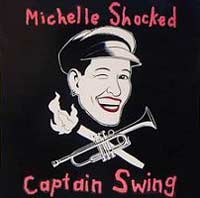 The following year Shocked returned to Los Angeles, where
she recorded Captain Swing. The
neo-1940s big band approach was a major change in direction, yet not as out of
right field as it appeared. She was simply staying true to her Texas roots; the
time honored spirit of individualism, and, as she defines it, “music as
functionality – it’s the background for dancing.” Decades
before, Bob Wills & his Texas Playboys had epitomized the concept by incorporating
big band, yodeling, fiddle tunes and German waltzes. The following year Shocked returned to Los Angeles, where
she recorded Captain Swing. The
neo-1940s big band approach was a major change in direction, yet not as out of
right field as it appeared. She was simply staying true to her Texas roots; the
time honored spirit of individualism, and, as she defines it, “music as
functionality – it’s the background for dancing.” Decades
before, Bob Wills & his Texas Playboys had epitomized the concept by incorporating
big band, yodeling, fiddle tunes and German waltzes.
The album’s opening track, ‘God Is a Real Estate
Developer,’ surmised that when it comes to the existence of a heavenly
creator; “it's all down to speculation.” It wasn’t the first
time she had questioned the need for organized religion. ‘Campus Crusade,’
which was included as a bonus track on the reissue of Short Sharp Shocked, expressed contempt for overly aggressive
Evangelical Christians.
Nonetheless, near the turn of the decade, she began
attending church. It wasn’t due to any conscious spiritual pursuit.
“You know, looking back on it, it was a
musicologist’s path; I was so passionately enamored of the breadcrumb
trail of American roots music, that I just began following it voraciously, and
it led me back to gospel. There was just no avoiding it.”
Among other forms, rock, blues and R & B all have their
roots in the church. Shocked decided to investigate, and began attending the
West Angeles Church of God in Christ. Predominantly African-American, COGIC is
the largest Pentecostal denomination in the U.S.
She was inspired by the choir, but put off by the message,
figuring “’this music would be so good if they just got rid of all
that Jesus stuff: ‘Jesus this, Jesus that.’ I’m like, ‘come
on, let’s just rock out.’”
After attending for six months, she responded to an altar
call. She laughs: “I just went one Sunday too often. I went for the
singing, but I stayed for the song.”
She took the gospel message at face value. A quote on her
website reads “…I was lost but now I’m found,” and
she’s described her faith as; “…garden-variety, born-again,
Evangelical Christianity.”
The whole concept of the Christian church was and remains
anathema to many in the folk world. “I’ve always conceived of it as
the one forbidden fruit that an artist may not touch, and so of course
I’m going to.”
It’s certainly the road less traveled. “Probably the only
real template we have for people like myself in terms of their career –
getting saved – is the path that Bob Dylan laid out. And if he was Judas
for going electric…”
Dylan’s audience grew significantly when he challenged the status
quo and plugged in. It took a declaration of Christian faith to finally lose
his exalted standing. “The same people that embraced him for his
creativity and his willingness to evolve [dropped him].”
She was exhilarated. “It was the same thrill that I
experienced when I dropped LSD for the first time, or any number of radical
things that I had done. It was like; ‘This is going to change my life.’
And frankly, as you get older, they come fewer and farther between. So
you’re kind of exhilarated; ‘Wahoo! Another joy ride, let’s
go!’” She recognized it was a commitment that would last a
lifetime. “I knew it would be. Because that‘s the kind of person
that I am; I’m very sincere. I don’t make that kind of commitment
unless I really have [thought it through] – I don’t dive in head
first; I had been going for six months.”
Sadly, the type of radical transformation she experienced is
rarely communicated to the outside world. Too often, the church is guilty of
losing touch with it’s roots. “Like the Institutional Revolutionary
Party in Mexico; It’s like the revolutionaries take over and then they
become an institution.”
She was surprised to learn people had been praying for her
long before she even entered the church. That continues to be the case.
“I just had a beautiful email from a fan…He’s got a copy of
the gospel album, and he says; ‘I just have to tell you, Michelle, I saw
you years ago…and you were sharing some really sad stories about your
childhood, and I prayed for you. And I thank God – I hope you don’t
feel it’s presumptuous - but I feel like he heard my prayers.’ And
he was so sensitive about it; he didn’t want to claim the victory, but I
wrote him back, and I said ‘Thank God for you! Thank God for your
prayers!’”
Instead of disparaging scandal-ridden celebrities,
she’d love to see the church intercede on their behalf. She’s
thankful for those who already do; “It’s about time we start asking
all these public figures and musicians who do get saved; is it just because
they’re that phenomenal and unique? Or is it because there is a ministry,
an active ministry of believers who love music and listen and hear their
stories of pain and heartache, and are praying on their behalf?” Not for
the first time, she’s almost overcome with emotion; “And God
answers prayers. If that’s going on, it’s all to God’s glory.
He’s got the victory on that one.”
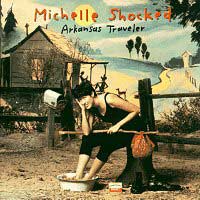 Returning with her third studio effort, 1992’s Arkansas
Traveler was yet another departure; a
sincere exploration of the blackface minstrel tradition, in which performers
would paint their faces in a broad caricature of the Negro population. Refusing
to bow down to the gods of political correctness, she made the point that
blackface was not racist; the practice had existed for over a century, and
served to introduce African-American music into the mainstream. Returning with her third studio effort, 1992’s Arkansas
Traveler was yet another departure; a
sincere exploration of the blackface minstrel tradition, in which performers
would paint their faces in a broad caricature of the Negro population. Refusing
to bow down to the gods of political correctness, she made the point that
blackface was not racist; the practice had existed for over a century, and
served to introduce African-American music into the mainstream.
While it’s rarely mentioned today, country music owes
a great debt to the custom; Hank Williams, Gene Autry, Bob Wills and Jimmie
Rogers all performed in blackface. And it wasn’t just white artists;
black performers were known to don makeup as well.
The album featured songs – many with new, original
lyrics – that she had grown up singing with her father and brother, both
of whom showed up on a few tracks. It was recorded in a variety of exotic
locations, including steamboats, an antique store, and a barn, and featured an
impressive list of guests, including Doc Watson, Clarence
‘Gatemouth’ Brown, Alison Krauss and Taj Mahal.
The album was conceived as the final piece of a trilogy
representing her influences. Short, Sharp, Shocked had been inspired by songwriting contemporaries like
Guy Clark and Townes Van Zandt, Captain Swing offered tributes to the swing sounds of Bob Wills
and Louis Jordan, and finally, the traditional songs she had learned from her
father inspired Arkansas Traveler.
They also confirmed just how far ahead of the curve she was.
Captain Swing had predated the swing
craze of the late 90s, and Arkansas Traveler foreshadowed the bluegrass roots revival spurred by O
Brother, Where Art Thou? a decade later.
Her world view has changed considerably, but she’s never
dropped the songs that were critical Christianity. One article claims she no
longer sings ‘God is a Real Estate Developer.’ “That’s
not a quote from me…somebody distorted that one badly,” she laughs.
“I’d sing it, but I haven’t had the band configuration.”
Even ‘Campus Crusade’ remains; “I’ve sang that in the
last couple of years. I don’t really look at my past work as something
that needs to be erased from the history. It does a good job of documenting
where I am today.
“I may not be as enthusiastic about singing, for
example, ‘33 RMP Soul,’ [from Arkansas Traveler] which on the surface looks like it’s a
pre-gospel, prequel to [my] gospel project, because it says; ‘consecrate
your soul/or there’s gonna be hell to pay/you got them where they live on
the judgment day.’ And recording it with Pop Staples, that’s
obviously got some gospel cred to it, as well. But the subtext is that
it’s a song about censorship.” Buried within the song are
“seven words…that if the FCC knew were in there, couldn’t be
played on the radio.” For the most part, listeners don’t pick up on
the subtleties; “Mostly just when I point it out; which is fine with
me.” Pops wasn’t aware of the hidden message. “Thankfully,
no. I just live in terror of Mavis [Staples – Pop’s daughter] confronting
me with it someday.” So far, she’s said nothing. Shocked laughs;
“She may be too gracious.”
On the opening track from Short Sharp Shocked, she had sung “we’re gonna have a
hundred and twenty babies…” By 1993, she was married, and hoping to
start a family. The couple knew it would be difficult; the tubal ligation was
meant to be permanent. They endured repeated attempts at in vitro fertilization,
which - outside of a miscarriage - proved ineffective.
 Ultimately, she accepted that she
would never have children. “I just think the hand that I was dealt
wasn’t necessarily a royal flush, whatever it was. But I’ve played
the hand that I was dealt. I look at parenthood as a ministry. And it’s
probably a lot of justification, but I look at my current activities and
identify them as ministries [too]. So whether I’m ministering through
parenthood or ministering through creativity - working out my own salvation -
you know, [it’s still ministry].” Ultimately, she accepted that she
would never have children. “I just think the hand that I was dealt
wasn’t necessarily a royal flush, whatever it was. But I’ve played
the hand that I was dealt. I look at parenthood as a ministry. And it’s
probably a lot of justification, but I look at my current activities and
identify them as ministries [too]. So whether I’m ministering through
parenthood or ministering through creativity - working out my own salvation -
you know, [it’s still ministry].”
She continues to support a woman’s right to choose,
but it’s tempered with compassion, and newly found insight. “I
would desperately hope that a woman would avoid finding herself in that
situation. But if a woman is in that position, I would hope that her own cries
to God for an answer would direct her.
“I was an unwanted pregnancy, and there were more
times in my life than less that I felt that was very much a curse. The
overwhelming influence of that fact was an oppressive negative that I never
crawled out from under.
“But in my reconciliation with my mother [the two
reconciled a few years ago], I felt more regret for her. The guilt and shame of the unwanted pregnancy inhibited her
from seeing and realizing that I was [a] gift. Some women get past that; they
get past the guilt and shame. She wasn’t able to do that, and that had a
profound influence on my own thoughts about unwanted pregnancies.”
Knowing first hand the damage that shame can inflict,
she’s particularly concerned that the church be there for women in
crisis. She singles out the African American Church’s handling of the
issue. “It’s not quite the same shame as in other organized
religions. When you’ve come up under the condemnation of slavery like the
black church did - and the reconciliation that it brought about - I just think
it’s one of those visceral experiences that you don’t quickly
forget.
“I wish that other groups who have experienced
oppression and come through it with grace as the redemption would remember
those lessons. I have to believe it’s not inherent in the African
American dream; I believe that it’s a social conditioning that is fresh
enough, that they have been at the bottom, underneath the foot of oppression,
and now, through God’s grace coming up out of it, there’s so much
grace to offer others. To me, it’s a model for what the true power of
God’s grace is; that forgiveness.”
As she prepared to follow-up to Arkansas Traveler, it became clear there were problems with the label.
She had suggested two possible ideas for her fifth album, and Mercury balked at
yet another change in direction, claiming she was “stylistically
inconsistent.”
“The first one - that really outraged them - was
called Prayers.” It was about as
far as you could get from a chart-friendly release. “Prayers was literally me, in the darkest night of the soul”
She explains the concept; “As your thoughts veer wildly from one fear to
the next, you’re praying; reaching out to a God that you don’t have
a really good relationship with, praying with a desperation that is really
intense. But you’re writing it down. And then go into the studio, and
hire a piano player to just start kind of playing along.”
In short, an improvised album of desperate prayers.
“And of course, they were like; not ‘No,’ but, ‘Hell, no.’
“The second proposal was far more cogitated –
there had been a power shift at Polygram, and there were now two guys running
Mercury.” When the dust settled, Ed Eckstine was the new President. The
change did not bode well for Shocked. “Eckstine had previously run what
they euphemistically called the ‘Urban Division.’ His big success
was [former Miss America] Vanessa Williams, and I’ll let you draw all the
conclusions you want after that.” Eckstine brought a new philosophy to
the label, and it didn’t include Shocked. “Well, it was the best
thing for Vanessa Williams; it was great.” She laughs. “Just glad
you appreciate the irony.”
Her pitch worked both as an artistic statement, and as an
attempt to placate Eckstine. “He had signed an act called Tony! Toni!
Tone!, who had released an album a year earlier called The Revival. [They] took gospel standards and updated them with
their own lyrics. And it struck me that what I had just done on Arkansas
Traveler - taking the string band and
fiddle tunes that I had grown up with and adapting my own lyrics –
[well], you can see the light bulb going off, right? I would do a collaboration
with Tony! Toni! Tone! We’re label mates, they’d come straight out
of the church, but they’re contemporary urban guys… Let’s do
it!”
The project never happened. “That was turned down, too…it’s
like they sensed my desperation, and they had me up against the wall.”
When the proposal was rejected, she realized it wasn’t
about the music at all. “It’s kind of been presented that it was
over stylistic issues…but the writing was already on the wall. It was
about money. It was about ownership of masters. It wouldn’t have mattered
if the proposal I had was to do an album full of profanities; it didn’t
really matter.”
As far as the label was concerned, she had cut too good a
deal for herself. They wanted to renegotiate and get the rights to her
catalogue. Until then, they were refusing to pay for studio time, in effect,
baring her from recording.
She sued to get out of the contract, citing the 13th
Amendment of the U.S. Constitution, which abolished slavery. “Instead of
putting my catalogue on ice, they put me on ice. I couldn’t record and I
couldn’t leave. They used creative inconsistency as a straw dog; getting
me in line was not even an issue. They didn’t even want me - only the
masters.”
In defiance of a stipulation preventing her from recording
for other labels, she sold a limited-edition, privately-pressed album entitled Kind
Hearted Woman at her live shows in 1994.
Just her and her electric guitar, the disc was recorded and released in less
than a week. The album may not have sold in numbers like her earlier releases,
but the fact it existed at all spoke volumes.
Continue article >>
|
Singing about death and poverty, the dark, sparse sound
reflected her state of mind. “I was drawing on metaphor to articulate the
frustration [and] despair. All the disappointment and bitterness…was
catalyzed by the circumstances that I found myself in.”
In addition to the ongoing dispute with the record company, she
was dealing with the death of her paternal Grandmother. “After I’d
run away from home, [she was] the only person still willing to invest, and
believe in me and my potential and my future. Everyone else had kind of judged
and rejected and written me off.”
They were close until the end. “She was dying of
cancer, [and] got out of her hospital bed and flew to New York, because I was
performing at Carnegie Hall. I loved that old girl...”
When she only had a few days left, Michelle visited her in
the hospital. Unbeknownst to Shocked, her mother had been invited to offer her
last respects as well. She arrived soon after Michelle, and, upon seeing her
daughter, offered her a cup of cocoa. Michelle was enraged, and left without a
word. She never saw her Grandmother again. She also ceased contact with her
father, who had invited his ex-wife to the hospital.
After relocating to New Orleans in 1994, Shocked took up
membership at a local COGIC church where the congregation members referred to
her as ‘our unique sister.’
 1996 saw the release of Artists Make Lousy Slaves, a collaboration with Hothouse Flowers guitarist
Fiachna O’Braonain that was written, recorded, and released in the span
of a week. 1996 saw the release of Artists Make Lousy Slaves, a collaboration with Hothouse Flowers guitarist
Fiachna O’Braonain that was written, recorded, and released in the span
of a week.
Later that same year – on the day the case was to
finally appear in court - Mercury settled with Shocked. She retained rights to
her catalogue, and was free to record whenever she chose. She immediately
re-recorded Kind Hearted Women with a
full band. Mercury was allowed one more album; Mercury Poise
1988-1995, an anthology of
previously-released material.
Two decades after winning the battle, she’s hardly
encouraged with the state of music industry. “I have…vastly
underestimated the American public’s willingness to submit to propaganda.
They just don’t know what time it is.” Like American Idol? “A case in point. Maybe I could find two or
three good things to say about it, but the negative effects culturally and
creatively far outweigh the positives.”
Even punk has gone corporate, with bands like Sum 41 -who
she equates with seventies soft rocker folkie John Denver – selling a
safe, sanitized version of rebellion.
 Meanwhile, she’s accepted her role as an independent
artist. Her entire catalogue is currently distributed at retail through Sony/Red,
online via iTunes, and – for the more personal touch - through her own website;
“Call ‘em up and tell ‘em what you want. And send a note in saying
you want an autograph,” she laughs, “it’s that hands
on.” Meanwhile, she’s accepted her role as an independent
artist. Her entire catalogue is currently distributed at retail through Sony/Red,
online via iTunes, and – for the more personal touch - through her own website;
“Call ‘em up and tell ‘em what you want. And send a note in saying
you want an autograph,” she laughs, “it’s that hands
on.”
Good News, another
tour only limited edition, came out in 1998. The album was inspired by her time
in New Orleans, which was coming to an end. The following year she returned to
Los Angeles.
 After a period of relative inactivity as far as recordings,
in 2001 she set up her own label, Mighty Sound, and reissued her first four
albums as expanded sets with bonus tracks over the next couple of years. After a period of relative inactivity as far as recordings,
in 2001 she set up her own label, Mighty Sound, and reissued her first four
albums as expanded sets with bonus tracks over the next couple of years.
In 2002 she released Deep Natural, her first disc of new material in four years. This
was not – as some bios claim - the gospel album she had wanted to put out
a decade earlier. She describes the disc as the sound of someone
“stumbling towards grace. Kind of what you get when you have one foot in
the door and one foot out.” She explains; “I was still drinking at
the time.”
Drinking – both hers and her husband’s - had
become an issue. For years, she had been blind to the problem. “I
hadn’t really even acknowledged my role - the way I saw it is; he drank,
and I would drink to put up with his drinking…I didn’t untangle the
knot; I give God all the credit for [that]. But once you start examining the
knot [addiction], you start to see the dynamic.” She laughs; “I
guess that’s what they call the recovery process: ‘Oh! That’s how I got into that…’”
Another equally troubling dynamic was a thinly-veiled
hostility on her husband’s part. He regularly criticized her in public
and to the press. Like the drinking, she was oblivious to the severity of the
attacks. “I hear from people that he would belittle me and put me down in
public.” She does concede that it could get ugly; “He was
overbearing; domineering and overbearing.”
Recognizing that the relationship was mutually destructive,
and unlikely to change, she stopped drinking, and filed for divorce.
“Maybe it’s the easy path, [to] say that I was a
co-dependant, an enabler, the wife of an alcoholic, but since my ex-husband
doesn’t really identify himself as an alcoholic, I’ve chosen a
little bit more rigorous path for myself, and just said ‘I am a
recovering alcoholic.’”
“When I did stop drinking - and it’s only with
God’s grace – I never had another drink.” Although she
identifies herself as being in recovery, she never joined a 12-step program.
“I tend to do it through my organized religion approach. I think that
would be looked down on; true 12-steppers would say go to church and go to 12-step. I don’t do that. The only
counseling I claim really is the counseling of the Holy Spirit. I read the
scriptures, I pray, and I confess my sins. And those three things seem to do an
adequate job of revealing insights to me to help me understand how to not get
into that again.”
Understanding came quickly. “It was a gift. The whole
thing was just a gift. It was like God looking down going; ‘You
knucklehead, you’re never going to figure this out. Look; this
one’s a gimmie - I’m gonna give you a break.’ But, you know, it
was a gift. It really was.”
Reinvigorated, Shocked returned with a vengeance in 2005,
releasing three albums on the same day.
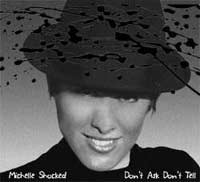 She dubbed Don’t Ask, Don’t Tell her ‘secret divorce album.’ It was a
major return to form. There’s a long tradition of albums inspired by
divorce, with Richard and Linda Thompson, Bob Dylan and Marvin Gaye all
producing some of their best work while mired in real-life pain. Shock adds a
few classics to the genre here, including ‘Elaborate
Sabotage.’ She dubbed Don’t Ask, Don’t Tell her ‘secret divorce album.’ It was a
major return to form. There’s a long tradition of albums inspired by
divorce, with Richard and Linda Thompson, Bob Dylan and Marvin Gaye all
producing some of their best work while mired in real-life pain. Shock adds a
few classics to the genre here, including ‘Elaborate
Sabotage.’
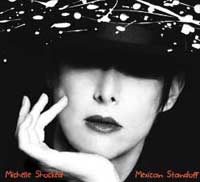 Mexican Standoff
mixed original Latin-tinged numbers with Texas blues, sung in her best
‘bastardized Spanish,’ She’s part Spanish, so the disc was
nowhere near the stretch it might appear. Mexican Standoff
mixed original Latin-tinged numbers with Texas blues, sung in her best
‘bastardized Spanish,’ She’s part Spanish, so the disc was
nowhere near the stretch it might appear.
The final piece of the trilogy was Got No Strings; a collection of songs from Disney films performed
western swing style. Shocked had struck up a friendship with former Disney
illustrator David Willardson when he did the artwork for Deep Natural, and - inspired by his work - took on the Disney
songbook.
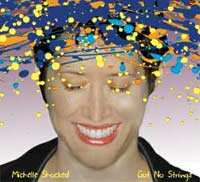 The friendship continued to grow, and they’ve been
romantically involved for the last five years. On occasion the two perform
together, with David painting while Michelle sings. The friendship continued to grow, and they’ve been
romantically involved for the last five years. On occasion the two perform
together, with David painting while Michelle sings.
Longtime fans were not surprised when the three discs
appeared together. The number has always appealed to her, but for strictly
aesthetic reasons; “Some people are outright
numerologists…that’s never had a fascination for me. But as a
poetic device; yes. I started writing in trilogies, I started recording in
trilogies. And it just so happens that my God,” she laughs,
“manifests himself in three ways.”
Her latest album, ToHeavenURide was recorded at the Telluride Bluegrass Festival in
2003 – the title is a play on the festival’s Colorado location.
Outside of an appearance at the Gospel Tent at the New
Orleans Jazz Festival in 2001, this was the first time she had performed a
completely gospel-derived set. Along with her regular backing band and Nick
Forster of Hot Rize – who produced Got No Strings - sitting in on pedal steel, she brought along a
five-piece choir led by Sean Dancy, from New Greater Circle Mission Church in
south L.A. to liven things up.
Offering a full hour of sanctified singing and preaching,
it’s clear that Shocked is no stranger to rousing worship services, and
the disc makes a powerful case for music, politics and faith working together.
In addition to four of her own songs, there are tributes to
the Staple Singers and Sister Rosetta Tharpe – Shocked was a highlight on
Shout, Sister Shout, a Tharpe tribute
disc that came out a few years back. A relatively recent addition to the gospel
cannon, Fred Hammond’s ‘We’re Blessed’ fits well, as
does Billie Holiday’s ‘God Bless the Child;’ a song not
usually associated with gospel. She laughs, “Well, it technically is
scripture based;’ she recites the key lyric: ‘them that’s got
shall get/them that’s not shall lose.’ “It’s taken bit out of context, but it
is.”
The disc almost never happened. Shocked’s contract had
stipulated no recordings be made, and she adhered to the agreement. By all
accounts the set was inspired, but appeared destined to remain nothing more
than a memory for those who were there. Fortunately - unbeknownst to the band -
festival organizers had commissioned a documentary DVD of the weekend, and the
entire set was recorded although – initially - unavailable for release.
Shocked’s career trajectory has taken a variety of
twists and turns, and her fan base has changed as much as her music.
“I’ve probably lost and gained countless thousands. But the bottom
line…is, if you don’t satisfy your soul, who else is gonna be satisfied?”
If she’d stuck to one genre, she’d undoubtedly
enjoy a higher profile today. But that was never the point. “I’ll
say it like this; you get the audience you deserve. And so, the audience I now
have, I cherish and treasure them, for all the changes I’ve gone through.
It seems to be the common thread, that they expect the unexpected.”
She’s never been afraid to hold unpopular positions or
argue with her detractors. With such a strong-willed personality, it’s no
surprise that she can elicit equally passionate responses from her audience and
co-workers.
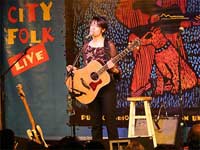 In a recent online poll listing best and worst concerts
voters had attended, Shocked placed high on both categories; some were taken
with her absolute lack of pretense and traditional show-biz ethos, while others
faulted her for talking as much as singing. In a recent online poll listing best and worst concerts
voters had attended, Shocked placed high on both categories; some were taken
with her absolute lack of pretense and traditional show-biz ethos, while others
faulted her for talking as much as singing.
After performing on Arkansas Traveler, the Band’s Levon Helm wrote a song called
‘The Burden of the Greatness in You.’ In an interview he later
commented “…we wrote that tune ’bout ol’ Michelle Shocked…Man,
weren’t she a piece
’a work?”
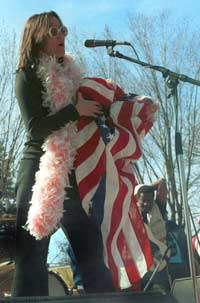 The reputation as a headstrong entertainer is not one she
relishes. “That’s not by me. If you look at it, it’s like
it’s been foisted on me. People needed that, needed me to fill that role
whether I was volunteering for the job or not.” The reputation as a headstrong entertainer is not one she
relishes. “That’s not by me. If you look at it, it’s like
it’s been foisted on me. People needed that, needed me to fill that role
whether I was volunteering for the job or not.”
Her confrontational stance comes, she now believes, as the
result of “a lifetime of self-justification.” She explains;
“I’m drawn to the purist, the idealist, the clean hands school of
thinking. As all Philosopher Kings are. All Philosopher Queens are. But
it’s a faulty road. I just spent my whole life trying to be perfect so
that I could judge other people for not being as good as me.” She laughs
at the irony; “Only to find out I was the biggest knucklehead of the
bunch.”
Shortly after her divorce, she reconciled with both of her
parents.
At a Mother’s Day show this year, she brought her mother
onstage to play autoharp. The reunion was a long time coming. “It
definitely, definitely was. I can very clearly say that was not my vision. I
watched the hand of God unfold in my life bringing grace and peace for both
myself and my mother. But it was his vision for our lives, not mine,” she
remarks.
They first spoke three years ago. “I called her up and
said ‘Mom, we need to talk.’” It was a tough call to make.
“I had forgiven her in my heart a long time ago. I had just never gotten
around to telling her. It was just the lack of courage; I didn’t have the
courage.” It was a surreal experience; “When I made the call…I
felt like I was just watching myself from above, like being a good daughter.
And,” she reminds us, “I’m nothing like a good daughter.”
Her mother unhesitatingly accepted the offer of
reconciliation; “That was a beautiful part; she was as gracious as you
could have asked for. She said ‘Yeah, it couldn’t be soon
enough.’
She believed that her actions alone were the cause of the
falling out. “Well, my Mother is probably the first one to blame herself,
to be responsible - for everything. She’s someone who carries around a
lot of regret and guilt. She’s just hard on herself. I was able to tell
her, when we got together after 25 years, ‘Mom; you never gave me
anything less than your very best.’”
Though her mother remains a member of the Mormon Church,
there’s no desire to try and convert her to more orthodox beliefs.
“You know, I could, but the truth is, having the reconciliation at the
age that I am, I no longer have that need, that adolescent need for her to be
my mother, or even my friend.”
The break with her father wasn’t as dramatic, but was
nonetheless painful. “I’d been very close to him… [but] we
weren’t close during the years of my marriage.” Her ex-husband had
encouraged her to break ties; “Typical to alcoholic behavior, they will
kind of circle the wagons, and drive away anyone with an outside influence who
might be able to challenge or criticize their control. So that’s what I
allowed him to do with my father.”
Their relationship continues to heal. “I think I
really hurt his feelings, and did some damage to the relationship. I allowed my
resentments about what he did or didn’t do for me growing up to kind of
fester. So I think I just have to keep on working on my resentments. But
he’s been reasonably gracious. The nice thing is he writes a column for
my magazine [Jams – available on
her website
], and he’s still who he is, a diehard born again atheist, and sometimes
I feel like he’s writing articles to kind of smack me and my
beliefs.” (His column, Philosopher’s Corner, argues against “beliefs for which there is no
evidence, e.g., an afterlife and eternal justice.”). She reconsiders;
“But I don’t really think that. I think he’s just being very
consistently himself. And so, I just told him how proud I was to have his voice
in the magazine. I think that’s kind of where it’s at now, that
rather than trying to make my dad proud of me, I’ve come to realize that it really means a
lot to him to feel like I’m proud of him. So,” she paraphrases St.
Francis of Assisi: “ask the Lord, not so much that I be loved, as to
love.”
She’s recently seen a whole other side of her father.
“My younger brother [Max Johnston – who in addition to playing with
Michelle, is a former member of Uncle Tupelo and Wilco], he’s just had a
baby, and I see my father’s response to that; very warm, very positive.
He really, really enjoys it, but it’s very, very different than the role
he played in my life as a father.”
On the topic of mending broken relationships, I wondered
where things stood with her ex-husband. She’s momentarily at a loss for
words, before commenting on how “The lawyers are still working that one
out.” Realizing the statement could be taken any number of ways, she
elaborates. “From what I just told you, you can’t even draw
conclusions, because it is so
unorthodox, it is so unusual. It
is such a strange situation to be in, that it implies either there’s a
lawsuit, or this, or that. It’s weirder than you can even imagine. But I
can tell you this much; there is going to be a light at the end of the tunnel
in November. But when the story comes out, it’s really weird.”
It is. “He disappeared.” She declares, as if
still not quite believing it herself. “I hired private investigators, I
scoured the internet, I contacted every friend that I could, and he not only
disappeared, he deliberately went underground. He went into hiding. I’m
sure it seems really rational to him. And there is a financial motivation
behind it.
“But you asked if I’m on good terms, do we talk
a lot? I couldn’t even find him, much less talk to him.”
Surprisingly, there’s little sense of frustration or
anger on her part. “Not because of him; only by the grace of God.
Because, I’m not the kind of person that could live with that kind of
non-closure very easily.”
Peace came about in an unlikely way. “I kind of hate
admitting this, because to non-believers this would really just seem like, you
know, exhibit ‘A’ for what’s wrong with Christians, but it
was a book of prayers.
“About the time of the separation, a friend gave me a
book – and you’re not supposed to get your prayers out of a book -
but I had so many hang-ups about how to get into a prayer life, that unlike
most people, I grabbed this book, and I devoured it. It gave me a way of
getting into prayer, and now, just like any alcoholic in recovery saying the
Serenity Prayer, or following the Big Book or whatever, I have lived
consistently by this daily prayer.”
 As a result of the experience, she’s now a fervent
believer in the power of prayer. “If I can get to spend an hour with my
God praying each day, there’s nothing; there is no power on the face of
this earth that is greater. There is nothing that will be an obstacle. So
that’s what’s allowed me to have this – whatever peace you
hear.” At this point, she’s almost overcome with gratitude.
“It’s not me. It would have driven me back to drink a long time
ago.” As a result of the experience, she’s now a fervent
believer in the power of prayer. “If I can get to spend an hour with my
God praying each day, there’s nothing; there is no power on the face of
this earth that is greater. There is nothing that will be an obstacle. So
that’s what’s allowed me to have this – whatever peace you
hear.” At this point, she’s almost overcome with gratitude.
“It’s not me. It would have driven me back to drink a long time
ago.”
Shocked is a long time member of the West Angeles Church of
God In Christ.
She makes no secret of her preference for African American churches.
“If I go to hear a white preacher talk; he better really have some Holy Ghost fire. Because, if he
doesn’t, I’m looking at him as a hypocrite.”
She’s aware that might come across as politically
incorrect. “You know, typically, when you take a position like this,
especially in a political context, it’s seen as reverse racism. But
here’s my parsing of it: they have the moral authority. As a people, as a
generation, they put their lives on the line for what they believed in. And
that’s not to say that white activists did not follow the same path of
non-violence. It’s not like that. The way I parse it, is;
somebody’s got soul, they’ve got my attention.”
It’s not exclusive to race. “A white person can
have soul. We settled that question long, long ago. But, there is an
inheritance.”
The fact she’s one of the few white women in the
congregation does not escape her. “You know, my favorite story is when
they found out I was some kind of singer;
they invited me up to sing, and I did Sister Rosetta Tharpe’s…”
she begins to sing in a soulful voice;
“‘Come by here Lord, come by here…’ You know,
and just wailin’ on it, and doing my gospel damnedest. And afterwards - so graciously - the Pastor’s
wife came up and thanked me profusely, to let me know how much she appreciated
hearing country music. She said,
‘We just love country
music.’ Think about it; all of the cultural [differences]… it cuts
both ways. We sound country to them. They sound soulful to us.”
She sings in four different groups at the church, including the
200 strong Mass Choir. “I get a chance to sing once a month guaranteed,
but sometimes two and even three times.” Singing in the church takes
commitment. The Mass Choir, for instance, rehearses twice before each
performance, and the Sunday schedule would exhaust the most road-hardened
musician; “It’s an all day ministry on Sundays. So you start at
7:00 in the morning, and you’re there until 9 or 10:00 at night.”
The Church of God In Christ takes a conservative stand on
many issues, including homosexuality, and she’s uneasy about sharing her
own views on the subject – especially with a publication that’s
marketed to the Christian community.
“I’m a songwriter’s songwriter, but
I’m not really a Christian’s Christian. And so to have stands, or points
of view, or politics…it’s really not wise on my part. If I was
setting myself up to be a Christian’s Christian, I would say
‘Great; find out what my position is.’ [But] the truth is I am not
courting the Christian vote, I’m not courting the Christian demographic
for my audience. I’m just stumbling towards grace like most
people.”
With that caveat, we proceed.
Over the years she’s been critical of the
church’s stand on homosexuality and opposition to gay marriage.
She’s recently had a change of heart.
“I can only tell you my experience. When I first went
to this church I heard [a visiting Evangelist] literally stand up there in the
pulpit and say ‘In the Bible it says Adam and Eve, not Adam and
Steve.’ And no one laughed. And I was like; ‘You’re joking,
right? This is like a comedy sketch. You’re trying to show us how
narrow-minded and bigoted people can be. You’re an African-American
church. You know how people can be.’ No one laughed. And at that moment I
had to make a decision; is this kind of thinking going to drive me away from my
salvation, or am I going to just accept that this is where people are at? And
so, eventually I approached my own Pastor with the question; ‘So, what
about the gays?’ As a Pastor he said that he was obligated to preach what
God says about it. As a man, I felt like he kind of came down on the line of
‘some of my best friends are gay.’
“But as a pastor - and where I’m currently on it
- is that I was sitting in the choir stand four or five months ago, and the
subject of the woman caught in the act of adultery came up, and Christ kneeling
down and writing in the sand, and looking up and her accusers were gone. And it
was really a call to order, because I have been in a relationship for going on
five years now with a wonderful, wonderful man that involves, you know… and the preacher right then and there, he
articulated in almost legal terms; the definition of adultery and the
definition of fornication. And there was no avoiding it; I am a fornicator. I
am a fornicator.
“For a couple of weeks, I just squirmed. Now, through
this grace of forgiveness, that was no longer acceptable to just keep
squirming. I went to my Pastor, and I said, ‘Look; I’m not married.
And I don’t want to get married again.’ And he did exactly with me
what he had done on the issue of homosexuality. He’s like;
‘I’m not here to judge you. I’m just going to tell you what
God says.’ But that same Pastor did not shy away from pointing out my
sin. And,” she chuckles at the memory, “he loved when he was doing
it, too - he’s going; ‘It’s getting awful quiet in
here…’ So, he’s fair.
“And so, the comfort that I have found now, is that,
as I’ve read the scriptures, it’s no greater of a sin to be a
homosexual than to be a fornicator. It’s pretty clear that they’re both
pretty much violations of what God’s vision for our lives are. So, what I
do now is I continue to fornicate, and pray feverishly. And every time I do, [I
pray]; ‘Dear God; please bring me closer to your will. Please make me a
doer of your word and not a hearer only, but meanwhile, thank you for your
grace because I wouldn’t make it without it – I love this man,
there’s no way that I’m going to give him up.”
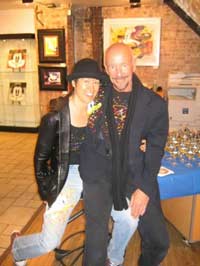 With great trepidation, she informed him that things would
have to change. “You know, I really took a risk with him. He feels the
same way about marriage that I did. And so I took a risk, and I almost lost it
all. For about a month we were separated while he got his head around the idea
that sooner or later this road is going to lead to marriage. I don’t know
where that leaves homosexuals, but I know for us fornicators, I’m working
it out.” With great trepidation, she informed him that things would
have to change. “You know, I really took a risk with him. He feels the
same way about marriage that I did. And so I took a risk, and I almost lost it
all. For about a month we were separated while he got his head around the idea
that sooner or later this road is going to lead to marriage. I don’t know
where that leaves homosexuals, but I know for us fornicators, I’m working
it out.”
A wedding date is yet to be determined.
“He’s not popped the question, but he’s
very keenly aware of what the standards are and I don’t think he feels as
directly as I do the pain of the sin; the violation of God’s will. It
really, really wears on me.”
The next time we speak, Shocked is concerned her previous
comments may be misconstrued, or perceived as homophobic. She explains:
“Where I really would like this
understood, is that the Pharisees were trying to trap Christ. They were trying
to catch him in a contradiction. And so, the way the Bible describes it, they
brought before him a woman caught in the very act of adultery. I like to pause
right there, and say, what did it take, for these Pharisees to catch a woman in
the very act of adultery? That couldn’t have been easy.
First of all, they had to catch a woman
in the very act of adultery.”
Which makes it clear where their concerns lied. “They
didn’t care about the woman, and they surely didn’t care about
adultery. What they cared about was catching Christ in a trap. And because
he’s Christ, he knew the wisdom of their heart – he knew it. So
they brought her to him – we all know the story – he kneels down on
the ground, and begins to write with his finger, [he] says, ‘Any of you
here without sin, cast the first stone.’ Now again, pause. Would you not
love to know what he was writing with his finger in the dirt? I can‘t
even fathom the power of what he wrote. But I know it had something to do with
judgment, and I know it had something to do with mercy. I just know it, because
the consequence is, one by one, the Spirit convicted their hearts, and they
walked away. And he looked up, and only she was standing there; ‘Woman,
where are your accusers? Do none remain?’ ‘None, Lord.’
‘Then neither do I. Go and sin no more.’ And then the Preacher
likes to pause and say; ‘Jesus wasn’t saying it was good to commit
adultery. He said go and sin no more.’’
 “And up until a few months ago, I had found all the
justifications that I needed for myself regarding my monogamous, faithful,
committed relationship to a man that I’m not married to. And having been
married, wasn’t very interested in going down that path again. After all,
marriage is just a legal institution, sanctioned by the state, and has nothing
to do with a spiritual bond or commitment, right?” She laughs;
“Trust me, I tried parsing it every single way I could. But when the
spirit convicted me, it convicted me. And I had to put down that rock, and walk
away. And that’s really what I would like to say.” She imagines
herself in that very same crowd; “You brought me a homosexual. And
I’m standing there with a stone in my hand, ready to throw it at him? I
don’t think so…”
Utterly convicted, she voices the only logical response; “Goodbye.” “And up until a few months ago, I had found all the
justifications that I needed for myself regarding my monogamous, faithful,
committed relationship to a man that I’m not married to. And having been
married, wasn’t very interested in going down that path again. After all,
marriage is just a legal institution, sanctioned by the state, and has nothing
to do with a spiritual bond or commitment, right?” She laughs;
“Trust me, I tried parsing it every single way I could. But when the
spirit convicted me, it convicted me. And I had to put down that rock, and walk
away. And that’s really what I would like to say.” She imagines
herself in that very same crowd; “You brought me a homosexual. And
I’m standing there with a stone in my hand, ready to throw it at him? I
don’t think so…”
Utterly convicted, she voices the only logical response; “Goodbye.”
T Bone Burnett once said he believes the reason the
conservative church focuses on abortion and homosexuality is because most of
its members don’t have personal struggles with either issue. Therefore,
there’s little need to examine one’s own motivations.
“It’s true. But then again, the hypocrisy of it, is that they all
have family who are.”
She’s well aware that her arguments and actions may at
times appear inconsistent. That no longer fazes her. “I don’t think
you can ever eliminate all the contradictions…I love self-justification,
but it’s just not a very practical course for me to pursue. It’s
better just to accept…” she starts to laugh; “that I’m
in the mess with everybody else.”
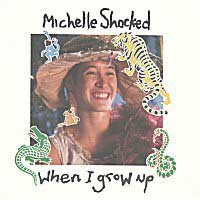
The artwork for Shocked’s debut single, ‘When I
Grow Up’ posed the question; ‘Why don’t people get more
radical when they grow up?’ Twenty years on, she’s absolutely
certain she’s accomplish that goal; “Yeah! I’m telling you!
Christianity is the most radical thing going - I’m sorry that left in the
hands of Christians it’s just kind of boring and mundane. But it is
radical. It has the power to change the world.”
 She considers her LSD-induced vision – as a spiritual
warrior on a global battlefield – a gross distortion. “I frankly
resented that. To me, the gospel is one of peace, forgiveness, and
reconciliation.” Not that she disagrees with the theological premise of
warfare. “I do believe that I am battling strongholds and principalities,
and tearing them down mightily, but the weapons of my warfare are spiritual,
and guess who the biggest enemy is?” She pauses; “It’s right
inside me.” She considers her LSD-induced vision – as a spiritual
warrior on a global battlefield – a gross distortion. “I frankly
resented that. To me, the gospel is one of peace, forgiveness, and
reconciliation.” Not that she disagrees with the theological premise of
warfare. “I do believe that I am battling strongholds and principalities,
and tearing them down mightily, but the weapons of my warfare are spiritual,
and guess who the biggest enemy is?” She pauses; “It’s right
inside me.”
http://www.michelleshocked.com
October 2007
|