|
BCCN’s series of faith profiles marking the 150th
anniversary of the founding of the province continues, with the story of
one of the province’s more colourful missionaries. Taken from Canada: Portraits of Faith (Reel
to Real), edited by Michael Clarke.
By Ted Gerk
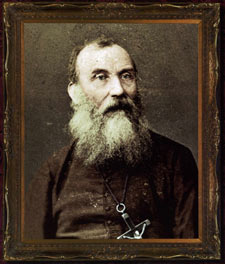 OLD-TIMERS in the Okanagan who knew him well remembered
Father Charles Pandosy as a huge, powerfully built man, capable of amazing
feats of strength, with a big booming voice and a ready wit. OLD-TIMERS in the Okanagan who knew him well remembered
Father Charles Pandosy as a huge, powerfully built man, capable of amazing
feats of strength, with a big booming voice and a ready wit.
Although a deeply religious Oblate missionary, Pandosy
was also known to settle an argument by challenging his opponent to a
fistfight. Today, Pandosy is best remembered as Canada’s Johnny
Appleseed.
Charles John Felix Adolph Pandosy was born in
Marseilles, France, in 1824 to Marguerite Josephine Marie Dallest and
Etienne Charles Henry Pandosy.
His father was a navy captain and a landowner and was
thus able to provide comfortable living conditions and a good education for
his family It was his father’s navy career that drew Pandosy to
the adventure of distant ports.
As a step in this direction, while attending the
Bourbon College at Aries, France, Pandosy decided to enter the Oblate
Juniorate of Lumineres, a seminary for men seeking ordination into the
Oblate Order of priesthood in the Roman Catholic Church. He took his final
religious vows in 1845.
Bishop de Mazenod, founder of the Missionary Oblates of
Mary Immaculate, provided him with an inspiring admonition: “There
are in this world but two loves: the love of God extending to the contempt
of self; and the love of self extending to the contempt of God. All other
loves are but degrees between these two extremes. Do not fear, you obey the
One who rules the world.”
This wisdom would guide Pandosy’s missionary
endeavours in the Pacific Northwest for more than four decades. In
February 1847, the 23 year old Pandosy and four others were sent from
France to the mission fields of the Oregon Territory.
It was an arduous eight-month journey, culminating in
their arrival at Fort Walla Walla. Here, the men began to fulfill the
objective of their journey: the evangelization of the Yakima Indians.
Pandosy and the others quickly discovered the violence
of the region. On November 29, 1847, the Marcus Whitman Massacre took
place, in which several Cayuse Indians killed 13 people and took more than
40 hostages. In February 1848, American troops were dispatched, and the
Cayuse War began. The war was to last two-and a half years.
Motivated by these perilous events, Pandosy’s
superiors allowed for early ordination. Pandosy and a colleague officially
entered the Oblate Order in early January 1848, the first priests ordained
in what was to become Washington State. Pandosy altered his name at this
point to Charles Marie Pandosy.
The missionaries not only cared for the spiritual needs
of the natives, they also served as translators and as peacekeepers.
Pandosy and his co-workers managed to keep the Yakimas from entering the
war. Pandosy became fluent in the Yakima language and eventually
compiled its first dictionary. He later acted as a mediator and an
interpreter between the Yakimas and the white man while continuing his
missionary work among the Indians and serving as an army chaplain.
In March 1859, war flared between the U.S. Army and the
Spokane and Yakima Indians, and the Oblates made the difficult decision to
close their missions among the Yakimas and the Cayuses.
In summer 1859, Pandosy was sent to the Okanagan Valley
in British Columbia, where he established a mission known as L’Anse
au Sable, the Cove of Sand, in an area that is now the City of Kelowna.
Pandosy quickly recognized the agricultural potential of the
Okanagan’s temperate setting and planted its first apple trees,
encouraging new settlers to do the same.
Continue article >>
|
A friend of Pandosy wrote: “The first trees
planted by the missionary produced a beautiful apple, deep red, shaped like
a Delicious – a good winter apple.” Pandosy’s orchards
eventually established the Okanagan Valley as one of Canada’s chief
fruit-growing areas.
Pandosy was a devout pastor who also served his flock
as doctor; teacher; lawyer; orator; botanist; agriculturist; musician
(he played the French horn); voice instructor; and sports coach. He
fast became known as a troubleshooter, a peacemaker, a defender of justice,
a champion of the underdog – and, above all else, a great
humanitarian.
But Pandosy was not your typical priest. Once, when his
young Indian interpreter and guide gambled away Pandosy’s brand new
saddle, Pandosy immediately challenged him to a fight.
Love and respect for his priest kept the native
man’s hands down by his side, causing Pandosy to grab the culprit by
the scruff of the neck and demand that he put up his fists and defend
himself. Pandosy, however, tripped on his cassock, allowing his opponent to
jump on top of him.
Those who observed the spectacle were surprised at
Pandosy’s unpriestly behaviour. Dusting himself off, Pandosy
thundered: “I’m not mad at him, I’m mad about the
saddle.”
Pandosy, who experienced other missions throughout
British Columbia – Esquimalt, Fort Rupert, Fort St. James, the
lower Fraser, Stuart Lake, Mission City and New Westminster – was
among those who believed that Indians and their culture should be
respected, and that the ways of the white man were largely responsible for
the indifference that many Indians displayed toward Christianity.
He wrote to a superior in the 1850s: “But I
shiver, Reverend Father, when I think of the miserable state of the
Savages, as I cannot delude myself, at least in the country where we live,
the Savages around us are what the Whites have made them and what we have
let them become instead of working hard and generously to make them
otherwise with the help of the grace of God.”
On February 6, 1891, Father Pandosy died near
Penticton, after a pastoral visit during cold weather to Keremeos. His body
was brought to the mission that he had founded on the site of present-day
Kelowna, and lovingly laid to rest.
Pandosy influenced whites and natives alike and saved
the lives of thousands during the various wars between natives and
settlers. He taught that two cultures and two worlds could live together
peacefully based on mutual trust and respect.
Pandosy’s life of faith and sacrifice are
evidenced by the missions he founded and so diligently served. On his own
behalf he said, “I expend myself and over this is spent God’s
grace.”
Ted Gerk is director of
operations at Heritage Christian Online School in Kelowna.
October 2008
|