|
By Len Hjalmarson
ALAN ROXBURGH is co-author of The Missional Leader. He is also
vice president of Allelon Canada, a ministry dedicated to promoting
the ‘missional church’ perspective, whose advisory board
includes authors Brian McLaren, Leonard Sweet and Eugene Peterson. Roxburgh
was at Trinity Baptist Church in Kelowna September 23, to introduce the
Allelon Training Centre initiative. He spoke to BCCN a few weeks before the event.
BCCN: You have been
involved in some interesting projects the past few years, from the GOCN to
the Missional Schools Project. Fill us in.
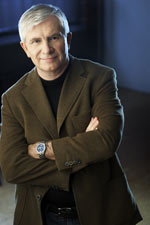 | Allelon Canada vice president Alan Roxburgh |
Alan Roxburgh: GOCN is the
acronym for Gospel and Our Culture Network. Its spiritual father was Bishop
Lesslie Newbigin. The GOCN helped clarify that the missional conversation
was the critical element in seeking to shape Christian identity in late
modern North American cultures. In retrospect, we too easily made it into a
conversation about the church – rather than, as Newbigin did, the
question of how the biblical narrative enters and transforms culture.
One of the things we recognized was that if we are to
form missional communities in North America, we would have to address the
question of leadership formation. Many seminaries are acknowledging the
need for a massive shift in the paradigms of theological training. Allelon
underwrote a series of gatherings of some 20-plus seminaries to investigate
the potential of developing a multi-year project to discern how to create
missional curriculums for the formation of leaders.
BCCN: More recently Allelon
has launched a training initiative and is creating training hubs across
North America. Is this another seminary? And why now?
AR: We are creating a
series of Allelon Training Centres – ATCs – across North
America. No, these are not intended to compete with seminaries. We
are partnering with Together in Mission (UK). We see the need to train up
thousands of men and women (who don’t plan to attend seminary or quit
their vocations) in the theory, skills and practices of missional
leadership – in order to generate a movement of lay-led local,
neighbourhood-based new churches. We won’t require people to leave
their contexts.
BCCN: The ATC structure
involves a missional order in the formation component. What is a missional
order, and why attempt to combine it with a training initiative?
AR: Mission-shaped life
isn’t about new tactics or new formulas for church. It requires a
radical transformation of Christian life in North America. This kind of
transformation is not about criticizing the church or setting up false
dichotomies between institutional and organic, or corporate and emergent.
We are calling men and women into a recovery of the Way – of the
practices and habits that make Christians a distinct people.
BCCN: Are you concerned that establishing a rule of life merely adds
another burden to the fragmented, tired, overburdened Christian leader?
AR: It does demand and call
for a re-ordering of habits. This is hard work and doesn’t come
easily to any of us – so it can be seen as adding burdens. At the
same time, without someone calling out stop to the awful fragmentation of our commodified lives, we are
lost no matter how big our churches get. A Rule of Life is a way of calling
stop; providing
people with a track on which to establish a different direction. But yes
– this is hard, hard work.
Continue article >>
|
BCCN: You have been
involved in rethinking leadership lenses and practices in the context of a
rapidly changing culture. Why do we need to be about this task? What will
our new lenses look like?
AR: I would suggest reading
The Missional Leader for
this one. Our paradigms for leadership are borrowed from everywhere,
and then we baptize them with God language – but none of that covers
up the poverty of our leadership models.
New lenses begin with the God questions. That’s
tough, because we have lost the art of knowing how to ask God questions
first and how to be people who dwell in the scriptures – not to
confirm our visions but to be confronted by the Spirit.
BCCN: Many leaders feel we
can renew existing structures. Others argue it’s “easier to
make babies than raise the dead.” Are we trapped with this either/or
choice?
AR: No, because it’s
a really dumb analogy. Whoever said making babies was somehow doing
something outside existing structures?
This wooly thinking is shaped by a modernity that
believes it’s possible to start with a clean sheet. Of course we need
to change existing structures – what’s new about that?
We need to stop listening to these gurus who suggest
it’s possible to start new with a new formula or some hidden secret.
All we have are ordinary, fallible men and women struggling to make sense
of what it means to be Christian in a confusing time.
But if you think changing structures, or throwing out
structures or promising some radically new structure will actually bring
about transformation or the kingdom of God, then I have swamp land to sell
in Florida.
Today’s radical new organizational structure or
church will be tomorrow’s existing structure that can’t be
renewed. Am I saying things don’t need to change? Not for a moment!
Is it hard work? You bet it is! But then, what isn’t that’s
worth calling human life?
For more information, contact 250-765-3596, or: www.allelon.org/training/atc_regions.cfm
October 2008
|