|
By Frank Stirk
AUTHOR and photographer Marja Bergen calls herself “just a foot soldier” seeking to always obey God’s will. But she had no idea how powerfully he planned to use her when she got up
in a worship service at her church – Brentwood Park Alliance in Burnaby – early in 2006 to talk about her struggle with severe bipolar disorder.
“It was at a Good Friday service,” she recalled. “I told some of my story and talked about my feelings. About three people came up
to me after, who I had not thought had a [mental health] problem, and told me
what they were dealing with.”
Revelation
Bergen said she also discovered that senior pastor Don Dyck had no idea that
many of his people were suffering from some form of mental illness or mood
disorder. He concedes it was a revelation.
“Here was a particular group of people,” Dyck said, “that were marginalized by the church and the church didn’t even know it . . . So as I came to understand that, I thought: ‘We’re going to have to work to change that here.’”
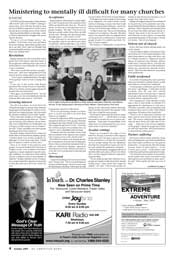
It was out of this resolve that Bergen launched the Living Room in September 2006; it is a Christ-centred support group for people with mood
disorders.
Once again, God surprised them. “In very short order, we were overwhelmed with the response that came from it,” said Dyck.
Growing interest
Nor did it stop there. As word about the Living Room began to spread, other
churches began approaching Bergen for help in forming their own support groups.
She responded by creating a manual, and a leader’s guide.
Three years later, Bergen is no longer sure exactly how many groups there are. “There’s one in Victoria, one in Surrey, one in Kerrisdale, two in Abbotsford, two in
Burnaby, one in Regina. I believe there’s one in Ontario,” she said. “There’s probably even more groups starting up than I have heard of.”
Recently, Bergen learned that a church in South Africa was interested in
starting a group. “I believe there’s one in New Zealand, too, although I’ve lost touch with them. I think they’ve opted to work it on their own.”
There is no doubt of the need for such groups. As a recent study by the
University of Calgary noted, over a million Canadians experience a major
depressive episode annually, making it “as common as other leading chronic conditions such as heart disease or diabetes.” Studies estimate one in 10 experience a major depressive episode at some point
in their life, and one in 20 in the course of a year.
Acceptance
Bergen believes what attracts so many sufferers to the Living Room is the
assurance they will be accepted for who they are. “We don’t advise, we don’t try to save [anyone] or to set people straight,” she said. “Our focus is to help give people a place where they can talk openly and – through the devotional time, through prayer – come closer to God.”
“One of the keys to our success is we’re in this together, and we care about each other on all levels,” said Lorraine Isaac, one of three Living Room co-facilitators at Highland
Community Church in Abbotsford.
“We’re not presenting ourselves as therapists, or in any way able to do more than
what we do together.”
Formed in September 2008, 43 people had attended at least one of the group’s biweekly meetings by the time it broke for the summer. They ranged in age from
17 to 85. “And only two of those people were actually from our church,” said co-facilitator John Konrad.
“It underscored the view that we have, that this is a ministry of the church to
the community as much as it is to the church itself.”
But while the number of groups has grown, the Living Room’s structure has not kept pace. It has a vision and mission statement, but no
office, no staff and no funding – apart from what Brentwood Park Alliance provides to cover the cost of producing
its manuals and brochures.
Movement
“I guess I’m leading it, but not in any formal way,” Bergen said. “We’re not policing how people run their groups. All we’ve done is put the information out there. What they do with it is up to them. We’re more of a movement.”
Yet Bergen sees some benefit in it becoming more organized. One option under
consideration is forming a society, but that would mean naming a board of
directors – and so far, she has not found people willing to serve.
“I’d like to have one. This is not something I want to do in isolation,” she said. “But they need to be onboard with our original intent of Living Room as
faith-based. Sometimes people wonder if it could be any faith. No. This is
Christ-centred.”
The leaders of Highland’s Living Room group, on the other hand, believe that keeping it a loosely
structured “movement” is the best way to help the most people.
“If you leave it open and don’t put too many constraints on it . . . I think there is a huge potential for
people all over to pick it up,” said Isaac. “Some of us,” Konrad added, “even think that to be faith-based does not necessarily mean it has to be
Christian.”
Continue article >>
|
Secular settings
Bergen too recognizes the value of non-believers having a mental health support
group. Recently, she gave a person in California permission to rewrite the
manual for use in a secular setting. Her one stipulation was that the Living
Room name was not to be used outside the permission statement.
But she said Christians struggling with mood disorders still need a place of
their own where they can find support without compromising their faith.
“In the small groups that churches have, people are fearful to talk about their
mental health issues. They think they might be judged,” she said. “And secular groups are fearful to talk about God, because a lot of people don’t take well to that.”
Perhaps the biggest obstacle the mentally ill in the pews face is the persistent
and widespread belief that their problem is essentially spiritual. “Most churches just [assume] that if you read your Bible and pray and go to
church, that surely is all you need to do,” said Warwick Cooper, pastor of counseling and family ministries at The People’s Church in Toronto. “But it’s not helping.”
Driven out of church
In fact, this may well be driving many out of the church.
A recent study by Baylor University in Texas found that out of 293 church
members who asked their pastors for help with their own or a family member’s diagnosed mental illness, 32.4 percent were told they “did not really have a mental illness, and that the cause of their problem was
solely spiritual in nature (eg., personal sin, demonic involvement).” They were also advised to stop taking their medications.
Faith weakened
As a result of hearing this, most said they were now less likely to attend
church, or that their faith in God has been weakened.
“I wish people would learn more from the Job story,” said Bergen. “I wish they would recognize that the way Job’s friends responded to him is not the way to respond [to people with mental
disorders]. And yet so many still do respond that way.”
One consequence of this attitude, Cooper said, is that it casts doubt on whether
it is appropriate for churchgoers to visit even a Christian counsellor, since
perhaps the only treatment they need is some solid biblical preaching. He
believes they need both.
“There’s a lot of depressed Christians out there, and we need to give them hope,” he said. “We need to walk people through this time [in their lives] and really take it
seriously. . . . That’s not a vote of non-confidence in the gospel. I think the gospel and Christ are
still very much alive. But [God] wants us to deal with the whole person.”
Pastors suffering
The irony is that in many churches, those who are battling the most with mental
illness and other major problems are the pastors themselves. Cooper knows this
first-hand, because many of these pastors – in the Toronto area, at least – would rather come to him than ask their denomination for help.
“I’m shocked at the number of denominational leaders who don’t even believe that their pastors have problems in these areas,” he said. “That’s pretty sad, but I see a lot of that.”
Cooper added: “Because we’re nondenominational, a lot of pastors who are struggling end up coming here.
Depression, marriage problems, family problems, addictive behaviour – that’s more prevalent than I’ve ever seen before.”
At the same time, Dyck is somewhat disappointed that despite the Living Room’s expansion into other churches, very few pastors have shown any interest in
finding out more about it. “To be honest,” he said, “I would’ve hoped that I would’ve heard more from other pastors than I have, but I haven’t really heard that much from anybody.”
Dyck is convinced that the key to changing the attitudes of pastors and churches
toward the mentally ill in their midst begins with raising public awareness.
“I suspect many pastors are simply not aware that on any given Sunday morning,
probably about 10 percent, if not higher, of their adult attenders will be
dealing with some kind of mental health issue or mood disorder,” he said.
“Nobody knows about it. So you start by recognizing that they’re there. That’s a step in the right direction to then being open to listening to them, and
hearing their story and going from there.”
October 2009
|