|
As the worldwide Boy Scout / Girl Guide movement
celebrates its 100th anniversary this year, BCCN offers Ed Hird’s reflections on the
organization’s faith-based foundation.
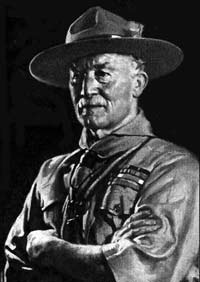 FROM the very beginning, Lord and Lady Baden-Powell
were committed to making a significant difference in the lives of young
people. FROM the very beginning, Lord and Lady Baden-Powell
were committed to making a significant difference in the lives of young
people.
They saw the effect of the 20th century’s
industrialized, urbanized society: the deterioration of physical health,
moral standards and self discipline.
Robert Baden-Powell – or B.P., as he is
affectionately known – returned from South Africa in 1903 as a war
hero. He had bravely defended the South African town of Mafeking, with only
a small band of soldiers, for 217 days.
During the siege, he used the boys of the town to carry
messages, offer first aid, and do other vital jobs. These boys, a prototype
of the Boy Scouts, played a vital part in saving the beleaguered town.
 The Boer War, as a whole, was a great embarrassment to
the English nation. Their troops performed poorly and inefficiently.
B.P.’s defence of Mafeking provided a bright spot in an otherwise
dark period. The Boer War, as a whole, was a great embarrassment to
the English nation. Their troops performed poorly and inefficiently.
B.P.’s defence of Mafeking provided a bright spot in an otherwise
dark period.
When B.P. returned to England, he was appalled at the
deterioration he saw in English youth. He described “thousands of
boys and young men – pale, narrow chested, hunched up,
miserable specimens, smoking endless cigarettes, numbers of them
betting.”
He was also concerned about the rampant sexual
immorality, resulting in disease, poverty and unwanted children. B.P. the
war hero wanted to use his popularity to help rebuild the vitality and
dynamism of young people.
The amazing popularity of his scouting movement
probably surprised him as much as anyone else.
Within one year after he wrote the best selling Scouting for Boys, more than
100,000 boys had already enrolled as Scouts. The movement quickly crossed
the seas to many countries around the world. King Edward VII was very
interested in scouting, and suggested B.P. give up his army career and
devote all his time to scouting worldwide.
He met the future Lady Baden-Powell on an ocean cruise
in 1912; Robert and Olave Baden-Powell were married in a quiet church
wedding that same year. The two formed a powerful alliance, which has
unforgettably shaped the character of countless young people throughout the
world.
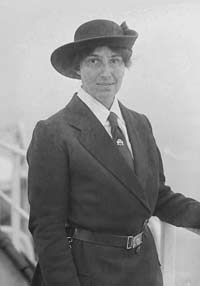
At Robert’s request, Olave took on the leadership
of the floundering Girl Guides. Under her capable direction, the guiding
movement exploded with new energy and growth. Thanks to this remarkable
husband / wife team, more than 17 million boys and eight million girls
worldwide are now involved in the scouting and guiding movements.
Continue article >>
|
Some people mistake scouting and guiding as merely
recreational diversions for rambunctious children. In fact, the
Baden-Powells considered recreation merely one of many tools to build
lasting character.
Robert saw scouting/guiding as “education in high
ideals, in self reliance, in sense of duty, in fortitude, in self respect
and regard for others – in one word, in those Christian
attributes that go to make character.”
Robert and Olave believed character could not be
imposed from outside. Character and self-discipline had to come from
within. Character building for the couple had a lot to do with
trustworthiness, honesty, loyalty, duty, responsibility, friendliness,
courtesy, thriftiness and moral purity.
They also believed the heart of character building came
from loyalty to God and country. That is why, in the very first part of the
Scout/Guide Promise, they included “doing one’s duty to
God.” They were both committed Christians.
Olave expressed her Christian commitment by serving as
godmother to more than 40 baptized children – a responsibility she
took very seriously. In her autobiography, she wrote: “If I have any
message to leave, it is this: believe in God. He guides and protects you
all through life.”
Robert, when dealing with conflicts within the scouting
movement, recommended that people “ask themselves the simple question:
‘What would Christ have done under the circumstances?’ and be
guided accordingly.”
Character building for Lord and Lady Baden-Powell was a
very spiritual activity. They were also impressed by the impact of taking
urban young people away from the city, and back to the great outdoors.
Robert saw camping as a golden chance to bring young
people to God through the direct appeal of nature’s wonders.
“Our aim,” he stated, “is to get hold of the boys and to
open up their minds . . . to make them into good men for God and their
country, to encourage them to be energetic workers and to be honourable,
manly fellows with a brotherly feeling for one another.”
Olave was equally impressed with the beauty of
God’s creation. She said: “1 am sure that God means us to be
happy in this life. He has given us a world to live in that is full of
beauty and wonders, and he has given us not only eyes to see them but minds
to understand them – if we only have the sense to look at them
in that light.”
In this centenary year of their creation, may the
inspiring example of the Baden-Powells encourage each of us to be more
thankful for the beauty of God’s world.
Ed Hird is rector of St. Simon’s Anglican Church
in North Vancouver, and author of Battle for the
Soul of Canada.
November 2007
|










