|
By Peter T. Chattaway
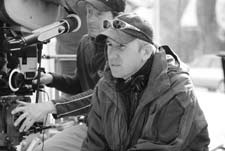 | | Director David Cunningham on the set of The Seeker. |
A CHRISTIAN filmmaker produces some independent films,
directs a couple of TV shows, and finally gets his shot at a big-screen
movie backed by a major movie studio. And what is his movie called? In the
case of David L. Cunningham, it is The Seeker.
The title may sound kind of spiritual, in some circles
at least, but the film is actually based on an award-winning
children’s fantasy novel by Susan Cooper called The Dark is Rising – and that
used to be the movie’s title, until the studio changed it just a few
months before release.
Cunningham, speaking on a cell phone from Hawaii after
dropping one of his daughters off at school, says the original title
wasn’t working with test audiences. “Everybody was interpreting
that as a horror film or something that wouldn’t be appropriate for
families,” he says, “and so it was changed to The Seeker – which is
really the theme of the show.”
The movie concerns an American boy living in England
who discovers, after his 14th birthday, that he is destined to take part in
a cosmic battle between Light and Dark. The boy, Will Stanton (played by
Vancouver native Alexander Ludwig), has to travel through time and
‘seek the signs’ which will help him to defeat a villain known
only as The Rider (Christopher Eccleston).
Cunningham knows a thing or two about living in foreign
environments. His parents, Loren and Darlene Cunningham, co-founded Youth
With A Mission in 1960 and the University of the Nations in 1978 –
and the younger Cunningham, who was born in Switzerland in 1971, has been
to more than 130 countries.
Cunningham made a handful of short films and
documentaries before turning to feature films. The first, Beyond Paradise (1998), featured a
cast of unknowns and took place in his home state of Hawaii; but his
second, To End All Wars (2001), starred Kiefer Sutherland and Robert Carlyle in a
true story about Allied prisoners in a Japanese camp during World War II.
To End All Wars dealt with
matters of faith and belief, but it also sparked some discussion in
Christian circles because it had a fair bit of profanity, too. However,
Cunningham says the language and the violence, which earned the film an R
rating in the United States, were essential to the story he was trying to
tell.
“I make movies that I’m passionate about,
and whatever that particular subject may be, I try to be honest to it and
to the spirit of what that is,” he says. “And in the case of To End All Wars, the subject was
suffering and forgiveness in the context of suffering, in the middle of an
awful situation – terrible, terrible circumstances – and how
they chose on a daily basis to forgive their enemies, and the
transformation that took place. And so it was important to show the reality
of that aspect, and for the film to be as intense as it was for that
message to get across.”
Continue article >>
|
Some of Cunningham’s next few projects –
including the mini-series Little House on the
Prairie (2004) and the Moscow-set thriller After . . . (2006) (the
latter of which was written by Abbotsford resident and occasional BCCN contributor Kevin Miller
– passed without incident. But controversy dogged his steps again
when he directed The Path to 9/11 (2006), an Emmy-nominated mini-series which was
criticized by some for its portrayal of the Clinton administration.
Cunningham says he tried to show the “unvarnished
truth” of what both the Clinton and Bush administrations did, or
didn’t do, prior to the September 11 attacks – but the film has
never been released on DVD, partly out of concern that it would harm
Hillary Clinton’s presidential campaign.
“A lot of people want to see the film,”
says Cunningham, “and it’s too bad that people are being
influenced by politics and not letting people think for
themselves.”
The controversy over that series led some people to
accuse Cunningham and his parents of trying to smuggle a right wing agenda
into Hollywood. There were even death threats.
“People went to my bios on the internet, and
changed them to make it look like I was some radical nut and my parents
were snake handlers, and it got out of control,” says Cunningham.
For his next project, he turned to something lighter: The Seeker, a young-adult fantasy
which had been developed by Walden Media, the firm created by Christian
billionaire Philip Anschutz to produce movies based on popular
children’s stories such as The Chronicles
of Narnia and The
Bridge to Terabithia.
“I wanted to make this one because I have three
kids now,” says Cunningham. “I wanted to have something that my
kids could go and see. But it also has a good message. It’s a fun
fantasy adventure movie, but it also says something about making good
choices. When you do make a choice, whether it’s right or wrong, the
implications of that choice go well beyond you.”
The film, distributed by 20th Century Fox, opened to
mixed reviews and lower-than-expected box office returns October 4 –
a fact Cunningham chalks up to the unexpected success of another family
film, The Game Plan,
which opened just one week before. “That really took a lot of the
market,” he says. “It was also a tough weekend all the way
around. But this is a difficult, tricky and flaky business, and you never
know what’s going to happen.”
But Cunningham says he will continue to “mix it
up,” producing films in a variety of genres and working in both
mainstream film and independent cinema. “I’m not going to rule
anything out,” he says. “At this point I’m just hanging
out with the family. I’ve had four or five pretty intense years of
back-to-back movies, so I’m just getting my batteries charged right
now.”
November 2007
|