|
By Jack Krayenhoff
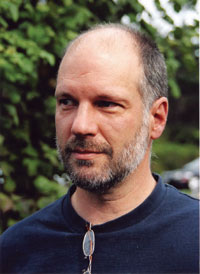 | | Robert Fitterer |
THE BAPTISTS are closing in on the University of
Victoria.
At the south end, Emmanuel Baptist has always had a
special interest in students – in fact, it was built at its present
location at the Henderson Street entrance to UVic, specifically to serve
the campus community. The appointment of Dr. Robert Fitterer as lead pastor
has greatly intensified that focus.
And now Arbutus Christian Fellowship – which
also belongs to the Baptist Union of Western Canada – has moved
closer to the north end of the campus; this is most convenient for the
students who make up 70 percent of the congregation. It found a home at the
Maria Montessori School (formerly Fairburn Elementary).
“Now we can grow,” says John Schaper, the
pastor. “The gym can seat 300, and with three classrooms we can also
offer Sunday School, a nursery and other ministries.”
How do these two pastors see the specific needs of
students, and how do they meet them?
BCCN went to quiz both
Fitterer and Schaper and found they agreed that the main needs are two. One
is to welcome the students – make them feel at home, and cared for,
and provide a community that can take the place of the home church they
left behind.
The other need is to help them meet the challenges of
the secular and intellectual campus setting.
Education of Christians, and of Christian students in
particular, is the great passion of Robert Fitterer. His experience in that
field – witness his work to launch a Christian community college in
Victoria – was the main reason he was initially called to Emmanuel
Baptist.
“I have a deep interest in connecting with
students on an intellectual level,” he says, “to help them
integrate their studies with a Christian world view.”
Already he is establishing a firm connection with
William Carey Institute, the undergraduate school formed by
Vancouver’s Carey Theological College. Within this framework,
Catherine Scambler, of UVic’s Law Department, will offer a course
called ‘Global Justice and Reconciliation’ at Emmanuel in
January.
Fitterer hopes such Christian worldview courses can be
taken by UVic students as electives which could be transfer-credited to
their B.A. programs. That way, they would cost the students no extra time
and effort.
These arrangements are not yet in place; but, given the
necessary negotiations, he sees them now as “quite
plausible.”
The need for such courses for Christian students is
great, says Fitterer. “The biggest challenge we face is safely
transitioning young students from their childhood theology to an adult
understanding of their faith. You have no idea how often a 19 year old will
walk into a biology class with a 10 year old’s understanding of
origins and human nature, and get it shot down in five minutes by a
professor. He then thinks his Christianity has been shot down. It has not,
but it needs to mature.”
Continue article >>
|
Another key factor is the understanding of biblical
hermeneutics, or the principles of interpretation.
“For instance,” says Fitterer, “a
discussion about the Darfur genocide will raise tough questions by a
professor, saying the God of the Old Testament ordered Israel to commit
genocide on the Canaanites. Here the student, who has grown up with a sense
of the Bible as authoritative, thinks he has to believe either in a
storybook Christianity, or else decide his faith is not true. But instead,
he has to learn that God is too big to be defined; human language is
inadequate. To reveal the metaphysical Actor behind history, you need
people, stories, parables.”
Meanwhile Schaper, at Arbutus Christian Fellowship,
also aims to equip the students to survive on campus with their faith
intact.
At the moment, he is doing a series of messages on the
theme ‘Being a Christian in a non-Christian world.’ In
addition, he runs a course called ‘Truth Project,’ a study
produced by Focus on the Family which deals with the issue of objective
truth – the existence of which is widely doubted in today’s
society.
He finds students are vitally interested in how they
can lead a holy life.
“There is a realness about them,” he says.
“They don’t want to play church, they want the authentic thing.
They display a hunger for the Lord that I have not seen in older people. It
is extremely refreshing.”
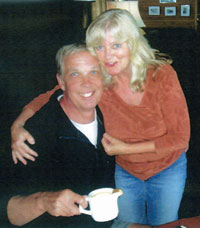 | | A heart for students: John and Lynne Schaper. |
Schaper clearly enjoys students greatly.
“It’s fun,” he says. “I’ve come to appreciate
them tremendously.”
No doubt, that sort of attitude attracts the students
to his church. Of himself, he says: “I am not an intellectual. The
reason students keep coming is not the brilliant messages, but the love and
acceptance they get.” For this, Schaper gives the credit to his wife,
Lynne.
“My wife is a wonderful, welcoming woman,”
he says. “A lot of them look on her as a mother. She gives them a big
smile and a hug. I myself did not used to be like that; but she has taught
me, and others in the congregation as well.”
At Emmanuel, the students find this welcoming in the
form of free Tuesday night dinners.
“As I was focusing on the educational
aspect,” Fitterer says, “God began something new in the
relational area. Two years ago it began as a small dinner, and now it has
grown to 400 students that are bursting the seams here every week.
It’s a massive potluck, put together by the whole congregation as a
selfless act of grace and hospitality.”
And what are the fruits of this prodigious effort?
Fitterer explains that it is pre-evangelism, and says it goes a long way
toward softening the cynical attitude many non-Christians have toward
churches. It demonstrates a loving, serving Christian community in action.
“It works,” he says. “Last year,
students from the music department put on a thank you concert. A barber
shop quartet – none of them Christians – actually learned three
hymns to sing for us!”
The fact that Emmanuel’s members
‘walk the walk’ is also a great help to Christian students, who
can now take their friends to a place which illustrates what they have been
talking about. “It has opened up opportunities for relationships that
are fantastic. You have to know that [some] of the students that come are
not Christians,” Fitterer concludes. “It’s a huge
blessing.”
November 2007
|