|
BCCN’s series of faith profiles marking the 150th
anniversary of the founding of B.C. continues, with the story of one of the
province’s more astute politicians. Taken from Canada: Portraits of Faith (Reel to
Real), edited by Michael Clarke.
By Bob Burkinshaw
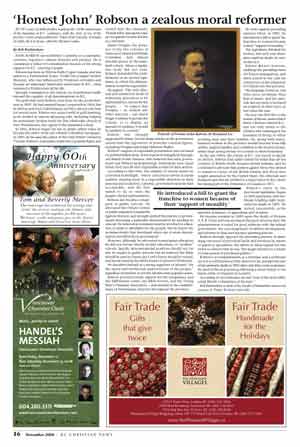
JOHN ROBSON served British Columbia as a journalist,
reformer, legislator, cabinet minister and premier. He is considered a
father of Confederation because of his strong support for B.C. entering
Canada.
Robson was born in 1824 in Perth, Upper Canada, and was
raised in a Presbyterian home. Unlike his younger brother Ebenezer, who was
influenced by Wesleyan revivalists and became an important Methodist
missionary in B.C., John remained a Presbyterian all his life.
Strongly committed to his church, he nonetheless loudly
stressed the equality of all denominations in B.C.
The gold rush lured Robson west from his dry goods
business in 1859. He had married Susan Longworth in 1854, but he left her
and their child behind, and they did not join him for several years. Robson
was unsuccessful at gold panning, so he worked at various labouring jobs,
including helping his missionary brother build the first Methodist church
in New Westminster, the capital of the mainland colony.
In 1861, Robson began his rise in public affairs when
he became the editor of the city’s British
Columbian newspaper. In 1869, he became the
editor of the Daily British Colonist in Victoria. Robson’s journalism made him a popular
figure and earned him the nickname ‘Honest John’ among his
readers; he quickly became known as a reformer.
James Douglas, the governor of the two colonies of
Vancouver Island and British Columbia, had almost absolute power in
the mainland colony, where a legislative body did not exist. Robson
demanded the establishment of an elected legislature, to which the
administration would be responsible.
He argued: “The only effectual and satisfactory
mode of redressing grievances is by representatives, chosen by the people .
. . To expect that Douglas – or, indeed any other autocrat
– can much longer continue to govern the Colony, is to display
an amount of verdancy it would be prudent to conceal.”
Robson was strongly supported by many, but his sharp
attacks on the government earned him the opposition of powerful colonial
figures, including Douglas and Judge Matthew Begbie.
Robson’s support of responsible government was
not based on political beliefs alone. It was typical of evangelicals
throughout British North America, who believed that such government had
biblical underpinnings: individuals were equal before God, and all were
responsible to him for their actions.
According to this view, the stability of society rested
on converted individuals – whose consciences served as moral rudders,
steering them in a responsible direction in their personal and social
lives. Likewise, government must be held accountable, and the best suited
to do so were the peoples’ elected representatives.
Robson also became a champion of public schools. He
advocated the Ontario system of public education founded by Egerton
Ryerson, and strongly resisted the practice of governments favouring a
particular denomination by funding its schools. He believed government must
be involved in education to make it affordable for the people, but he
feared the sectarian rivalry that developed when one or more denomination
benefited from government.
However, although he advocated nonsectarian education
he did not favour strictly secular education, or “godless”
schools. Specific denominational positions should not, he felt, be taught
in public schools; but he believed the Bible should be used in classes, the
Lord’s Prayer should be recited, and moral training should be based
on general Christianity.
He described himself as a strong supporter of reforms
“for the moral and intellectual improvement of the people,”
regardless of whether or not the reforms were popular causes.
Continue article >>
|
Robson provided steady support for the temperance and
the Sabbatarian causes, the Bible Society, and the Young Men’s
Christian Association – and assisted in the establishment of
Presbyterian churches throughout the province.
He went against prevailing opinion when, in 1885, he
introduced a bill to grant the franchise to women because of their
“support of morality.”
The legislature defeated his motion; but each year
thereafter, until his death, he reintroduced it.
Robson did not, however, challenge the prevailing views
of Chinese immigration, and often joined in the calls for restrictions on
the admission of Chinese into the province.
His language, however, was often more moderate than
that of many, and his rationale did not seem to be based on a hatred of
other races, as was often the case.
His fear was that the coolie system of labour, under
which many Chinese entered B.C., was not only unfair to the Chinese but
endangered the standard of living of white working men and their families.
He, along with many, believed workers in the province should become bona
fide settlers, support families, and contribute to the local economy,
rather than saving money for a return to their homeland.
In the late 1860s, the colony of B.C. was forced to
decide its destiny. Robson had earlier stated his belief that all the
colonies of British North America should federate, and he continued to
advocate that position against those who desired to remain a colony of the
British Empire and those who sought annexation by the United States. His
editorials and eloquent speeches are credited as a major factor in the
colony becoming part of the Dominion of Canada in 1871.
Robson’s career in the provincial legislature
began in 1866 and lasted, with two breaks totalling eight years, until his
death in 1892. He served, successively, as the minister of finance, of
agriculture and of mines.
He became premier in 1889 upon the death of Premier
A. E. B. Davie and was serving in that post
when he died. His administration is noted for good relations with the
federal government, the encouragement of railway development, and reforms
in land and resource granting policies.
Robson strongly opposed the prevailing practice of
alienating vast tracts of provincial lands and resources by means of grants
to speculators. His efforts in these regards led one writer to observe that
he was “the single reformer in a dreary 15-year period of provincial
politics.”
Robson’s accomplishments as a reformer and a
politician are not as well known as they deserve to be, perhaps because of
his untimely death in 1892 after only three years as premier. He died of
blood poisoning following a minor injury to his hand, while on business in
London.
According to one historian, he was “one of the
most influential British Columbians of his time.”
Bob Burkinshaw is dean of the faculty of humanities and
social sciences at Trinity Western University.
November 2008
|