|
By Steve Weatherbe
ST. MARY’S parish in Metchosin continues to serve
as a handy window into the divided world of Anglicanism.
Earlier this year, when most of the parishioners voted
to exit the Anglican Church of Canada (ACC) over the latter’s
acceptance of homosexual relations, they were forced from the
building.
Early in October, no longer housing dissidents, St.
Mary’s hosted the synod of the Diocese of British Columbia,
comprising all of Vancouver Island.
The delegates heard details of a planned downsizing
that could see one Victoria parish closed and eight more merged, while
up-island, four more await the same fate.
Meanwhile, many of those exiled from St. Mary’s
attended a meeting at the Cridge Centre in Victoria, along with other
Anglicans unhappy with the ACC’s interpretations of moral theology.
They were there to hear about the plans of Anglican
traditionalists worldwide to form a new communion with like-minded
churches in the Third World.
In Metchosin, Bishop James Cowan told the 200 delegates
that shrinking attendance at many churches had led to plans for closure or
merger.
Named for closure in the Victoria area was St.
Alban’s, while merger was bruited for All Saints and the Church of
the Advent; St. Columba’s and St. Martin in the Fields; St.
Mary’s and St. Stephen’s; and St. David by the Sea and an
as-yet unnamed partner.
Up-island, All Saints Crofton was designated to join
with St. Michael & All Angels in Chemainus, while Nanaimo’s St.
James was slated to merge with St. Paul’s.
However, the ink was barely dry on published reports of
the synod when the diocese announced that the plans were tentative, not
final. Nonetheless, it has been understood for several years that there
would have to be a shrinkage in the Vancouver Island infrastructure, due to
membership loss.
Cowan commented that the church had acted too long as
if people would come to its parishes on their own; what was needed was
evangelism.
Amen to that, was the word at the Cridge Centre
– appropriately enough, named after the 19th Century Anglican
bishop of Victoria. Edward Cridge had led his congregation out of the
church when it appeared to be falling under the influence of Tractarians,
an abortive movement to rejoin with the Catholic church.
Cridge joined the Reformed Episcopal Church
– whose current bishop, the Right Reverend Charles Dorrington,
spoke at last month’s presentation about a meeting of
traditionalist Anglicans in Jerusalem during the summer.
Continue article >>
|
The Cridge meeting was organized by the Anglican
Network in Canada (ANiC), a group of 21 congregations across the country
that have left the Anglican Church of Canada over the blessing of
homosexual unions.
The group has its own bishop and operates currently
under the oversight of the bishop of South America; but the news from the
Jerusalem event – the Global Anglican Future Conference (GAFCON)
– was that something more permanent is in the works.
There were more than 1,000 participants, most from the
Third World; but many members of biblically conservative groups came, from
Canada, Great Britain, the U.S. and elsewhere in the Commonwealth
– some new, and some as old as Dorrington’s Reformed
Episcopal Church.
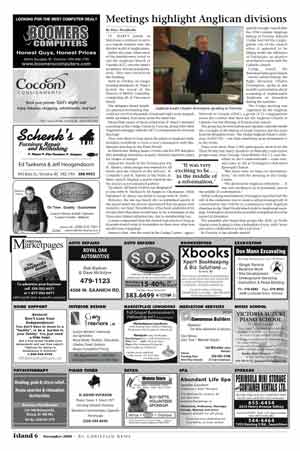
“But there were no lines, no
denominations,” he told the meeting at the Cridge Centre.
“We all stood for Anglican orthodoxy . . . It was
very exciting to be in Jerusalem, and in the middle of a
reformation.”
While nothing was finalized, Dorrington reported that
the will of the conference was to create a self-governing body of
conservatives who will be in communion with Anglican churches in the Third
World which hold to traditional teachings. Dorrington stressed the powerful
evangelical mood he sensed in Jerusalem.
The assembly also heard that groups like ANiC in North
America were hoping to form a federation of sorts, with “more and
more collaboration at the local level.”
In Victoria, it has already started.
November 2008
|