|
By Frank Stirk
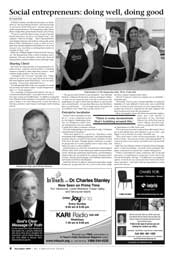
JOANNE Laubach and Brenda Snowden see themselves as “the most blessed women” with the best jobs of anyone in North Vancouver – because their non-profit catering business, The Banqueting Table, allows them to
help other, less fortunate women earn a living.
“We get to work with these women, we get to become friends and sisters, we get to
encourage them,” says Laubach. “And even though . . . there’s ups and downs and disappointments and sadness, and people going back to their
old behaviour, every so often we see a light that just gets brighter and
brighter in one of our women’s eyes. And there is nothing that would ever compare to that – ever.”
Based out of Hillside Baptist Church in North Vancouver, The Banqueting Table is
both a business and a ministry. Like any enterprise, clients pay them for their
products, and the workers receive an hourly wage.
Sharing Christ
But while the usual priority of businesspeople is to make money, Laubach and
Snowden’s overriding mission is instead to share with these women – most of them single mothers – the love of Christ.
“Catering’s a bit of a front,” Snowden says. “That’s what we do and love to do, and I think we do it well. But what happens inside
that kitchen – or in our truck, traveling – is way more important for us.”
The Banqueting Table is just one example of a small but growing movement called “social entrepreneurship,” or “social enterprise.”
It is a marriage of business and mission: the use of entrepreneurial principles – by people whose motivation may or may not be faith-based – to address a social problem. Whether their enterprise is non-profit or
for-profit, the goal is always to be more-than-profit, in that the desire of
having a positive social impact outweighs solely making money.
“The general idea behind social enterprise,” says Michael Hodson, visiting professional in residence at Regent College, “is that you are using the sale of goods or services in the marketplace in order
to fund other products or services that have a social benefit – or to produce them in a way that [they] have a social benefit . . . Or you might
just be doing the job in a different way, which has a social context to it.”
Enterprise incubator
Hodson will be speaking November 13 – 14 at a conference hosted by the Regent’s Marketplace Institute. It is designed to assist Christian entrepreneurs who
are seeking to apply their faith to business ventures.
He is also helping Regent develop what it calls a “Christian Social Enterprise Incubator.”
“That was a signal to us – a good one – that there is some momentum that’s building around this,” says David Holcumb, program director of JustWork Economic Initiative in East
Vancouver. He adds: “Perhaps Regent could serve as a place for groups like us to come together and to
share ideas, and share successes as well as failures.”
JustWork grew out of the life of Grandview Calvary Baptist Church. Since 2006,
it has started four small non-profit businesses: landscape gardening
(JustGarden): potterymaking, which makes use of a studio in the church’s basement (JustPotters); catering (JustCatering); and building maintenance and
small renovations (JustRepairs).
JustWork finds its workforce among its immediate neighbourhood – people who live on or close to the street, single mothers, refugee claimants
and others.
“About 70 percent of those we employ are on disability,” Holcumb says.
“Obviously, if you’ve got a mental disability or a physical disability, it’s very difficult to find work. And so JustWork exists to help provide that kind
of work opportunity for people who need it to supplement the basic support that
they would receive from the government.”
Often, the benefit to those who find even part-time employment goes well beyond
a paycheque. In fact, Snowden believes one of the best ways to restore dignity
and self-confidence to people who have fallen on hard times is to offer them a
job.
“We’ve got one mom that comes in from Abbotsford. We’ve got moms taking buses and Seabuses to get to work – and happy to do it, because it’s work,” Snowden says.
“They don’t have to have all the prerequisites. We train them to work – show up, be on time, dress appropriately. ‘If you know how to cut a carrot,’ we used to say, ‘you can work with us.’”
Julie Toh, the Christian owner of Charisma Events Management, a Vancouver-based,
for-profit social enterprise that plans conferences for clients, has a similar
hiring policy.
“When I need help for a large conference, like set-up and tear-down, I would
bring in contractors I work with in the Downtown Eastside,” she says. “I wouldn’t go to a recruitment agency. As much as I can, I try to get some women who have
some experience – and I give them an opportunity to come and work with me.”
Eco-friendly
Toh also encourages clients to make choices that are more eco-friendly. “When you attend a conference, you just get a lot of stuff,” she says. “I would suggest to my client: instead of a paper bag, use a cloth bag. And
instead of hand-outs, give a DVD or a memory stick. I don’t like using foam cups – or paper cups, even.”
While the ‘social enterprise’ label may be relatively new, this impulse on the part of Christians – to come alongside the poor and the hurting, and to be good stewards of God’s creation – is as old as the Bible. It has resonated in various ways and at different times
throughout history. And the prospect that its time seems to have come again
gives Holcumb hope.
Continue article >>
|
“It’s not a new concept, but the term – and the way in which it’s packaged – is new, at least in the past 20 years or so,” he says. “There’s been a new recognition that this is a model and an approach that makes sense – not just for faith-based organizations, but across the board.”
“The people in the Christian community who are concerned about this are . . .
trying to put together a theological basis for this,” Hodson says. “The Roman Catholic Church has had a lot of social teachings for a long time. We
want to try to build on that, and maybe go back to our roots in the Reformation
and before then, as well as the Christian Socialists.”
And yet Hodson notes that most social enterprises today are not faith-based – for several reasons, not the least of which is the decline of the church’s influence in society.
“You have,” he says, “the rise of NGOs [non-governmental organizations]. You have people turning to
various social causes . . . and looking for alternative ways of doing things.
You have government discovering that charities are often more efficient at
delivering what it is that government wants to deliver. And you’ve got people looking for an alternative to capitalism, which they think isn’t working.”
One Vancouver example of a successful non-faith-based social enterprise is The
Cleaning Solution, a janitorial service started with help from the Canadian
Mental Health Association in 2004. Its purpose, stated online, is to provide “individuals recovering from mental illness with a path back to the mainstream
workforce, enabling them to rebuild their confidence, sense of purpose and
quality of life.”
Corporate responsibility
Also informed by the same social values is ‘corporate social responsibility,’ an awareness by the business community of the need to be more involved in the
betterment of society, but without what Hodson calls the “commercial tinge” of social entrepreneurship.
“Definitely, it’s a huge, huge trend,” says Richard Goossen, director of the Centre for Entrepreneurial Leaders at
Trinity Western University’s School of Business.
“In the past,” he says, “people would think, ‘If I’m a good guy or [run] a good company, I’ll give money.’ Whereas today, we’re not really talking about just being a donor. But rather, social
responsibility would mean recycling, biking to work, good workplace conditions,
work-life balance, giving time, initiating projects – a whole range of things.”
Goossen is the founder and CEO of MakeGood, a web-based company that helps
clients publicize more effectively their socially responsible activities. “Rather than the company talking about what it’s doing, the information is actually inputted by the charities they’re working with,” he says. “It’s a third-party portrayal of what a company is doing.”
But Hodson is skeptical. “It’s very difficult to tell companies that have corporate social responsibility
programs in order to improve their image and get better sales in the market,
from some organization where the principal objective is not making a profit but
helping a social cause,” he says.
Toh adds, “When you talk about sustainability to the business community of Vancouver,
people think about the environmental side of it straight away, but not the
social part of it. So we still have a lot of work to do on that part.”
Given the complex nature and the internal politics of corporations, Hodson is
not surprised that they remain largely uninfluenced by social entrepreneurship.
But that puts the onus on the small business sector to grow the fledgling
movement, even though it is ill-equipped to take up the challenge. “It’s a sad fact of life that smaller companies tend to be less efficient on the
whole. And the smaller you are, the more difficult it is to be philanthropic
and let some of your profit go to somebody else,” Hodson says.
“So all the more power and credit to the ones that do, and to the people who put
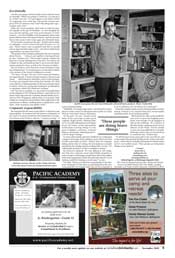
their livelihood into small social enterprises – where they’re probably getting below-market wages, and it’s not terribly secure. These people are doing brave things, in my opinion.”
Contact:
justwork.ca
makegood.com
charisliving.com
cleaningsolution.ca
hillsidebaptist.ca/thebanquetingtable.html
The Centre for Entrepreneurial Leaders will present Richard Goossen and Shell
Canada CEO Clive Mather, speaking November 4 at Trinity Western University.
Call 604.513.2035.
November 2009
|