|
By Lloyd and Edna Mackey
VISITING a cluster of sites sacred to Christendom was high on the agenda a few
weeks ago, for 19 American and Canadian faith-based journalists – who were guests of the Jordan Tourism Board.
Among the sites related to both New and Old Testament events were:
Umm Qais, the place where it is believed Jesus cast demons from a deranged man, and
directed them into a nearby herd of swine. The animals immediately plummeted
over a cliff to group suicide, probably in the nearby Sea of Galilee.
Mount Nebo, where Moses is believed to have viewed the land west beyond the Jordan River.
According to biblical records, that land had been promised to the
desert-wandering Israelites. Moses died at Nebo, and the task of actually
leading the people across the Jordan and into Jericho fell to Joshua. The
present day town of Jericho is clearly visible from the Moses Memorial at Nebo.
Bethany Beyond the Jordan, just north of the Jordan’s outlet into the Dead Sea. This site is commonly recognized as the place where
Jesus was baptized by John the Baptist. At one time, it was a backwater to the
Jordan – and, for hundreds of years, was a favourite baptizing site for Christians of
various stripes from the area.
In recent years, irrigation and climatic conditions have shrunken the Jordan to
one-third of its size, and the backwater is as dry as a bone. But the site
contains the ancient steps to the water used by the baptismal candidates, and
the ruins of three different churches from various eras.
We saw other sites as well, which have significance to the three Abrahamic
faiths which populate the Middle East – or West Asia, as Jordanian Prince El-Hassan BinTalal prefers to call the cluster
of nations that surround Jordan and Israel.
While Christians are very much in the minority in Jordan (which is considered 95
percent Muslim), their history – relating to Roman, Byzantine, Orthodox and, more recently, Catholic,
Presbyterian and evangelical influences – helps to shape the pilgrim’s view of the antiquities in such places as Petra.
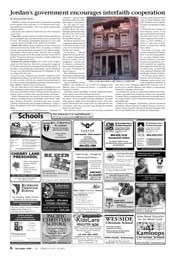
Indeed, ask the average North American – Christian or otherwise – about Jordan, and Petra will be the name that jumps to recognition.
For the past 60 years, evangelical Christians have learned about the place
through materials like Petra, Rose Red City of the Dead, produced by the iconic Moody Bible Institute.
And those less tied to the evangelical culture learned of the place because it
was a key set in Indiana Jones and the Last Crusade.
Government officials helped our tour group trace the complex relationships
between Jordan and its neighbours – and the role its religious communities play in monitoring and, to an extent,
brokering, the quest for peace.
Prince El-Hassan, uncle to the present Jordanian king, held a 90–minute briefing with our group.
A good summary of that briefing – put together by one of our tour colleagues, Jack Haberer, editor of Presbyterian Outlook – is available at that magazine’s website.
Continue article >>
|
Jordanian senator Akel Biltaji concisely detailed the history of the region, from the Jordanian viewpoint.
Evident in the senator’s presentation was the way in which his nation – more accurately, his king’s kingdom – has dealt with massive refugee issues through the years. They have helped
Palestinians who could not be accommodated in the West Bank – and, more recently, Iraqis fleeing the wartime tension in that nation.
The structure of the tour was such that the journalists received a clearer
picture about ways in which Muslims, Jews and Christians work together in
Jordan and among its neighbours.
If there was any message we were meant to receive, it was that we should be more
mindful of the best way for Christians to approach the world of Islam: to allow Muslims, in effect, to ‘put Jesus in their hearts’ on terms that will fit their culture.
That seems to be why, even among evangelical Christians, there is an increasing
emphasis, in many Muslim-dominated countries, to let these things work
themselves out – with relatively less emphasis than might have been the case in earlier years, on
inducting Jesus-oriented Muslims into specifically Christian churches.
We did hear reports about a Baptist school in Amman, the Jordanian capital,
where over 1,000 students are enrolled. As well, one of our colleagues talked
with someone who is involved in a satellite ministry that helps to communicate
indirectly to Muslims about Jesus.
In assisting the group to understand Middle East Christianity, especially in the
Jordanian context, our tour leader, Christine Moore, paraphrased a
Bedouin-descended Christian, Issam Ghattas, owner of the first Christian
bookstore in the Middle East.
Ghattas told a colleague: “Christianity, in Rome, became an institution. When it spread throughout Europe,
it became a culture. When it went to America, it became a business. But, here
in the Middle East, it is still about relationship.”
November 2009
|