|
By John Cody
 As U.S. head of the Beatles’ Apple Records, Ken Mansfield had a ringside seat to one of the greatest shows on earth. As U.S. head of the Beatles’ Apple Records, Ken Mansfield had a ringside seat to one of the greatest shows on earth.
That position alone would qualify for a lifetime worth of anecdotes, but there’s far more. As performer, club owner, artist manager, producer, roadie, songwriter and label executive, Mansfield has had first-hand experience in pretty much every facet of the music business.
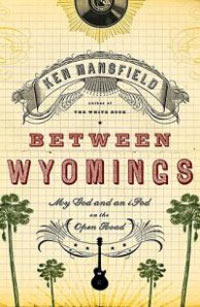 Over the course of three books – including the just released Between Wyomings - he’s told his story. In addition to the pertinent musical exploits, each details an equally fascinating personal journey; as an adherent to Ayn Rand’s Objectivism philosophy, following a worldly Indian Guru, and an eventual whole-hearted embracement of Biblical Christianity.
It all started in Lewiston, which he describes as a “small, smelly town in Northern Idaho.” As far back as he can remember, records were in his blood.
“We had a little record store that I would go into from the country. They would get just so many records a week, and if a record with a guitar came in, he would set them aside, and I would buy ‘em automatically. I was just in love with the guitar; I was a guitar nut. The first record I ever bought was a Chet Atkins record: ‘Crazy Rhythm’ - the back side was ‘Hybrid Corn’ on that one. The second was Les Paul’s ‘How High the Moon.’”
Initially, his purchases were restricted to country music. “Where I grew up, there was nothing but country. It was in the night clubs and on the radio. You never heard anything except Roy Acuff and Eddy Arnold and Ernest Tubb and Lefty Frizell. That’s all you heard.”
By the time he started high school, listening habits had broadened considerably, and country took a backseat to more sophisticated fare. “Our rebellion music was jazz. For us teenagers, as we grew up in the ‘50s, that was our music.”
As exciting as big band, swing and be-bop might be, when rock ‘n’ roll burst onto scene in the middle of the decade, even jazz seem tame by comparison. “I graduated in ’55, and the music and the song that actually broke us loose and freed us - was just everything - was Bill Haley and the Comets’ ‘Rock Around the Clock.’”
The song topped the charts for eight weeks the spring/summer of ’55. “That was as stunning as anything; we had never heard anything like that.”
He was determined to leave home as soon as possible, and there was only one destination in mind: Southern California.”It was those pictures you’d see of the surf and the sand and the pretty girls; everything just seemed so sunny and happy and warm. I grew up just below the Canadian border, so the idea of being some place warm really appealed to me.”
There were few options as to how to get there. “For me to escape - and this is the way most of us escaped out of there - is we joined the service. So, 17 years old, I joined the Navy, and I got put on an airplane in Spokane, Washington. I was wearing this big heavy wool clothing and it was eight below zero.
“I got off the plane in San Diego, and it was 78 degrees. I see all these people in shorts and tank tops, and I go, ‘Whoa!’ I got off the plane, and I’d say within eight blocks, I was a Californian. I was there forever.”
After being discharged from the Navy, Mansfield attended San Diego State University, earning a Bachelor of Science in Marketing.
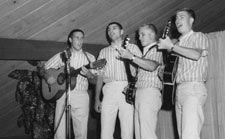 | | Town Criers (Mansfield on left) |
He put together a vocal quartet, the Town Criers, with fellow students in 1962. It was his first taste of the entertainment business up close. They quickly gained a following, and even released an obscure single on Fred Astaire’s record label, before an ill-fated performance brought about the group’s demise.
“We were supposed to replace the Limelighters at RCA, and we blew the audition. What had happened was the Limelighters were breaking up, and so RCA wanted to plug a group into that spot. We were really hot on the west coast at the time, and they had heard about us. Whoever had seen us locally had arranged for us to come into the Troubadour and do a set, and they flew in everybody from New York. It was a pretty big deal to replace the Limelighters; they brought in all the executives for that.”
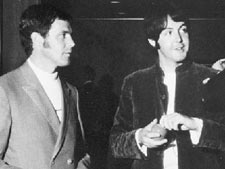
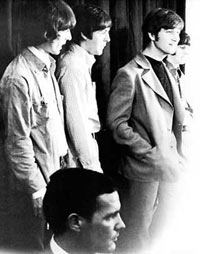 | | Mansfield with the Beatles in '65 |
The Town Criers were in the middle of a road trip at the time. “We were doing a big tour with Hal Ziegler [Hal Ziegler’s 1963 Hootenany Tour] and we were up in Salt Lake City the night before. We flew in from Salt Lake City, and the lead singer got a cold and his ears plugged up. We sang kind of like the Four Freshman or the Modern Folk Quartet - four part harmonies, that kind of a thing, and Tom’s having trouble hitting his notes and singing his lead parts, because he has the high part in the group.”
To make matters worse, there were serious technical difficulties. “We got on stage - we worked off four mikes - and two of the mikes were dead. But they were live in the stage monitors. We thought we were singing well, because we were hearing ourselves. But the audience was only hearing two of the four voices. About two songs in, nobody’s liking what we are doing. We just can’t figure it out, so then we start fading apart. When we got done, we looked out and all the people - the [William] Morris agents -just got up and walked out the door. They didn’t even come up, or say ‘nice to meet you.’ Not even saying ‘good-bye.’ At that point we were so disenchanted,” Mansfield laughs, “we ended up breaking up. But that’s the music business.”
Weathered and wizened, he decided to switch gears, and opened a night club back in San Diego. The Land of Oden became a popular stop for folk and blues acts, and led indirectly to his next opportunity.
With experience on both sides of the stage – plus a degree in Marketing – he was offered a position in the promotions department of Capitol Records, one of the biggest labels in the business.
From legends like Judy Garland, Bobby Darin, Al Martino, Lou Rawls, Nancy Wilson and Glen Campbell, to Peter & Gordon, the Beach Boys, and the Seekers, plus later acts like The Band, Bob Seger, Quicksilver Messenger Service and Steve Miller, Mansfield worked with pretty much every major act on the label.
When it comes to the label’s storied roster, he was a fan first. “Oh, Stan Kenton, George Shearing, Peggy Lee; think about it, man; our record company had the Four Preps, the Four Freshman…we basically had them all at that point.”
In addition to working full-time for the label, there were frequent side projects; a common industry practice at the time. “Everybody was just doing everything. We were all scrabbling. Denny Bond, who was Harry Nilsson and Paul Williams’ manager, he and I had a separate office on Hollywood Blvd. and we were managing an RCA group.
“Denny and I knew we were going to be famous,” Mansfield jokes, “because we took Hedda Hopper’s suite on Hollywood Blvd. when she died. Jerry Lewis had just redecorated his office, and we got his carpet. So we started out with Hedda Hopper’s suite with Jerry Lewis’s carpet - we knew we were on our way.”
One of his pet projects was the Deep Six, a sextet he discovered back in San Diego. They scored a regional hit with an independently-released single, yet Capitol declined to sign the act. “I was on the side promoting and producing the Deep Six. I was a Capitol Records promotion man, yet they wouldn’t take them. I don’t care how hard I tried.”
He secured the group a deal with Liberty Records, but after a promising start, the end came without warning - a scenario he was becoming all too familiar with.
“On New Year’s Eve, one of the guys in the band had been approached by the Nitty Gritty Dirt Band. All he did was meet with them. He really had no intention of leaving; it just kind of made his ego feel good to have another name group that wanted him.
“Well, the girl singer heard about this before the show that night, and she decided ‘this sucks; we’ve been together so long, and here’s Tony betraying us.’ In the middle of the second set, she turned to the bass player - who was her boyfriend - kissed him good bye, and walked off the stage. That was the end of the group.”
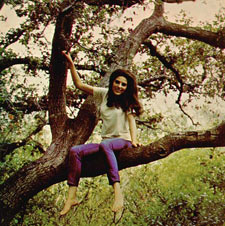 | | Bobbie Gentry |
While traveling with Capitol artist Bobbie [‘Ode To Billie Joe’] Gentry In 1967, Mansfield was introduced to Objectivism, a philosophy developed by Ayn Rand. Gentry’s ‘aw shucks’ hayseed image might appear in stark contrast, but she embraced the philosophy wholeheartedly.
“Oh boy, she did - absolutely. Here was this supposedly sleepy-eyed southern belle who was a simple person and all that,” Mansfield recalls, “and this woman was sharp. She was focused. She knew what was going to happen in her life; this lady was going to be wealthy and rich and famous. She ended up marrying Bill Harrah [owner of Harrah’s in Lake Tahoe], and it was a matter of her whole Ayn Rand Objectivist philosophy.”
As he escorted her on a lengthy promotional tour, Mansfield became more and more curious about the books Gentry was reading. “You hear about people converting somebody in the back seat of a car or something; she basically converted me to objectivism on a flight between Chicago and St. Louis, or someplace like that.”
He became enamored with the philosophy. “It was perfect, because I was totally self-centered and selfish, and thought everything revolved around me. The theme of it is I am not my brother’s keeper, and what is good for me, is good. I didn’t have to worry about anyone else, just as long as I took care of myself; that was the main thing. So boy, I loved that.”
There was no desire to preach it’s attributes to others. “You didn’t promote it too much, because you had an advantage, and why encourage it? We weren’t exactly people who wanted to spread or share the wealth. We were drawn to each other; It was almost like Scientologists; you could sense each other, and when you found somebody else [who] was into Ayn Rand and Nathanial Brandon - those were people you really migrated to.”
Meanwhile, as Capitol’s District Promotion Manager – West Coast, his star continued to ascend. “Unfortunately, or fortunately - because I was becoming a success - I had the tools, so I had everything I needed for that philosophy to work. I didn’t have to think about anyone else but what I wanted.
“The interesting thing is, that first period was probably one of the best periods of my life, from an earthly sense. When everything centers around you, and you have all the tools? Man, there is nothing in your way. You can just accomplish everything, and it’s incredible.
“But one day it falls apart, and it’s not based on a very good idea; because when you’re living that on the way up - and you start coming down - there’s nobody there for you. And that was really part of my downfall. There was nobody there when you were on your way up, because you didn’t care.”
The biggest selling act in Capitol’s history – or any label for that matter – was the Beatles.
Mansfield first met them in 1965. They hit it off right away. ”This is maybe hard to comprehend – but when they were coming up and trying to make their bones, they were just like me in Idaho.
“Everything they saw was Hollywood. The surf, the sand, the beach; the music – all these artists that were coming out of there - the convertibles, and the girls in the bikinis.
“So when they met me: I’m a 20-something guy, I’ve got the suntan, I’ve got the convertible, I’ve got the big house with the pool in the hills, and my friends were all the people they were fascinated with. So I was as intriguing to them as they were to me.
“In those days, we didn’t have that exchange with other cultures like we do now. I was just fascinated with the way they talked, the phrases they used, and how funny and different things were in London - and Mulholland Dr., Grauman’s Chinese Theater and all these things were just fascinating to them. So we were a doorway to each other in a way, to these worlds.
When the Beatles created Apple Records in 1968, they requested Ken as U.S. manager.
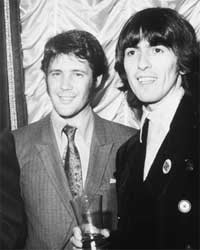 “Everybody from Apple stayed at my house. George stored his guitars in one bedroom; and I’d be sleeping on the couch sometimes in this big house, because I’d have so many people from London staying.”
Having known them up close, personally and professionally, he has nothing but praise.
“They changed society entirely. We had Kennedy being assassinated, the Vietnam War, all these hard times, these troubles - and what they did is they freed the youth to get out from underneath all that was going on. They led this rebellion though their music, and through their persona, and growing their hair long.
“They changed hair, they changed clothes, they changed music; they changed everything. They were the Pied Pipers to the world’s youth, and they set us all free. Funny, because while I’m talking, I can go right back into what I felt like then; they set us free. Well, Christ set me free later on.”
Mansfield laughs, and observes: “If you were a Lutheran pastor interviewing me right now, you would have hung up a long time ago.”
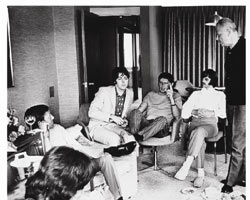 Until an offhand comment by Ringo made it clear he had permission, Mansfield had refrained from documenting his years with the group. “I never took advantage of my position with the Beatles, which paid off. Never had my picture taken with them, never asked them to sign something, never asked them for anything - and they would have done it. I’d always said I was going to save up a favor someday, and that was it.”
Of the literally thousands of titles devoted to the Beatles, only two books have ever been approved by the band; their own Beatles Anthology, and Mansfield’s The Beatles, The Bible and Bodega Bay.
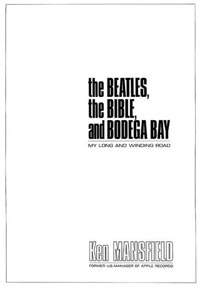 “This is pretty amazing; when I started putting the book together, I had all these pictures that I thought I had a right to.” It wasn’t just photos that were a problem. “John Lennon wrote me a letter. It’s a letter from John thanking me, and he drew a picture on it. It was a letter from John to me; my letter.” Not so, according to the lawyers. “I didn’t have rights to it. John’s estate had rights to it, because it was a creative effort.
“All the lyrics in the songs, and all these pictures that I thought were mine, were actually owned
by Apple. And all of a sudden I’m in this mess, where I’ve got this book and I realize I’m not in control. Well, fortunately for me, Bruce Grackal - who was my attorney - was also Ringo’s attorney.
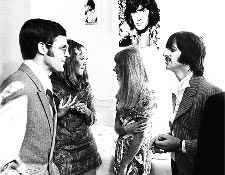 “Ringo and I go back to 1965. We had a long, good friendship, so the first thing I had to do was go to Bruce and say ‘Bruce, you’re on the board of directors of Apple, and you’re Ringo’s attorney; can you represent me? Is this going to be a conflict of interest?’ He said, ‘Give me the manuscripts. I’m flying over to London for meetings with Apple, and I’ll read it on the plane and tell you what I think I can do.’
Grackal’s reaction was not what he had expected. “Bruce was just a hardcore attorney, nothing to do with Christ or anything like that, and he read the book and came back - and Bruce always talked hard and rough - and he said, ‘Ken; I want to tell you, I read the book on the plane’ and his voice was breaking up, and he said ‘uh, you know the Beatles stories? Fine. That’s what I do all day long, that’s semi-interesting to me. But I was really touched by your spiritual stories.’
“He said, ‘Yeah. I can do this.’ So, there’s the start. So Bruce goes directly to Ringo, and Ringo gives the book his blessing. Now the flood gates are open. So it’s; ‘Hey George; Ringo has already said it’s okay, and Bruce is representing it, and it’s Ken, and dada dada da.’
“George signs off, then it was Paul, and then Yoko. Then [Apple CEO] Neil [Aspinall] and everybody. They just fell in order, one by one. I didn’t realize it, but Grakal told me later it was the first time that everybody had signed off.”
It certainly got the attention of his fellow writers. “I had all these other writers that had written Beatles books that said ‘how did you get these pictures? How did you get this approval? We can’t even get an answer at Apple Records; nobody will even talk to us. We’ve never gotten any approval.’ So that was pretty neat.”
Mansfield manages to cover his career and spiritual journey in equal measure, without coming across as the least bit manipulative. It’s simply his story.
“It really was, and Bruce told me one of the reasons the guys approved the book, was ‘because the book is about you - it’s not a Beatles book. It’s your story, and they’re in it.’ They liked that.”
As the sixties unfolded, there was little interest or sense of Christianity within the contemporary music community. It simply wasn’t relevant to most people. “It wasn’t even on the table. A lot of people ask me if I ever witnessed to the Beatles, and I say I can’t remember the subject even coming up. And if it did come up, we probably brushed it aside so quick it never had a chance.”
The spiritual realm was by no means ignored during the era. From psychedelics to Eastern thought, all manner of experimentation was taking place. Mansfield’s own interests broadened considerably during the seventies. “I was a New Ager for ten years, and I was very, very deep into it. I was a teacher of meditation, of all the advanced meditations. I did crystal healings and astral projections. I was a favorite of a national guru [Gururaj Ananda Yogi – founder and leader of the International Foundation of Spiritual Unfoldment].
In Wyomings, he says he paid dearly for those years of resisting God. When he was resisting, did he believe in the God of the Bible? “I didn’t believe in Him for real. I believed in ‘god,’ but I believed in the god of my own shape. I liked the other ones better; they were more fun. Oh my gosh, you could get high and have sex and talk nasty, you know, you could do whatever you wanted to do.”
Continue article >>
|

He describes New Age spirituality as ‘Chinese restaurant religion;’ where the practitioner may indulge in whatever practices are desired, including drugs and alcohol. “Absolutely, if I felt like it.”
That was certainly the case during his encounters with Gururaj. “In fact, when we used to go on retreats, go away and get spiritual, he used to make us drive down out of the mountains and find him a liquor store. It was late one night and we couldn’t find anything but beer and wine, and we brought it back and he was really mad at us. He wanted hard stuff; he didn’t want beer, he didn’t want wine.” Mansfield chuckles at the incongruity; “Here we are, these devotees in the dark up in northern California trying to find a little town with a liquor store in it.”
There was also the uncomfortable issue of the Guru’s sexual proclivities. “That too; we were all surprised, all the pretty girls were his special assistants.”
When Allen Klein took over Apple in 1969, he cleaned house, dismissing almost the entire staff. Curiously, he offered to triple Mansfield’s salary if he would stay on. Understandably weary of the notorious businessman, he passed, taking a position with MGM Records instead. During his tenure at the label he oversaw acts like Eric Burdon & War and Roy Orbison, the latter becoming a life-long friend in the process.
From MGM, he went on to run Barnaby Records, a subsidiary of Columbia Records owned by Andy Williams. The label’s biggest act was Ray Stevens, who topped the charts with ‘Everything Is Beautiful’ in 1970.
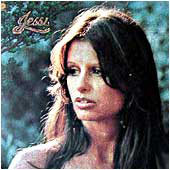 | | Jessi Colter |
Sensing that the burgeoning Outlaw country movement was about to take off, Mansfield pushed to sign more country acts in the early seventies. When his suggestions were vetoed, he resigned, starting Homemade Productions, under the aegis of which he would produce hits for Waylon Jennings, Jessi Colter (including her #1 ‘I’m Not Lisa’) and Tompall Glaser.
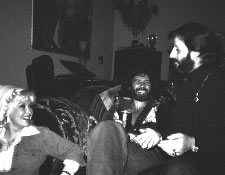 | | Dolly Parton, Mansfield and Ringo |
In spite of leaving Apple and switching genres, the Beatles connection continued. “They were all fans of Roy Orbison, and I was producing Waylon, and Ringo was a big Waylon fan - all these things - so we just kind of started mixing with each other.”
Mansfield produced ‘We Had It All’ for Jennings’ 1973 breakthrough, Honky Tonk Heroes. The project was ostensibly a collection of Billie Joe Shaver songs, excepting the one last minute addition. How did the song - not written by Billie Joe - end up on the album?
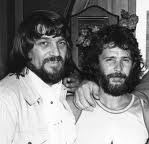 | | Mansfield and Waylon Jennings |
“You know, I just don’t understand it to this day - because that was a very definite concept album. It made no sense to put that song on there. I didn’t think it fit. It was out of character with the rest of the album. But Waylon went right over to the record company and told them he wanted that for his next single, and wanted it on the album. I don’t know. I still can’t figure it out to this day.”
One theory holds that Waylon - concerned Shaver would receive too much credit – added a song by another writer. It’s an idea new to Mansfield.
“That doesn’t make any sense to me, because that was Waylon’s idea to do that as a concept.” He stops, and reassess; “But Waylon did have a problem with the people he got associated with. If they started getting fame, he really backed off, and backed away from them, and boy, now that I just contradicted you, I’m going; ‘Wow - that sounds like Waylon.’ This is a brand new thought for me. That is typical, and that is why he wanted that for his single. Wow. Very typical for Waylon to do that.”
He found himself in a similar position, with his name absent from various producer credits, including one of Jennings’ biggest hits; “That’s why my name is not on [1979’s] ‘Amanda,’ you know. And there are some other songs and things.”
For five years, the two were especially close; at one point Waylon asked if he could list Mansfield as next of kin on a hospital visit. In the end, a volatile combination of drugs, inflated egos and a healthy dose of paranoia soured the relationship.
The party came to a crashing halt soon after. Homemade Productions went belly up, and music-related opportunities dwindled to the point where he was forced to take a job working menial construction. With few prospects, Mansfield moved from California to Nashville in 1984. All that remained of the glory years was stuffed into a half dozen boxes and suitcases. He began working his way back up, moving gear at a local venue – occasionally, for the same acts he had once advised.
Demoralized and financially devastated, Objectivism no longer held it’s appeal. Which begs the question; if material success had continued; would he have adhered to the philosophy? “I always say if I would have maintained the level of success I had, I would have never turned to God - because I never would have needed Him. And I just praise God every day of my life for the circumstances that did bring me to him; the crash and fall from a very high point, down to a bottom, to where I realized in my Objectivist philosophies, that it was all about self, doing everything yourself, and my own bad self wasn’t doing so good.
“And so, a strange thing I realized one day; I grew up dirt poor up in Idaho, and if I would have ended up like I did when I bottomed out - without going to the heights I had - I wouldn’t have even noticed. If I would have gone straight across, I would have had no motivation to seek God from where I’d always been if I hadn’t sought Him already. Going up to such a pinnacle and then dropping back down was really an extreme thing, so I really missed - I wanted something.”
He experienced a similar revelation when he finally stood up to his Guru. “That was a mammoth one. I can picture being on the phone, and him saying, ‘But Ken; how is your inner life?’ Because he just knew, after all these years of his deep teachings, that I would have to say; ‘Well yes, I have inner peace,’ and all that.”
Instead, his reply was the polar opposite of what was expected. “I took the phone away, and almost looked at it. He was in South Africa and I’m in Nashville. And I said ‘You know what? My life sucks. How’s my life? My life sucks!’And it was like, bam! That was it. I didn’t even discuss it. I said that ‘my life sucks,’ and I hung up, and I’ve never talked to him again.”
Nashville was where he met the women who would become his wife, and bring him to Christian faith. But not without a few bumps along the way.
“My life was in the toilet when she brought me to the Lord. But we had this problem. The thing about it was, God brought us together. There was no question that we were brought together. I had moved to Nashville, that’s where I met her, and we fell so deeply in love.”
“She’s taking me to Christian rock concerts, taking me to see Mylon LeFevre, we’re going to coffee house places to see Rich Mullens and Noel Paul Stookey, and taking me to the churches that had all the really great musicians in them. So she was doing everything; she was praying over me and preaching to me, but she couldn’t break [through]. She just could not do it.”
There remained – for her, at least - a fundamental doctrinal difference that couldn’t be bridged.
”I couldn’t understand why we had such a problem. Because I totally accepted her Jesus. In fact, I said ‘He’s one of the really better ones!’ I agreed, he is the path to the Father; he’s one of the really good paths, but he wasn’t the only path. There were other paths. I accepted her Jesus; why couldn’t she accept my way, my guru way? And she was so bullheaded and closed off. My gosh, lady! I told her I’d change gurus if you don’t like my guru, so come off the Jesus thing. It was a little bit, ‘let’s meet some place in the middle.’ And there was no middle for her.
“And so she did come to a conclusion. She came to me, she just said ‘I have to make a decision here, because I know where we’re heading.’ And she said ‘I can’t go there. We’d be unequally yoked, and so I have to make a choice, and I have to make it now.’ And she said ‘I need to choose between you and Jesus, and I choose Jesus.’”
It wasn’t the compromise he was expecting. “I went, ‘Whoa!’ I was stunned, because I knew how much in love we were. I knew how hard that was for her. To be completely in love, and then have to say, ‘Hey look it; I love you this much, but I’ve got to go.’ And so I realized how much that meant to her.”
It brought about a radical change in his perspective. “In all honesty, I wanted what she did. Instead of talking the talk, she walked the walk. And what she did, she showed me something that meant so much to her, she would give up anything for it. And I wanted to want something as much as she wanted that. And that’s how she brought me to the Lord.”
He discovered his years of Eastern meditation held an unexpected benefit. “I was very sincere in my practices, and when I became a Christian, it was just automatic, because I was so used to getting up in the morning and doing my chanting and meditations. It was like and athlete that had learned how to throw a baseball and then they became a football player; they had a strong arm already. So, when I became a Christian and I woke up in the morning, I read my Bible and said my prayers, and I understood.”
The mechanics were already in place. “And even as bad as it may sound, through my guru I had learned where to put my focus. Then, my focus was on him. But I found out what the true focus was, and everything was in place for me. It was almost like I’d been practicing a game, and then when it came time for the real thing, I was plugged in.”
Some practices that he witnessed during his years with the Guru – including levitation – are perceived in an entirely different light. “Back then, I just thought it was totally ethereal and so incredible, but really it was demons; that’s all it was. The devil has the ability to do miracles, too; and that’s all demon-possessed stuff, because it’s just manipulation to bring you into his kingdom. We’re human beings, we’re easily impressed some times; just show us - even a semi-miracle - and we bite for it.”
He believes God used his years with the Guru for good. “He’s the greatest economist of all time, I tell ya. You know, I say in my speaking engagements, no matter how long, bad or shameful and wretched you’ve been, he will turn to good what Satan meant for evil. Once you bring it to Him, it’s His.”
Mansfield claims to write “like a Christian on acid.” It’s a fascinating phrase, and one that has confused a few readers.
“In fact, I had to explain that quite a bit to the publisher to get him to let that fly. Well, it’s true; I’m a sold out Christian, I have been since 1985.
“But there’s still this spatial thing that’s left over from the ‘60s and ‘70s - and so, when I get to writing, it’s like when you’re stoned and on all these different kinds of trips and creative things. When I write, it’s almost like it’s surrounded by that.
“And what it does for me - and I hope this doesn’t sound too far out - but it allows me to just kind of really see Jesus and everything it describes in the Bible in a really real sense. Which,” he adds, “is a real kind of out there sense too.”
The era brought a profound societal shift not easily dismissed. “When you talk about peace and love - which Jesus talks about - you almost get a feeling [with] the peace and love generation of what he’s talking about; how nice we were to each other at one time.”
Mansfield writes of his mother praying ceaselessly over the years, refusing to give in, and eventually seeing both of her sons come to faith. “My brother and I are about as different as two people can be. We’re five years apart in age and we almost don’t know each other. Not because one of us doesn’t agree with the other, it’s just we’re different. He more or less stayed in the country, and never really wanted much else. I was the big brother that went away and had all the glitter. So it was a totally different thing for him. He was probably just off the trail a bit, where I was actually falling off the airplane.”
He believes a parents’ impact on a child – even later in life - cannot be underestimated. “Totally. Because I realized that she lived out her Christianity her whole life. I just didn’t recognize it when she was alive. I talk like my mother was a saint now; I realized she was a saint. She never once would criticize us.
“I’ll give you a perfect example; my daughter ran away when I was living in Hollywood. My sixteen year old daughter ran away with this guy, and they drove up to Canada. She had no reason to run away, it was just this guy talked her into it, and da-da-da. They were up in Canada, above Idaho, and I finally tracked her down and talked her into coming back home. She said ‘We’re out of money,’ and I said ‘do you have enough money to get to Lewiston?’ I wired money up to my Mom and Dad’s place so that they could carry on from there, and I talked to my Mom, and said ‘Mom, I want you to let her know what she’s done. How much she’s hurt all of us; I want you to set her straight.’ And she said ‘I’m just going to love her, that’s all I’m going to do.’ She wasn’t going to criticize her. She wasn’t going to put her down. She was going to love her granddaughter while she was there.
“And that was my Mom. Faithful prayer is the reason she never let up, and I honestly believe to this day that she would have died long ago, but not until she knew her boys were home. I totally believe that. Because, the life she had the last ten years; she was in total pain. She was so sick she should have died. I just really believe that; she wasn’t going nowhere.”
He finds himself in a similar position today, waiting on a prodigal, no matter how long it takes. “Right now I’ve got a 43 year son who has been a heroin addict for 25 years. He’s serving hard time in prison for armed robbery, and I’m praying for this kid, I tell ya, I wouldn’t hang in there, but my Mom did, and it worked.” He believes, as his mother did, that giving up is not an option. “Absolutely; that’s our witness.”
He’s also acutely aware of the damage a disingenuous witness can cause. “We have to be careful around people, we have to be careful what we say and do, because you can turn a person off eternally, or you can save them eternally.
“I’ll tell you how easy that is. When my son was trying to [get straight], he came down to live with me in Nashville. I was trying to bring him to the Lord and trying to break him off of his drug habits, and so I got him to work with this Christian rock band and this Christian producer, and boy, pretty soon he’s carrying a Bible, and he’s going out on their dates with them and stuff like that, and so I went ‘wow this is so great.’ Well, turns out the producer was a shyster and my son saw it, caught the deal, and saw that this guy was jiving, that he was using the Christian thing to screw people, and I haven’t been able to get him back since.”
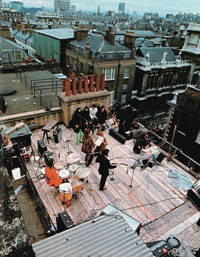 | | Mansiefd with Beatles (sitting, in white coat). |
Between Wyomings documents a road trip that includes a metaphorical journey to the Apple rooftop, where the Beatles gave their final public performance. Mansfield was one of a handful of firsthand witnesses to the historic event.
“I wrote how much the roof had meant - that whole Beatles thing - what I had done with it, and how it affected me. I realized that that was a pinnacle in my life, and I let it define me, and then I lived off of it. And it was just one of my conversations with God.”
Considering all the Beatles-related stories and anecdotes that occur throughout his books, it could appear disingenuous when Mansfield declares how little they mean to him nowadays. He’s well aware of the seeming dichotomy. “Well, I’m going to go crass on you here. It turned out I’m an evangelist, and the Beatles are a platform for me to where I have credibility - I have street cred with rockers and people out in the world. They go ‘wow the Beatles were incredible, and if this guy was with the Beatles and he says blue is red, then blue is red.’ And I just have this door open with people.
“I honestly believe in my heart, that the whole reason I was with the Beatles was not because I was so sharp and was such a neat guy and all these things. That was just a tiny part of the whole thing. It’s that God - He just put that so later on I could glorify Him and bring people into the kingdom.
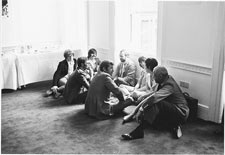 “I say from the stage sometimes, ‘You know what? Forty years of being in the business and being with the Beatles, every plane I ever got on, every book I’ve ever written, every prayer I’ve ever said - the first time Ringo fell of a bicycle or whatever - it all was for one purpose; for me standing here in Des Moines to reach one person. That God saw this person that long ago, and that’s how he decided to get him in. I have a feeling I may go home tonight and God’s going to call and say, ‘Okay Ken, you can go off the road now, that’s the person I wanted you to reach.’ “I say from the stage sometimes, ‘You know what? Forty years of being in the business and being with the Beatles, every plane I ever got on, every book I’ve ever written, every prayer I’ve ever said - the first time Ringo fell of a bicycle or whatever - it all was for one purpose; for me standing here in Des Moines to reach one person. That God saw this person that long ago, and that’s how he decided to get him in. I have a feeling I may go home tonight and God’s going to call and say, ‘Okay Ken, you can go off the road now, that’s the person I wanted you to reach.’
The fact he’s on the road at all is a bit of a miracle.
In 1996, Mansfield was diagnosed with Waldenstrom macroglobulenimia, a rare, incurable form of bone marrow cancer, and given one to three years to live. A combination of experimental treatment and prayer has prolonged the inevitable.
He’s well aware he’s living on borrowed time. “It’s incurable, so it’s not going away. I’ve had people all over the world praying for me, and I think God’s just set it aside for a while. Rick Warren and I have become friends, and he told me that he thought God was going to set the cancer aside for a period of time, because God had a purpose for me. And he was writing a little book called The Purpose Driven Life at the time.”
Understandably, the initial diagnosis threw him for a loop. “When I couldn’t figure out what my future was anymore - when you take all of tomorrow out - it really screwed me up for a while. We are earth bound, so you go ‘Next year we’re going to get a vacation here,’ and ‘If I plant this now, it’s going to grow, and in two years that tree’s going to be nice.’ I didn’t realize it at first - that that’s what was confusing me so much. And yet, I’ve got scripture right there. You don’t say ‘I’m going to do this tomorrow.’ You say, ‘If the Lord’s willing…”
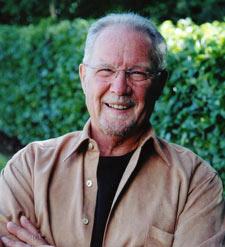 Mansfield’s speaking engagements are invariably well-attended, and draw from well beyond the traditional church walls. “We average about 40% visitors, or people that don’t go to the church I’m speaking at. So if I’m speaking at a church of two thousand people, I’ve got 800 people there. Mansfield’s speaking engagements are invariably well-attended, and draw from well beyond the traditional church walls. “We average about 40% visitors, or people that don’t go to the church I’m speaking at. So if I’m speaking at a church of two thousand people, I’ve got 800 people there.
“To give an example of how this has worked, I was speaking at a big Baptist church in Indianapolis College Park, and these two beer drinking buddies that were hanging out in the sports bar that were Beatle fans heard there was a guy from the Beatles speaking at the church, so they left the bar and came over, because they wanted to hear a Beatles guy. And they got touched, and they went home and told their wives about it, and they brought their wives back. The Pastor called me about a month later; both men and their wives had come to the Lord, and their kids were now in the Sunday School. Two complete families. And he said a couple of kids brought their friends the other day.
“Okay; now tell me God says you’ve got to be perfect all the time.” Like a celestial record rep delivering the hits, it’s clear he believes in his product. “I’m a street fighter, I’m not a closer, so I can’t take credit for these things, but I’ve seen so many people come to the Lord.”
November 2009
|