|
By David F. Dawes
WE CAME to Bethlehem during Advent, seeking a Star.
Three not-overly-wise men, myself and two other Canadian Christian journalists – armed only with digital cameras – were spending the morning of December 2, 2008 in the town of Christ’s birth.
I had seen photos of the famous metal Star of Bethlehem in the church marking
the nativity of Jesus, but had never been privileged to travel there myself.
Now, as part of a tour sponsored by the Israeli government, and with the help
of a Palestinian Christian guide, I would have my chance.
There is some question as to whether the Church of the Nativity is truly built
on the site of Christ’s birth. For that reason, one of our colleagues chose to pass up on the trip,
and stayed in Jerusalem. I can’t vouch for the absolute veracity of the site, of course. But the tradition is
evidently based on the writings of Justin Martyr, Eusebius and Origen, all
credible sources from early church history.
We approached the church by crossing Manger Square – a huge, paved courtyard with silver Christmas baubles dangling from several
wires strung across it. We could see a minaret across from the church – the Mosque of Omar, apparently the only mosque in the city. In front of the
long outer wall of the Church of the Nativity were two huge, bushy trees, with
strings of what appeared, in the daylight, to be Christmas decorations.
We turned a corner and there, several hundred feet ahead of us, was the Door of
Humility. The door was the main entrance to the church, and was built
deliberately low, so one had to stoop to get through it.
Inside the Basilica of the Nativity, there was a stalwart row of pillars on each
side of the nave; an ornate gold lamp hung down between each set of pillars.
In one section of the main floor, in a sealed-off compartment visible through
glass, was a portion of a 4th century mosaic from the time of Emperor
Constantine.
The front of the church was typical of Greek Orthodox places of worship, with
several elaborate chandeliers, and numerous icons on display.
Our guide showed the way to the Grotto of the Nativity. A doorway with
ornamental pillars led down into the birth site. I noted there were several
people ahead of us, and began to worry they would get in the way when I tried
to take a photo of the Star.
On the way down, we encountered an icon of the Virgin with Child; another
showing Mary and Joseph worshiping the Child; and an incomprehensible ancient
fresco, half obliterated.
When we reached the chapel commemorating the actual birthplace of our Lord, I
despaired. It was a small space, and it was packed. A cluster of tourists
grouped around the Altar of the Nativity. A good photo would likely be
impossible.
Not wanting to waste my time, I made the best of the situation and turned toward
the nave of the chapel. There were a dozen or so icons hanging, in gold frames;
I took a few shots.
Continue article >>
|
I turned hopefully back to the altar. The crowd had thinned out, but my view was
still blocked. More people were coming. Would time, and the press of the
oncoming crowd, permit me to get my shot of the Star?
Suddenly the space was colonized by a glut of African tourists. To my horror,
each of them seemed determined to have their photo taken separately with the
Star.
Would our guide give me time to take my own shot? I noted he was busy talking to
someone, and took heart. One after another, the pilgrims posed smiling,
crouching down beside the Star, each with a pointing finger resting on it.
Finally, the Africans moved off, grinning beatifically.
One of my colleagues chose that very moment to block my view. The guide was
trying to get our attention, presumably to move us off. Just as I was about to
say something terribly unchristian, my colleague moved aside.
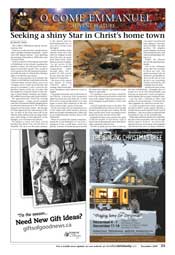
And behold, there it was: the Star of Bethlehem – all bright silver 14 points of it; set in rust-colored marble, and wearing an
impressive Latin inscription; almost gaudy, but not quite crossing the line.
I got my shot. I checked it, then took another for good measure. I followed the
other pilgrims out, relieved it was all over.
As I later pondered the whole episode, I decided it didn’t really matter whether a chunk of fancy metal marked Christ’s actual birthplace – any more than it mattered that December 25 was not his real birth date.
What truly mattered was the fact of his birth, the idea of the incarnation, the very thought that he came to
rescue us – as I saw it celebrated in the joy on the faces of the pilgrims who blocked my
view of a shiny ornament.
November 2009
|