|
By Alexa Gilker
“THEY SAY a picture is worth a thousand words.”
Coming from Rev. Ken Gray, who has been legally blind since birth, this
well-worn cliché takes on new meaning. The pictures he is referring to happen to be a striking
collection of photos he has taken over the last four years: the world as seen
by a jovial blind man.
Gray, the rector at Colwood’s Church of the Advent, says his interest in photography as a medium stems from
his days as a photojournalist with the Oak Bay High School newspaper. At that
time, however, photographic technology could not overcome his visual
impairment, and he was prevented from achieving clear pictures. Four years ago,
his discovery of new technology, namely auto-focus cameras, allowed him to
rediscover his passion and talent for the art.
For Gray, his photographs provide a “magnified view of life,” where he gets to see the details that his eyes normally miss.
Though his vision is poor, he uses the tools he has available to him – and learns to use them in extraordinary ways.
“I think that’s a stewardship principle,” says Gray, “going back to biblical language: we are to use what we are given well.”
Looking at a landscape, he says, “I see converging lines, or maybe some lines that intersect with some shapes . .
. But if I see a swatch of fall colours, I really react to that emotionally.”
His pictures reveal this vision. He has created a wide variety of photographs – with subjects ranging from children to pumpkin patches – taken from angles that those with full vision wouldn’t traditionally focus on.
“Every picture is an interpretation,” says Gray. “Images, therefore, have the potential for harm, or for beauty and blessing.”
His photos fall particularly well into the second category, as he is
increasingly intrigued by the potential of art as a vehicle for social change.
In general, Gray holds that the arts, including photography, have the ability to
“cut across a prejudice or opposition that we hold fiercely, and come in under
the radar.”
That quality, he says, makes photography an unlikely yet effective tool for
advocacy, and it is one that he is well-prepared to utilize.
Close to Gray’s heart is the issue of food security on Vancouver Island. Since 2001, he has
been involved in local efforts, such as the Capital Families Association food
security initiatives, to raise awareness about protecting local agriculture.
“I am interested in presenting the challenge to folks, to eat far down the food
chain, think organically and choose less processed food,” says Gray. He believes his photography can be a helpful tool in getting this
message out.
“I want to take photos of the actual farming,” says Gray, “to show people that food is actually being produced right here by individuals
who pay taxes in our communities.”
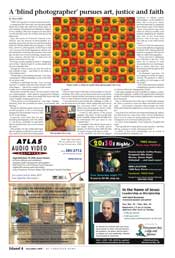
An example of his efforts can be seen in his bright photos of locally grown
peppers, in which he plays with the idea of organic living in all aspects of
life.
Continue article >>
|
So far, mobility has been his biggest handicap in taking certain photographs – as his inability to drive, due to his poor vision, prevents him from accessing
the more remote areas of the island.
Most of his photos have been taken at easily-accessible local markets,
displaying the distribution side of the food-chain process – but, as he says, “you can only go so far with lettuce leaves.”
However, Gray has requested a four month sabbatical, beginning in March 2010,
during which he intends to properly develop his skills as a blind photographer.
“I have one foot in sabbatical, but I still have a day job,” Gray jokes. He is anxious to start researching the use of photography in
justice advocacy, and determining what his part in that area might be.
“As Christians,” says Gray, “we are looking to portray an aspect of truth. The question is: what is the
ability of a still image to tell the truth?”
Part of this exploration includes compiling his mental collection of “photos which are changing the world.”
A favourite example of Gray’s is Shelby Lee Adams, a controversial photographer credited with significantly
raising the profile of secluded, impoverished Appalachian communities from
Kentucky.
Gray is interested in how this type of politically-charged art “gives a context to issues we often encounter theoretically . . . and creates a
narrative where people can really think about what the implications of any
action or reaction are.”
Gray knows he will have his hands full during the sabbatical, but hopes he comes
away with a clearer understanding of “how to create art which makes [us] think about the consequences of social and
political action’.
In terms of photography, Gray brings his thoughts full circle:
“We can talk all we want about social concerns – but they still say ‘a picture is worth a thousand words.’”
A gallery of Ken Gray’s photographs can be viewed at www.grayintheforest.smugmug.com.
November 2009
|