|
By Steve Weatherbe
IN JULY of 1209 AD, an army of crusaders broke into the French town of Beziers and killed virtually all of its
inhabitants – between 10,000 and 20,000.
This event began the Albigensian Crusade, the first religious war where both
sides called themselves Christians. Like the Wars of Religion 300 years later,
worldly objectives of secular lords were tangled up with the goals – both profane and spiritual – of religious leaders.
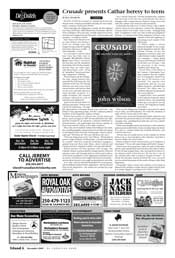
Now Vancouver Island novelist John Wilson has written a novel for teenage boys
that brings the issues and the leading historical characters vividly – if stereotypically – to life.
It is not hard to tell the black hats from the white hats in Crusade: The Heretic’s Secret, Book I (Key Porter). You know the bad guys are the emissaries from Rome who led the
crusade, because they are either ugly, sado-masochistic or fat – living in “unbridled” luxury and wearing “sumptuous” clothing.
The good guys are the Cathars, the wise, simple heretics who preached the
following: that the material world was evil; having children was bad; Jesus
Christ was not divine, and had not died on the cross; and that salvation came
through reception of a single sacrament, the Consolamentum, followed by a life
of austerity and singlehood.
Apart from his penchant for physical caricature, Wilson does a good job
explaining – through the observations of teenage friends John and Peter – the beliefs of the opposing groups, and the confused political loyalties of the
Languedoc region of France.
Wilson has written 22 other books, mostly historical fiction, since he began in
1989. He was attracted to the Albigensian Crusade by an infamous comment
attributed to Arnaud Aimery – the papal legate who led the crusade, on Pope Innocent III’s orders, at the Siege of Beziers.
Since only a few hundred Cathars were hiding in the town, the crusading knights
wanted to know how they were going to distinguish them from the townspeople.
Aimery reportedly said: “Kill them all. The Lord will know his own.”
“That just stopped me cold,” says Wilson. “What kind of person could condemn 10,000 people – and [in] what kind of a world?” And how could the world have changed so quickly from just three years before,
when Catholic and Cathar preachers engaged in public and peaceful debate?
Wilson answers the first question well enough. The Catholic church, as
personified by Arnaud Aimery, believed salvation came only through belief in
Christ and reception of the seven sacraments. It saw suppression of heretics as
an act of love, for all those who might otherwise be led astray – and for those heretics who might be lured back to the fold.
As to why a heresy that had flourished for several generations suddenly incited
violent suppression – first by war and then by the Inquisition – the answer lies outside the scope of the novel.
One Catholic historian, Thomas Brokenkotter, explains that the pope of the day
was a powerhouse who was as unhappy with corrupt bishops living in luxury as he
was with the Cathars and various secular monarchs.
As Brokenkotter tells it in A Concise History of the Catholic Church, Innocent III would have ordered the Albigensian Crusade earlier if he hadn’t been so busy – bringing King John of England to heel over who would pick England’s bishops, or insisting that Philip Augustus of France stay married to his wife
Ingeborg, or mounting a new crusade to the Holy Land.
Continue article >>
|
If Wilson makes a serious historical mistake, it is in confusing the Inquisition
with the Albigensian Crusade. In fact, the Inquisition evolved to replace the indiscriminate warfare waged by the crusaders – which killed between 200,000 and 1,000,000 on all sides over 20 years – with the precision of the torture chamber and courtroom.
In God’s War: A New History of the Crusades, Christopher Tyerman explains that the Inquisition in Languedoc turned over
just one in 100 heretics to be executed. Ten percent were imprisoned, and the
rest got lighter sentences – provided they recanted. The object was “to eradicate disbelief by persuasion and reconciliation.”
Coupled with a new austerity in the Catholic hierarchy, better educated clerics,
new preaching orders and convents for devout women, the Inquisition largely
succeeded.
Why was the Albigensian Crusade so ferocious? So much was at stake, says
Brokenkotter. Not only the salvation of souls, but the social order of the
time.
What’s more, Innocent declared the lands of heretics and any lords who protected them
to be forfeit, and foregave all crusaders’ sins – including those that were yet to be committed while crusading.
While some knights merely showed up to collect advance pardons and avoided
battle, freebooters like Simon de Montfort came to conquer lands and establish
dynasties, and took few prisoners.
Wilson does not make heroes of the Cathars; he shows them to be as close-minded
as the Catholics. And that is his true villain: the closed mind.
Wilson told BCCN that closed minds can be religious or ideological. “We see the same things with Stalin’s purges.”
Wilson gives his young hero, John, the task of representing the open-mindedness
and tolerance the author values. If only he had stopped there. But, moving from
history to the fantasy world of Dan Brown’s The Da Vinci Code, he also entrusts John with a long-lost ‘Gospel of Christ’ – in which the Messiah, having survived the cross, recounts how he settled
afterwards in the south of France with Mary Magdalene.
Presumably, there is more such evidence to be found in future books: perhaps a
certain ancient chalice used by Jesus at a certain supper; or perhaps even
Christ’s tomb?
November 2009
|