|
By Frank Stirk
 | |
| Author N. J. Lindquist is seen here at a booksigning in May. |
PUBLISHER Larry Willard sees a possible way out for
struggling Christian bookstores, which have been hurt by lost sales of
popular American titles – such as the Left
Behind series, The
Prayer of Jabez and The
Purpose-Driven Life – to retail
giants like Costco, Wal-Mart and Indigo.
“I think the focus needs to get off American
product,” he says. “They should be looking at Canadian product.
They have a unique product, and that’s what they should be trying to
put out the door.”
Novelist N. J. Lindquist (Glitter
of Diamonds) goes further. She believes
something needs to be done to “get bookstores across Canada, that are
Christian, to actually care that Canadian authors are promoted.”
Based in Markham, Ontario, she founded The Word Guild, a support
network for about 300 Christian writers, in 2002.
“I find it really, really difficult to get my
books into the [Christian] stores,” she says. “Frankly,
I’m selling more in the U.S. than in Canada, and I find it much
easier to get into the mainstream than I do into the Christian
stores.”
Profit margin
But Kevin Lee, proprietor of Sign of the Fish, a small
Christian bookstore in North Vancouver, counters that while he will do what
he can to promote local authors, the fact remains his profit margin depends
on him offering the products his customers want.
“I don’t feel guilty or overly mercenary in
doing that,” he says. “It has to be operated as a business . .
. as a prudent piece of stewardship. You can ‘minister’
yourself into the ground operating a bookstore, I think, and that’s
not going to do anybody any good.”
“We do in fact actually sell a really good
selection of . . . lesser known authors, simply to provide a unique kind of
selection,” says Margo Smith, co-owner of Hull’s, a family-run
Christian retailer in Winnipeg.
“There’s a lot of pressure that’s
been put on us, with the taking away of the cream of the crop.”
They may differ on how to resolve the problem, but no
one who writes, publishes or retails Christian books in Canada denies that
their industry faces some serious challenges.
Of the almost 700 Christian bookstores across Canada,
more than half operate as small or very small businesses. But regardless of
size, says Smith, “Sales right now are a challenge for all
bookstores. . . . There’s just so much competition.”
Not only are the high-volume stores siphoning off the
most high-profile Christian titles and selling them at discounted prices,
more and more people are also buying products online.
But Lee, who spent most of his career in marketing
before buying Sign of the Fish last year, believes these “seismic
shifts” are not unique to the Christian marketplace.
‘Monster’
“This industry is undergoing the same changes
that the book industry at large is undergoing. . . . Good grief! Indigo
alone controls more than 50 percent of the book trade overall in Canada
– and that’s a monster astride the country,” he says.
Smaller publishers are also being overshadowed by their
more powerful American rivals. “Our sales are down this year a good
30 percent. It’s been terrible,” says Willard, who owns the
Toronto-area Castle Quay Books and Bay Ridge Books – which, between
them, publish about a dozen titles a year.
Some Canadian authors, such as Alberta humourist Phil
Callaway (Golfing With the Master) and Vancouver Island pastor Mark Buchanan (The Rest of God), have succeeded
in getting U.S. companies to publish them. But most writers are far less
fortunate.
“It looks to many people that unless you have an
American publisher, you can’t get a Canadian distributor; and if you
can’t get a Canadian distributor, you can’t get in the
bookstores,” says North Vancouver Anglican priest Ed Hird, author of Battle for the Soul of Canada.
“So, basically, you’re shut out of the market.”
For Hird and others, including Lindquist, their only
recourse has been to handle their own publishing and distribution. Since
last year, Hird has sold 1,600 copies of Battle, and has managed to get the book into 85 bookstores across
Canada. It also won him The Word Guild’s award this year for best
independently published nonfiction book.
Timidity
“There’s a lot of negativity and timidity
in Canadian culture around the area of books, and so . . . a lot of people
basically tell you why things won’t work,” he says. “What
I’ve discovered is that it’s not easy, but it can
work.”
Continue article >>
|
Hird, says Lee, is “an example of an author who
maybe is doing what you need to do these days, which is getting out there
and marketing your book . . . talking to every last retailer in the
country. Locally, he was selling them out of his car.”
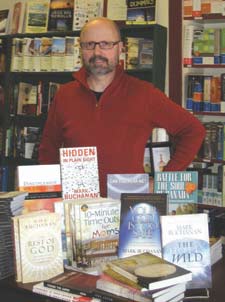 | |
| Sign of the Fish owner Kevin Lee
proudly showcases books by B.C. authors. |
But it is not an experience Hird would like to repeat.
“For my next book, I’d rather have an established publisher who
was able to run with a lot of it,” he says.
Some opt for so-called ‘vanity’ publishers,
who turn manuscripts into finished books. But Lindquist, who has written
nine books, does not recommend it. “You don’t have quality
control – and a lot of things can happen,” she says.
Authors who have landed an American publishing deal
caution that this does not necessarily guarantee fame and fortune. Montreal
writer Marg Buchanan’s two books (Famous
Jerks of the Bible and Parenting with Purpose) were both
published in the U.S. – breakthroughs which she credits ultimately to
the sovereignty of God.
“Your manuscript has to land on the right day
with the right person in the right mood. . . . It kind of has to be a slow
period for the big names, and they’re looking for something to talk
about,” she says.
Lost among giants
But despite twice getting accepted, Buchanan adds,
“I got lost among the giants. The sales reps are not going to
necessarily promote my book, if the same house has put out a Max Lucado
book that month.”
In 2004, Buchanan put her book-writing projects on
hold, so she could focus on raising her three children. She now works
full-time for a Christian charity.
“If anybody thinks you’re going to make
money writing books, you need to take a long, quiet nap,” says
Lindquist. “It’s not going to happen. Most people are
subsidizing their writing either by working or, in my case, my husband has
a good job.”
Indicative of the challenges facing this community was
the disbanding this spring – after 39 years – of the Canadian
Booksellers Association Canada. Faced with a declining membership, its
board decided it had neither “the time, energy, finances or will to
turn this ship around,” chair Lando Klassen (who runs House of James
in Abbotsford) wrote in a statement to members.
In its place, Lindquist hopes to see a new national
group emerge that embraces everyone involved in creating and selling
Christian books.
“We all need to be working together,” she
says, “because really we’re on the same team and we’re
all trying to do, I hope, the same thing – which is to get the books
that need to be read into the hands of the people that need to read
them.”
Smith sees more than a little irony in their current
circumstances. “We got into this believing our products were
worthwhile – and of value, in terms of spiritual development,”
she says. “And now that they’re quite widely available,
we’re in a tough spot.”
But for all the challenges and frustrations they face,
neither can they overlook what they have going for them. As Buchanan
realized, there can be a downside to signing with a big American publisher.
“You really are a small fish in a big sea.
Whereas, in a smaller publishing house, you can be the big fish even if
you’re just a beginner – because maybe they only print four or
five books a year and they can invest a little bit more time in your
title,” she says.
Rewards
For Buchanan, the writing can be its own greatest
reward. “I learn a lot by putting pen to paper,” she says.
“The book that I needed to read to change my own life [was the book]
that I wrote. It impacted my life going through that process. And so that
was a success.”
Hird is thankful for The Word Guild. “They have
been so helpful. These guys have been through the ropes,” he says.
“I have learned so much.”
As for the booksellers, Smith believes they need to
capitalize on what their secular competitors can never offer –
a meeting place for people of kindred spirit.
“We really value service in a much deeper sense
than others might,” she says. “We are one of the few
environments in which people of different backgrounds, different
denominations, different churches, actually interact.”
Lee, too, has a soft spot for people who come in with
their self-published book. “Even if it’s kind of hokey
looking and the cover’s kind of sideways and I don’t like the
font, I’ll take some and put them on the shelf – because
I’ve been through this,” he says. “I understand the
gumption that requires.”
December 2007
|