|
By Peter T. Chattaway
 THE LESS you know about Atonement (opens December 7) going into the theatre, the richer
and more rewarding an experience it will be. As it happens, the film is so
complex, and touches on so many themes, it would be impossible to give away
all that much about it in a short review anyway. THE LESS you know about Atonement (opens December 7) going into the theatre, the richer
and more rewarding an experience it will be. As it happens, the film is so
complex, and touches on so many themes, it would be impossible to give away
all that much about it in a short review anyway.
So consider this a spoiler-free taste of what’s
to come.
Based on the acclaimed novel by Ian McEwan, the film
concerns three people whose lives are irrevocably changed by an injustice.
The story begins in 1935, when a 13 year old upper-class girl with a lively
imagination named Briony (Saoirse Ronan) witnesses some puzzling, and
almost certainly scandalous, interactions between her big sister Cecilia
(Keira Knightley) and the gardener, Robbie (James McAvoy).
These moments are first presented to us from
Briony’s point of view. They are then shown again, from Cecilia and
Robbie’s point of view, and the contrast between these two
perspectives underscores the differences in how children and adults see the
world. It also prepares us for later moments in the film, when incidents we
thought we understood are revealed to be even more complicated than we
knew.
Before too long, Briony thinks she has witnessed
something else, too – and so she makes an accusation against Robbie
that ruins his life forever, and Cecilia’s too.
The film then jumps ahead five years, to World War II.
Robbie, given the choice of prison or the army, is now a soldier stranded
in France during the disastrous retreat at Dunkirk. Meanwhile, Cecilia and
Briony (the latter now played by Romola Garai of Amazing Grace) are nurses in London
– Cecilia because she loves Robbie and has cut off all ties to her
family, Briony because she wants to do some kind of “penance”
for the damage she has done. The two sisters do not associate with each
other.
One of the striking things about this film is the way
it emphasizes the role that both chance and choice play in determining our
fates. Young Briony, for example, is drawn to a window because she hears a
bee buzzing against it – and if it were not for that bee, she would
not have witnessed the first of the puzzling incidents.
The film also probes the fuzzy line between fact and
fancy in the way we remember things, and for that matter in the way we
sometimes live in the present. Briony’s imagination may be partly to
blame for the accusation she makes. And Robbie, more than once, thinks back
to certain pivotal moments in his own life and wishes they could be undone.
During a moment of delusional illness in France, he also imagines that his
mother (Brenda Blethyn) has come to soothe and take care of him.
Much of the film revolves around the act of writing;
even the musical score, by Dario Marianelli, makes frequent use of a manual
typewriter’s clickety-clack. One early scene shows Robbie composing
draft upon draft of a letter of apology to Cecilia.
Continue article >>
|
 | |
|
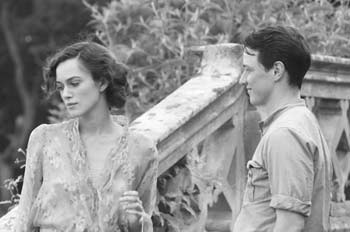
Keira Knightley and James McAvoy in Atonement |
Similarly, Briony wants to be an author, and to atone
for her error, she ultimately spends years writing and rewriting her
version of what really happened.
It is difficult to say much more without giving away
important plot points. But suffice it to say that the film, written for the
screen by Christopher Hampton (Dangerous
Liaisons) and directed by Joe Wright (Pride & Prejudice), raises
important questions about the relationship between honesty and kindness,
between truth and grace.
In thinking about this film, my mind often goes back to
Snow Falling on Cedars. Both films move back and forth in time, both films feature young
lovers interrupted in a moment of passion, and both films amplify questions
of personal, social and even cosmic injustice by dragging their characters
into the Second World War.
But where Snow Falling on
Cedars was about bearing your scars and
letting go of the past, Atonement seems to be about people who cannot let
go of the past, and are indeed haunted by the past and their knowledge that
it can never be undone.
Briony, in particular, is searching for grace, and the
fact that she can’t quite find it makes Atonement one of the more devastating, heart-breaking films in
recent memory.
* * *
Juno (opens December
14) is quite possibly the best of the unplanned-pregnancy comedies that
have come out this year. It is also the most explicit in its rejection of
abortion.
The protagonist of this film, a high-school student
played by Ellen Page, actually goes to a clinic to have her pregnancy
terminated – but then she walks out, because something a pro-life
activist said outside the clinic stuck in her brain.
It would be a stretch to say that this film –
written by former stripper Diablo Cody and directed by Thank You for Smoking’s Jason
Reitman – was made for social conservatives. Indeed, when all is said
and done, neither Juno nor her child end up in a traditional family, as
such.
But in a way, that just underscores the film’s
implicit pro-life sensibility; life is life, no agenda-driven strings
attached. And the fact that Juno matures quite nicely because she keeps her
baby certainly doesn’t hurt.
– filmchatblog.blogspot.com
December 2007
|