|
WHAT makes The Sanctuary so successful? It is doing something right, for it took
a third full-time staff member on board last June: Ben Barber, who joined
Rob Trepanier, the director, and Galen Falconberg. To find out the secret
of their success, your reporter went to quiz all three men.
The answer, he discovered, does not lie in the programs
they offer, nor in any talents or vast expertise any of them possess.
And though all three are congenial and good men, they do not come across as
magnetic or charismatic personalities.
But what they do share – and what fits them for
the job – is a genuine love for the young people they minister to.
These are kids who sleep under bushes at night, who are alienated from
their families and dealing with drug problems, and who face a life of
ongoing homelessness, addiction and isolation.
They are ‘youth at risk,’ and the Sanctuary
staff feel a specific attraction towards them: a sense of God’s call
to save them from a bleak future by providing a safe haven – where
they can experience love, healing relationships and community.
Many church people see the challenge to Christians that
these street people represent, but they feel uncomfortable and helpless
towards them. That’s how Galen Falconberg used to react, when as a
teenager he got the feeling that such youth were to be feared.
But then he matured as a Christian, and saw there had
to be something he could do to help them. At a discipleship training school
which focused on working with the poor, he says, “I was given
God’s heart for the poor . . . I have a tremendous love for these
kids, and God has given me grace to express his love for them. I relate to
them well, and they can relate to me.”
Barber’s experience was similar. He was
studying to become a teacher – and interrupted those plans in
order to join The Sanctuary.
Trepanier recalls that while he was youth pastor at a
church, he did an outreach to a high school and found himself drawn to
unchurched kids. That drew him to work with impoverished kids at the Boys
and Girls Club.
“That was an epiphany for me,” he says.
“I had a real love and joy being around them.” His chaplaincy
at the Youth Custody Centre further confirmed his calling to the
marginalized and excluded kids of our society.
What does the addition of Barber mean? In the first
place: more time for The Sanctuary to open its doors. The facility, which
is housed in the basement of the hall of the Church of our Lord, at the
foot of Blanshard Street – an ideal downtown location – will
now be open for two extra evenings a week.
But there is more. “This is a significant time
for us,” says Trepanier. “I’m getting on a bit, you know,
and Ben’s coming makes it possible to put the Sanctuary mostly into
his and Galen’s hands, and let them develop it into its full
potential. That frees me to pursue wider possibilities.
Continue article >>
|
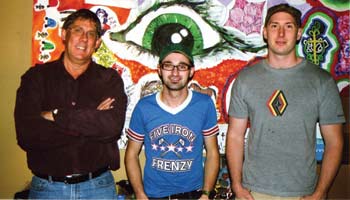 | |
| Sanctuary staff (left to right): Rob Trepanier, Galen Falconberg and Ben Barber |
“First of all, I’m trying to recruit more
volunteers. Some shifts are very short on volunteers who can do one-on-one
with kids. There is much fear among church people who want to help, and I
want to spend more time on orienting and training them.”
And what does he look for in volunteers? “Kids
need people their own age, and they need parent figures. Anyone with a
heart for the lost and broken is useful; the aim of everything that goes on
is relating to them, making friendships.” For the rest? “Well,
some volunteers have musical or artistic talents, others know how to cook,
or to organize – whatever.”
He adds, “I want the ministry to go deeper. My
heart breaks for the kids who have to sleep under a tree when we close our
doors here. I’d like to do more than hand out sleeping bags and
blankets. So I wonder about starting a safe house, as part of our
ministry.” He is exploring the possibilities.
The Sanctuary has been open for two years now. Is the
work living up to the expectations he had when it started?
“I am not fully satisfied until a kid has given
his heart to the Lord and is walking with him, and is experiencing
Christian community. That has not yet happened here, but it has happened
with kids I have worked with in the past. We sow the seed, and the Lord
will make it grow.
“For the rest – parents have thanked us for
being there for their kids. We are important to them. Since we opened, we
have had 3,100 kid-visits. There is also the harm reduction we achieve;
that is significant.”
And the finances? The vision for The Sanctuary came
from a number of pastors of churches in Victoria, and the money comes from
them; individuals have also helped with donations. The staff are
accountable to a number of pastors who function as elders, and to a board
of Christian businessmen.
– Jack Krayenhoff
December 2007
|