|
By Jack Krayenhoff
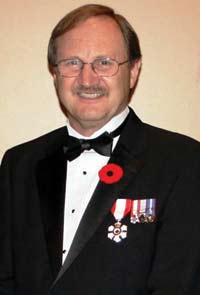 | |
| Humanitarian Norville Penny |
THE ORDER of Canada is the highest honour our country
can bestow on its citizens. A pediatric orthopedic surgeon from Victoria,
Dr. Norgrove Penny, received it October 26 for what he has done for
disabled children in Uganda.
Penny had a thriving practice in Victoria, when
he heard Christian Blind Mission (CBM) was looking for a specialist to help
children in Uganda.
Penny responded to the challenge. Together with his
wife Anne and their three young daughters, he set out in 1996, armed only
with a modest collection of surgical instruments.
When he saw the conditions he would have to operate
under – sometimes no running water, electric power on and off, no
oxygen – his first response was, “I can’t work
here!”
But then he realized he could not abandon helpless
children, and went to work with what was available. By the end of his six
years, he had operated on approximately one thousand clubfeet, as well as a
large number of other conditions.
About the result of these procedures, he says,
“It was far more than straightening out a foot or a limb. It meant a
child could now go to school and hope to get a job, that a girl could hope
to get married.
“It meant they regained their self-respect, for
with their disability they were looked upon as subhuman. In fact, their
condition was seen as the result of a curse, and getting them on their feet
meant that curse was broken.”
But Penny went far beyond surgical treatment. Without
rehabilitation, the results would be inadequate; so, in cooperation with
mission and government hospitals scattered around the country, he set up a
network of community-based rehab centres. The hospitals also would gather
the disabled children of their region for him to treat.
In addition, he trained Ugandans without medical
expertise to perform a simple, non-operative treatment, called the
Ponseti procedure – for effectively treating clubfeet in very young
children, before the deformity has become permanent. As awareness of this
treatment grows among the population, Penny expects the need for surgery
will decrease.
Continue article >>
|
By the time it became necessary for him to return to
Canada for the education of his growing children, he left behind in Uganda
a model for a nation-wide approach to treat children with disabilities that
was adopted by the country’s government. Not only that, but the World
Health Organization has approved the system and cooperates with Christian
Blind Mission and other groups to apply the same model in other developing
countries.
After his return to Canada, Penny upgraded his training
to become qualified as a sub-specialist in pediatric orthopedics, and is
now once more practicing in Victoria.
The Vancouver Island Health Authority has appointed him
as the pediatric orthopedic surgeon for the entire island, and as such he
conducts clinics in Nanaimo and Courtenay, as well as in the Queen
Alexandra Hospital on Arbutus Road.
Penny is a devoted Christian. Your reporter asks him
how his faith related to the work he did. Does it help spread the Christian
message?
He replies emphatically. “We at CBM are all
Christians, and what we do is in Jesus’ name. But we are
nondenominational; there are quite a few Catholics among us, as well as
Protestants – and our focus is not evangelistic or theological. We
are medical professionals, and we work in partnership with local
organizations, mostly churches.
“For instance, I worked in a hospital affiliated
with the Church of Uganda, which is basically Anglican. I saw that the role
of evangelizing and discipling was with the local church. There are 10,000
pastors in Uganda, but I was the only orthopedic surgeon taking care of the
kids. They speak the language and I don’t; they are far more
effective evangelists than I.”
Penny also notes the role of faith in clarifying his
perspective. “I am a follower of Jesus – that is, he is my role
model. Now read Matthew 8 and 9, and see what he did. He did some teaching
and spent some time with the disciples. But most of the time, he was
healing people with chronic disabilities: the deaf, the blind and the lame,
lepers, people with epilepsy. Perhaps you might add to that the demon
possessed, if you see them as disabled by spiritual/psychiatric problems.
“Jesus understood the burden they carried: they
were considered cursed and untouchable. Those were like the kids I was
seeing in Uganda – they were growing up disabled, isolated, less than
human.”
He concludes, “For me to work in Uganda was
exactly the way it was in biblical times. Like Jesus, we must minister to
the physical as well as to the spiritual. Evangelicals sometimes reject the
social gospel, but Jesus did not.”
December 2007
|