|
By Leonard Hjalmarson
Imagination is more important than knowledge. -
Albert Einstein
 | |
|
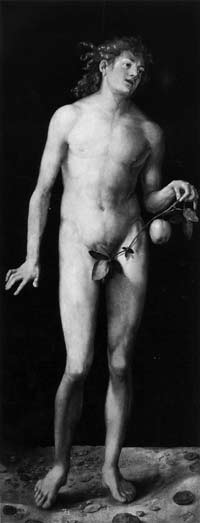
Adam, the first poet. Painting by Albrecht Durer
|
IN RECENT YEARS, we in the Western church have been
enamoured with words. As a writer, I understand that passion. As a lover, I
am intimately acquainted with their limits.
The direction of my soul when I am in love is toward
knowledge. Artists are lovers: in love with the world, in love with a
particular means of expressing their attachment. Art is a particular way of
knowing, and imagination is the link to artistic expression – to
incarnation. And incarnation, we know, is the path to God’s future.
Red pill
On this day in the history of the world, and on this
day in God’s story, we are like those awakening from a long sleep.
Like Neo in The Matrix, we have taken the red pill, and we are discovering how deep the
rabbit hole goes.
We are seeing how deeply immersed and accommodated we
have become to a narrow set of values, anchored solidly in a limited
Enlightenment epistemology – a particular way of knowing the world.
Parker Palmer – especially in To Know as We are Known and A Hidden Wholeness –
and other thinkers are helping us discern the violence of that method, and
we are discovering that, while science illuminated one set of truths, it
lost another.
Holy imagination is helping us to rediscover our heart
– and in the process, we might also reclaim the church as an
alternative culture.
In A Peculiar People, Rodney Clapp writes: “Reclaiming Christianity as
culture enables us to move from decontextualized propositions to
traditioned, storied, inhabitable truths; from absolute certainty to humble
confidence; from austere mathematical purity to the rich if less
predictable world of relational trust; from control of the data to respect
of the other in all its created variety; from individualist knowing to
communal knowing and being known; and from once-for-all rational
justification to the ongoing pilgrimage of testimony.”
What journey could be more important in this hour? The
journey to renewed hearts won’t be made by those who are immersed in
propositions.
Walter Ong, in Orality and
Literacy, declares: “Written words are
residue . . . When an often told story is not actually being told, all that
exists of it is the potential in certain human beings to tell it.”
The Hebrew word for ‘word,’ dabar, means both word and event.
Only what unites mind and heart, word and spirit, is incarnational. What is
born of the Spirit in the holy imagination may then take flesh.
Artists unwelcome
Sadly, artists and poets have not been welcome in the
Western church. Artists and poets reach for an unseen world; they grasp at
transcendence. Moreover, as Alan Roxburgh puts it in The Sky is Falling, “Poets remove
the veil and give language to what people are experiencing. The poet
listens to the rhythms and meanings occurring beneath the surface.”
What we see today in the West, according to Walter Brueggemann, is largely
a religion of immanence.
Continue article >>
|
With the Christendom compact, what had been a missional
movement became a civil and settled religion. Civil religion is about
immanence, the economics of affluence and the politics of oppression.
When Israel moved from a theocracy to a monarchy, then
God and the temple become a part of the royal landscape, with the
sovereignty of God subordinated to the purpose of the king. From this point
forward, God is ‘on call’ – and access to him is
controlled by the royal court. Royal reality overpowers the dimension of
hope and the place of imagination.
Static rule
When a nation (or a church) establishes a comfortable
and static rule, the last thing they want is people with new ideas to shake
things up. And in terms of the economics of affluence, you don’t want
people delaying gratification in favour of some future hope, you want them
seeking pleasure in the eternal now.
The result of all that pleasure, Brueggemann argues, is
that, “in place of passion comes satiation.” One of the reasons
we lose passion and imagination is precisely due to our success at
achieving comfort and security.
In The Prophetic Imagination, Brueggemann states: “Passion – as the capacity
and readiness to care and suffer, to die and to feel – is the enemy
of imperial reality.”
T.S. Eliot links sacrifice and knowledge in The Dry Salvages: “The point
of intersection of the timeless / With time, is an occupation for the saint
– / No occupation either, but something given / And taken, in a
lifetime’s death in love, / Ardour and selflessness and self
surrender.”
Adam as poet
It would be easy to assume a dichotomy between word and
Spirit for the holy imagination, but it would be a serious error.
I am fascinated that the second story of the creation
of humanity displays Adam as the first poet. We observe God’s
invitation to Adam to name the animals.
Imagination is at the heart of knowing, and humankind
is a language-maker – invoking new worlds of meaning, a sacramental
task. In the act of creation, we make visible what was only implied; we
connect matter with spirit. Imagination is God’s power in us, part of
the Imago Dei, and it
has the power to unite heart and mind – and so move us forward into
God’s future.
We now know that human transformation does not happen
through didacticism or through excessive certitude, but through the playful
entertainment of another scripting of reality – which may subvert the
old given text and its interpretation, and lead to the embrace of an
alternative text and its redescription of reality.
These are desperate times. We need artists who are
prophetic and poetic. We no longer have the luxury of assuming that the old
models or established leaders have the capacity to lead us forward. The
prophetic task is to criticize the dominant consciousness.
Alternate symbols
We must think seriously and creatively in two worlds
simultaneously. Symbols which promise life, but breed death, are exposed as
frauds – and alternate symbols are offered.
The poetic task is to evoke an alternative future among
a people who are so satiated that they have lost the capacity to imagine a
new world.
Alan Roxburgh notes that the imagination of poets is
not expressed in a modern manner. Poets “are not so much
advice-givers as image and metaphor framers . . . What churches need are
not more entrepreneurial leaders with wonderful plans for their
congregation’s life, but poets with the imagination and gifting to
cultivate environments within which people might again understand how their
traditional narratives apply to them today.”
Artists redefine our symbolic world so that we begin to
see the kingdom of God at work in our everyday lives.
I close with the words of Peter Senge in Presence: Human Purpose and the Field of the Future. Senge writes that a new way forward will emerge from
building three integrated capacities:
“A new capacity for observing that no longer
fragments the observer from what is observed; a new capacity for stillness
that no longer fragments who we really are from what’s emerging; a
new capacity for creating alternative realities that no longer fragments
the wisdom of the head, heart and hand; a new capacity for cooperation that
harnesses the intelligence and spirit of all people at all levels.”
Len Hjalmarson is a Kelowna writer and software
developer. For more of his writing see: NextReformation.com.
December 2007
|