|
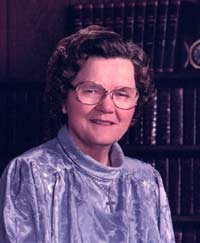 Bernice Gerard, one of
B.C.’s most respected Christian leaders, passed away November 1 (see
tribute on page 14). The following account depicts the key turning point in
her life. Bernice Gerard, one of
B.C.’s most respected Christian leaders, passed away November 1 (see
tribute on page 14). The following account depicts the key turning point in
her life.
JUST BEFOREƒ she signaled recess, our grade four
teacher called us to attention. “Beginning Sunday, there will be
gospel meetings here in the Jubilee School. The preachers are Miss Frances
Layden and Miss Clara Manary. Everyone is welcome. Boys and girls, please
tell your parents.”
Up went my hand. “Please, miss, what is a
preacher?” A little amused, the teacher
replied, “A preacher is one who speaks from the Bible.” Still
in the dark, I followed with a logical question, “What is a
Bible?”
In response, she drew from her desk a mysterious black
book with ‘Holy Bible’ in letters of gold on its front cover,
and gave us a few words of explanation. Our curiosity having been
satisfied, in a few minutes we were all happily playing in the schoolyard,
completely unaware of the effect the coming meeting would have on some of
us.
Somewhere to go
Somehow I managed to be there for the meeting that
first Sunday night – not out of love of the gospel, because I had not
the slightest idea what it was, but simply because it was somewhere to go.
Side by side in the same double desk we used in the daytime sat my pal
Helen and I.
Never will I forget that first gospel meeting! The
preacher chose someone to give out the hymn books, which the greener among
us regarded with curiosity. When we began to sing, the words were more or
less the same stream of thought as had been coming to me recently:
“We are fading too, like the flowers / That but
yesterday were in their bloom / Oh how many pass with the hours /
O’er our path falls the shadow of the tomb.”
There was something soul-stirring about the plaintive
melodies, and the solemn words – the logic of which it
was impossible to escape. Had I not so recently seen Aunt Sina lying in the
coffin? She had faded like the flowers.
Out came the mysterious book – the
Bible. The preacher read a few lines and then started to tell the most
wonderful story I had ever heard. Spellbound, I drank in every word.
It was about a man who was so wonderful that even his
enemies could find no fault in him.
He took the little children in his arms and blessed
them. He healed the blind and gave the lame power to walk. He even loved
the unlovely Mary Magdalene, out of whom were cast seven demons. He cared
for people no one else loved.
Thirteen years of age, mature beyond my years, I was
for the first time hearing of the marvelous Man of Galilee. The meeting was
quiet, the singing poor (nobody knew the hymns), but the preaching moved me
deeply. Jesus Christ was everything wonderful that one could imagine
and much more.
The lady with the book pictured his sufferings in the
Garden of Gethsemane and then in the judgment hall before Pilate; then
dramatically we walked the way of sorrow with him, feeling his anguish,
wanting to share the load of his heavy cross.
Rescue on the way?
When the procession reached the summit of the hill they
called Calvary, I felt certain that the story would soon be ending. Some
kind of rescue must be on its way. I was sure that some person of authority
would arrive at the last moment and set free the innocent one.
To my surprise and horror, his persecutors threw him
roughly to the ground, nailed him to a cross, and lifted him up to die.
Everything inside me was churning in revolt against this unspeakable
injustice. Then the preacher looked down at me, right into my eyes so it
seemed, and asked: “Do you know why he died?” Breathlessly I
waited for the answer.
She continued, “He died because he loved you. For
God so loved the world, that he gave his only begotten Son, that whosoever
believes in him should not perish, but have everlasting life.”
Could it be that he loved me? Nobody had ever loved me. I was the
little Gerard girl who would never come to any good, the black sheep
leading the other little lambs astray. In 13 years, I had lived in many
households, but belonged in none of them. I was nobody’s child. Now
the preacher was saying this man loved me enough to die for me!
Continue article >>
|
“Preacher,” thought I, “you
wouldn’t tell a beautiful story like that if it were not true, would
you?” If that was what she was doing, for some purpose of her own, it
was the meanest thing I could think of. In any case, I could not take my
eyes off her. I wanted the story to be true, and Jesus to be real.
If what she said was true, if God really did love me so
much that he gave his Son to die for me, I would give myself to him and
follow him all the days of my life. The thought of rejecting the gospel
never occurred to me – but I was plenty worried that he might not
want me.
Had the preacher asked us that first night to go
forward and take a stand for the crucified one, I would have done it.
Nothing in me was saying ‘No.’ My heart was painfully tender
and without a single prejudice against him. My own unworthiness
overwhelmed me.
Purity and pardon
Knowing nothing about my natural parents, I feared I
had been born out of wedlock. What little information I had gleaned on that
subject had been from questionable sources, and filled me with a sense of
shame. But worst of all was the burden of my own sin, which had nailed
Christ to the cross. I longed for the purity and pardon that the preacher
said would come when I confessed my guilt.
She quoted: “If we confess our sins, he is
faithful and just to forgive us our sins, and to cleanse us from all
unrighteousness.” As we got out into the fresh air at the
meeting’s end, Helen and I heaved a sigh of relief.
She said: “I am no sissy – but . . . if
they had kept on with the meeting, I would have been crying.”
Relieved to find that she, too, had been shaken up, I said: “I am no
sissy either; but I could have cried, too. I felt very funny inside when
the preacher told that story.”
It was not the number of meetings I attended that made
the impact, as I had the opportunity to get to only a few. One night,
having begged my father to allow me to go,
I walked alone through the woods about three miles to
the meeting. The blobs of phosphorus casting an eerie glow in strange
formation along the wooded trail usually terrified me; but now they seemed
insignificant. The sound of the gospel had become sweet music to my ears.
When the school house series came to a close, the
meetings moved to a house – where, on the first Sunday, the preachers
planned to ‘test’ the meeting. In a whisper, someone asked me
if I had made up my mind whether or not I wanted to follow Jesus Christ,
adding: “We will be asked to make known our decision on the last
hymn.”
My decision was already made.
At a shivaree the night before, a few of us had been
discussing the gospel meetings. The neighbours, having deposited coats and
babies in the bedroom, were expressing their good wishes to the newlyweds
by dancing until the rafters trembled. Most of the participants had drunk
quite a lot, and the housewarming was turning into a rough party.
Sitting on a large wooden barrel in the corner with a
few others around me, I voiced my disapproval of the celebration –
and to my own surprise, spoke out loudly in favour of the gospel meetings:
“When I grow up, I am going to give my life to God like the preacher
women have done.”
In the face of a flurry of comments, favourable and
unfavourable, I stood my ground.
From Bernice Gerard:
Today and For Life.
December 2008
|