|
By Steve Weatherbe
IN 1959, the leader of the Roman Catholic Church, Pope John XXIII, announced
that the world’s largest faith community would hold an ecumenical council of all bishops at
Vatican City.
The resulting event, which lasted from 1962 to 1965, made lasting changes to the
church – many of them still hotly debated among church members. Many say the church has
strayed far from the council’s recommendations.
This tendency to go beyond the documents published by the council has been known
by both its promoters and critics as ‘the spirit of Vatican II.’
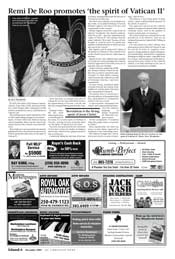
There has been no stronger advocate for Vatican II over the years than Remi De
Roo, the retired bishop of Victoria – now 85, but then the youngest bishop present at the council.
Hoping to rekindle the spirit which has become a stumbling block for many, he
recently held a workshop in Victoria – and also led off a six-lecture series on ‘The Spirit of Vatican II in Our Time.’
The series was sponsored by the University of Victoria’s Centre for Studies in Religion and Society, which De Roo played a decisive
role in setting up.
Controversy during the last years of his term as bishop estranged him from the diocese of Victoria for several years.
But there was evidently a reconciliation in the works as incumbent bishop of Victoria Richard Gagnon introduced De Roo and commented
on the council.
Bishop Gagnon noted the council was an effort to “modernize” the church’s relations with the world – and also maintained the “spirit of Vatican II” was a phrase that left some Catholics “ill at ease” because of how broadly it could be used “to justify any number of interpretations of what was actually said at the
council.”
But Gagnon said he preferred to think of the phrase as a reference to the
council’s focus on the church’s pastoral role, rather than on doctrine.
Bishop De Roo also addressed his remarks to the way the council changed the
Catholic church’s approach to the world, from one of austerity and even hostility.
De Roo told how, under John XXIII, the “Roman Catholic Church for the first time in history opened its arms lovingly” to other faiths, inviting observers from the Orthodox as well as Protestant
churches – and even communists.
He drew strong, sometimes harsh contrasts between the church of his childhood,
and the spirit of freedom that characterized Vatican II.
Continue article >>
|
His parents were so convinced of the unworthiness of humankind that they
participated in communion services only once a year.
A Eurocentrism dominated the church, and commanded that Latin – once the common language of Europe – be used for all important religious services.
De Roo commented: “I wondered what that might mean to a peasant in China.”
More significantly, the faith was seen as a static thing, expressed in medieval
or even Aristotelian terms.
But Vatican II taught that “relevation is not a book or a series of teachings,” said De Roo.
“Revelation is the living spirit of Jesus Christ,” which could be found expressed “in the whole of creation.”
This approach opened up the Catholic church to secular movements which reflected
Christian values, such as the equality of women and freedom of conscience.
The church itself was reinterpreted as the priesthood of all believers, and not
an ordained bureaucracy tasked with “telling us what to do.”
Left untouched by either bishop were phenomena which followed Vatican II, and
are seen by its critics as negative consequences: a huge decline in church attendance and membership,
matched by a significant shrinkage in religious orders – especially those for women; and widespread disobedience, among those who stayed
in the Catholic church, to its basic teachings in the area of sexual and
reproductive morality.
December 2009
|