|
By Paul Battjes
IT WAS down to this or Disneyland.
We did not choose Disneyland. As a result, instead of just another family
vacation, we had the adventure of a lifetime.
A few years ago, we heard about a renowned pilgrimage trail. My wife Joanna and
I made plans to go to Spain, with our son Forrest. A lot of people might not
understand why we would want to spend so much time travelling from place to
place on foot. For us, the answer was simple: because that’s the way Jesus did it.
Our ‘PilgrimWalk’ started in southern France and followed the Camino de Santiago (Pilgrim’s Trail) across northern Spain to end in Santiago de Compostela, near the
alleged burial place of the apostle James. The distance is approximately 800
kilometres.
People have been doing this journey for over 1,000 years, and each year about
100,000 people do sections of the trail, either on foot or on bicycle. Only
about 5 – 10 percent do the full 800 kilometres on foot each year.
Pilgrimages in Europe, starting about 900 AD, were a form of spiritual quest to
a holy destination that usually involved a long journey. What people discovered
was that the journey could be just as significant as the destination. Often
pilgrims were fed and cared for by the communities they went through. They also
worshipped together, and this is evident today by the numerous churches along
the way.
As you walk through the countryside, the religious history of the early
Christian church really stands out. Every village has a church, and often you
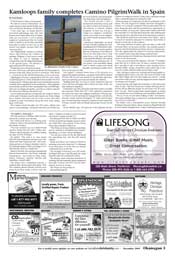
see icons, crosses and other symbols of early Christianity along the trail,
some dating back 1,000 years.
The Camino winds through over 250 towns, villages and cities to reach Santiago.
Along the way there are hostels run by local churches and municipalities that
house and feed pilgrims.
The hostels provide a bed, a shower and sometimes a meal, and are often located
in monasteries, old schools or historic pilgrim hospitals. At each one, you get
a stamp on a pilgrim’s credential, issued at the start of your pilgrimage, which tracks the places
where you stay.
Starting in September, we spent 40 days actually walking the trail, averaging
about 20 kilometres a day. Some people do it much quicker; but one of reasons
we took this journey in the first place was to step aside from a very busy and
often overcommitted lifestyle. We wanted to smell the roses along the way. At
one point, I can remember taking time to watch a snail crawl along the path,
something I wouldn’t have done in my previous life.
Last August, I stepped down from a CEO position at a regional hospital
foundation, a position I had held for almost 20 years. My job was very intense
to say the least, and sometimes my spiritual, personal and family life
suffered.
Walking each day, one step at a time, helped me step out of the fast lane and
appreciate a whole new side of life, one that embraces simplicity.
I remember one time along the trail when I had to actually ask someone,”What day is it?” I also wanted to experience the trail in the same way a pilgrim would have 600
years ago, so I tried to avoid mechanized transportation, cell phones,
internet, email, instant messaging, TV, radio and newspapers. Not having these
things for a period of time helped me to better connect with my family and
people we met on the trail.
Continue article >>
|
In the Middle Ages, 100 percent of the pilgrims did the Camino for religious
reasons. Today only a small percentage claim a spiritual purpose in doing the
trail.
Each morning, we would start our day by reciting the Lord’s Prayer. We also stopped for family devotions alongside a stream or in a church
courtyard. Often people asked why we were doing the trail, and this presented
an opportunity to share our faith. At one point, Joanna and I made cards with the verse John 3:16 and put them along the trail,
realizing that many people who came that way were searching for answers.
Also along the path there were many stone altars – places to stop for a moment and pray for someone back home or whom we had met
on the Camino.
“The long stretches of silence gave me time to talk with God and reflect on my
past activities. I’m certainly going to be more intentional about my future choices,” Joanna says. “We also appreciated the prayers of everyone back home. We couldn’t have done this journey without that.”
Joanna teaches art at Kamloops Christian School, and took a leave to do this
journey.
“I was concerned about the distance,” she says. “I wouldn’t walk that far in a whole year, let alone a month and half. But I was able to
take it one day at a time, trusting God to provide health, energy, motivation
and a great cup of cafe con leche (coffee with hot milk) several times a day!
“Also, having to reduce my clothing and living supplies to a backpack almost
drove me nuts; my closet at home looks like Value Village. But even this taught
me a lesson – I really can survive with a lot less, and my happiness doesn’t depend on having a lot of stuff.”
Forrest was the only high school student on the trail at this time of year. “My best memories, besides missing school, involve all the different people we
met from over 20 countries,” he says. “Most people didn’t speak English, so trying to communicate was a challenge and sometimes
hilarious.”
“For us, it was not just about taking a walk,” says Joanna, “but rather finding ways to experience and demonstrate the love of God on the
trail.”
The Battjes lead a contemplative prayer ministry through Kamloops Vineyard
Church. Money donated to PilgrimWalk will go to the church’s Kingdom Fund. Contact: kamloopsvineyard.com.
December 2009
|