|
By Jim Coggins
If anyone gives even a cup of cold water to one of these little ones . . . he will certainly not lose his reward. Matthew 10:42
A HOT drink offered to immigrants to Canada in 1948 is having an unexpected
impact six decades later.
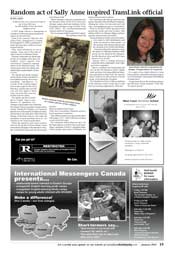
Anna Dean’s parents, Malcolm and Diana Dean, immigrated to Canada from England in 1948,
searching for a better life than they could see in war-ravaged Europe.
They “knew absolutely no one in Canada,” Anna said, so they did not expect anyone would greet them.
However, when they got off the ship at Pier 21 in Halifax with their two
toddlers, Anna’s parents were welcomed to Canada by representatives of the Salvation Army. The
workers gave them hot drinks and asked if they needed shelter, clothes or food.
The family had made arrangements ahead of time and did not need additional help,
but it was a wonderful introduction to Canada. It left a lasting impression on
the couple for the rest of their lives, and the story was told over and over
again to Anna (who was born later) and her brother and two sisters.
The family did find a better life in Canada. Anna is now director of operations
for Olympic Transportation for TransLink, the Greater Vancouver public
transportation system. During the Olympics, it is expected that the tens of
thousands of additional riders, all arriving at the same time, will create long lineups at SkyTrain stations. The waits are
estimated to reach anywhere from 20 – 30 minutes to two hours at peak times.
When the question arose what could be done for the people in those lineups, Anna
immediately thought of the Salvation Army. She contacted the Army and was put
in touch with Sharon Tidd.
Tidd is Olympics outreach coordinator for the Salvation Army, for the 2010
Vancouver Olympic Games; and is also facilitator for the Hospitality Working
Group for More Than Gold (MTG), the interdenominational outreach effort for the games.
The two groups readily accepted the request. The Salvation Army will lead the
effort on behalf of More Than Gold, but is recruiting volunteers across a broad
spectrum of churches.
They will be needed. It is expected the effort will require 1,700 – 1,800 volunteers working a total of 45,000 hours.
The volunteers will be placed at up to 20 SkyTrain stations, as well as
Vancouver Operating Committee (VANOC) ‘departure hubs’ (where people catch buses to Whistler, for instance) and events locations.
The volunteers will walk up and down the queues of people with refreshment
backpacks, offering hot coffee, hot chocolate and cold water, and engaging
people in conversation.
Continue article >>
|
Those in the lines will be spectators from around the world, and local workers.
(The athletes will live in Olympic villages and have separate transportation
provided.)
TransLink has previously invited the Salvation Army to offer refreshments and
music (by Salvation Army bands) – at the opening of Production Station and the opening of the Golden Ears Bridge.
TransLink offered the Salvation Army the option of collecting donations while
giving out the drinks at the Olympics, but the Salvation Army and MTG have
chosen not to do this.
Instead, MTG is seeking donations toward the effort, particularly from coffee and water companies.
Tidd is confident this fundraising will not cut into the Salvation Army’s regular work, and may even bring additional attention and funds for that work.
She said the Army’s main focus will continue to be the needy, even during the Olympics.
The refreshment service is thus a small part of the Salvation Army’s work; but it could have far-reaching implications, Tidd said.
If a couple of hot drinks offered to Anna Dean’s parents could still be having an impact over 60 years later, what impact will
millions of drinks have?
“People from all over the world are going to take this back to their countries,” Dean said. “It’s pretty special.”
January 2010
|