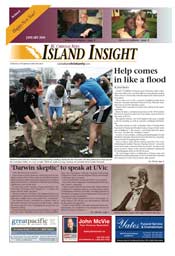
|
By Lloyd Mackey
A FAIR NUMBER of Duncan and Cowichan Valley Christians were able to live out their
faith in a near-disaster setting, when close to 300 homes were flooded in the
third week of November.
Those who rose to the occasion included people from Duncan Christian Reformed
Church (DCR), Duncan Christian School and the Salvation Army.
At press time, some flood victims were still in need of practical help.
Renee de Bree, secretary/receptionist at the 300-member Reformed church recalled
the crisis when interviewed for this issue of BCCN.
She said the church, one of the largest in the area, is usually a site for
worship, as well as concerts, weddings and funerals.
But when Somenos Creek, a tributary of the Cowichan River breached its banks and
flooded homes along several streets east of Highway 1, the church – just blocks from the disaster scene – became the “resiliency centre.”
As such, it was a shelter, cooking and meeting place for the hundreds of people
whose homes were flooded or, conversely, were involved in helping the victims.
And, at times, when all the various activities were overwhelming the facility,
Duncan Christian School – across the street and closely connected with the church – became a key point of action. Many of the school’s students volunteered for sandbagging duties at the flood scene.
The crisis began when a combination of heavy rains and high tides pushing
upstream on the Cowichan River pressed into Somenos Creek, which had no dike
system.
Managing the DCR church-centred activity was Violet Hayes of the Salvation Army.
She emphasized the fact that, as things turned out, recent community disaster
planning had proved valuable.
Hayes first learned of the impending need for help during a November 20 meeting
of community workers to plan for the Army’s annual Christmas kettle campaign.
A cell phone call alerted her to the need for some disaster assistance, and that
started the pattern of what was to follow for the next several days.
The Salvation Army was able to bring volunteers from throughout Vancouver
Island, all ready to help in the myriad tasks that emerged.
Gerry Klassen from the Mainland, connected with Mennonite Central Committee,
also linked his organization into the help network.
Notes de Bree: “Many of the people needing help were surprised and encouraged by the fact that
some of the people assisting them had come from as far away as Campbell River.”
The DCR church became the site of the middle level of help during the critical
days, and afterward. The first level was reception, where people who were
homeless or had major property damage checked in – and were directed to where they could get the help they needed.
The “resilient” phase of the activity included community meetings drawing up to 180 people; use
of the commodious church kitchen to supplement the Salvation Army’s mobile kitchen; and use of the church hall as a feeding centre, for breakfast
and other meals.
Continue article >>
|
Hayes pointed out that, understandably, “some people were angry at what had happened to them.” The community meetings “helped them work through those phases” by building community and reducing the sense of helplessness.
While the provincial government could be expected to pay up to 80 percent of the
damages brought on by the emergency, many people needed more immediate help.
“About 300 people had been evacuated,” noted Hayes, “and 151 homes were damaged, 29 of them severely.”
The recovery phase has been continuing steadily since late November.
Said de Bree: “The Red Cross was here for two weeks. They gave out cleanup kits and vouchers
for food and clothing. Government people were here to help in filling out the
forms.
“Some homes had as much as three feet of water in their living areas. Afterward,
some people had to take out their drywall and furniture, because of the flood
damage.”
Hayes spoke of the many little helping deeds that “put a smile on the faces” of people otherwise devastated by what was happening to them.
And she referred to the several other churches, which were not in the immediate
flood area, whose people came in with financial and volunteer help.
New Life Community Baptist started the ball rolling, and St. Andrew’s Presbyterian, Youbou Church, St. Cuthbert’s Catholic and St. John’s Anglican soon followed.
The need for help has continued, as has the supply of the available resources.
Hayes said that, at the time of the interview with BCCN, she was processing 400 Christmas food hampers, many of them for flood victims
who were still trying to pull the pieces together.
The last flooding approaching the 2009 levels occurred in the 1960s, according
to de Bree.
Municipal authorities are now considering what to do about the dike system
problem.
January 2010
|