|
By Steve Weatherbe
A TALE of 19th century derring-do was spun before a dry academic audience at the
University of Victoria last month.
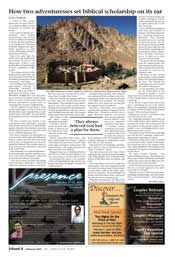
Over a series of lectures, B.C. expatriate Janet Soskice recounted how two
Scottish sisters set biblical scholarship on its ear with their expeditions to
the wilderness of the Sinai Peninsula. Margaret and Agnes Smith unearthed an early version of the gospels, stored in an ancient monastery.
About the same time the Smith twins were literally reading between the lines of old manuscripts, Soskice’s own grandmother was being brought to the B.C. goldfields as a babe in arms.
“You compare pictures of the Smiths and the gold rush, and if you put picks and
shovels in the Smiths’ pictures they would be identical,” said Soskice.
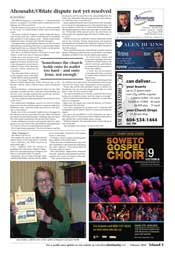
Now working as a professor of philosophical theology at Cambridge University in
England, Soskice has written a book about the Smiths, titled The Sisters of Sinai: How Two Lady Adventurers Discovered the Hidden Gospels (Knopf, 2009). It centres on the controversy their amateur explorations landed
them in, concerning the accuracy of biblical texts.
The title suggests the unveiling of secret Gnostic manuscripts, a la The Da Vinci Code. But their finds, in fact, supported the accuracy of later copies of the Bible – the ones used for the King James and other Protestant translations.
The Sinai Gospels were hidden in the conventional sense, said Soskice, concealed
from Roman persecutors and casual Muslim bandits (officially, the monastery was
under Muhammad’s protection at one point, and is now a Muslim pilgrimage site).
The sisters doubtless saw themselves as conventional, well-brought up
Presbyterian women, Soskice said. But they went where women were not supposed
to go unaccompanied by husbands. They became experts in areas only men were
allowed to teach and study at university.
They ultimately won acknowledgement – for their self-taught expertise, and their devotion to the cause of finding the
oldest and most authentic biblical manuscripts.
“They were in their 50s when they finally went to the Sinai,” said Soskice. “They could easily have died from accident or infection. But they had such a
strong belief in Providence that this didn’t deter them.”
They were raised by an indulgent widower as if they were sons, and proved to be
brilliant linguists. They responded to their father’s promise of a visit to any country whose language they mastered, by learning
French, German and Spanish at an early age. Later, to study the Bible more
devoutly, they learned Hebrew and Greek, both ancient and modern.
Their father’s death left them young, unmarried and wealthy.
A distant relative’s death left them fabulously so. They set out for a trip up the Nile, with their
female tutor as chaperone.
Thus far, said Soskice, both women – with their staunch faith in Providence – believed God’s mission for them was to be wives. Both made happy marriages to learned men
with similar interests – who, sadly, each lived only three years after their nuptials.
Margaret’s beau was a Cambridge librarian; they fell in love after a heated argument over
how to pronounce a word in ancient Greek.
He introduced the sisters to the academic world, and helped take the edge off
their Presbyterian fears that Cambridge University was a faith-destroyer.
German scholars’ criticism of the scriptures was making itself felt in Britain at the time,
causing great anxiety. The oldest manuscripts of the Bible were medieval. The
skeptics argued they were written far too long after the original events to be
believed.
The sisters – with money, time, linguistic expertise and experience roughing it in the Middle
East – decided on another trip to Egypt. They were acting on a hot tip that there were
unexamined, ancient biblical scriptures in St. Catherine’s monastery in the Sinai.
A German scholar, Constantin von Tischendorf, had already found a complete Bible
from the early 4th century in the monastery, in 1859. He had taken it back to
Europe with him; it would achieve worldwide fame as Codex Sinaiticus.
Tischendorf’s act of ‘scholarship,’ and subsequent thefts by others, had left the monks hostile to academic visitors.
The sisters learned ancient Syriac before making the trip, and also learned the
budding craft of photography. They would take home pictures of their
discoveries, not steal the originals.
Their expedition involved an eight-day camel journey. Their only complaint was
that the camel’s movement made it hard to study ancient Hebrew while in the saddle. Arriving at
the monastery, the pair charmed the monks with their fluent Greek – and found the rumoured trove of manuscripts.
Continue article >>
|
Diligently perusing them, they discovered that an 8th century manuscript
chronicling the lives of female saints was actually a palimpsest. Faintly
visible underneath the text was an earlier manuscript of the New Testament.
They carefully photographed their find, and returned to England. After being
dismissed by a Cambridge professor as dilettantes, they shrewdly invited his
wife to tea – and she brought him along. Once he saw the photos they had artfully laid on the
piano, little time was wasted before Cambridge was mounting an official expedition to the Sinai. It was kept a secret, in order not to alert German
scholastic rivals.
The sisters were also excluded from the original plans. But they insisted on
going along – which required the professors’ own wives to come too, for propriety’s sake.
The sisters, in turn, invited along Quaker scholar Randall Harris, who had
tipped them to the trove. This enraged the Cambridge team, who wanted the
credit for themselves.
At the monastery, the sisters left the transcribing of the palimpsest gospels – which turned out to be from the late 4th century – to their Quaker friend, and the pair from Cambridge.
At the monks’ request, they took on the task of cataloguing the rest of the hidden library.
This enraged the Cambridge profs all over again. What if the sisters found
another treasure? Who would get the glory?
Ultimately, by chance or Providence, it was the sisters who got the credit.
The Cambridge academics sent a letter off to the London Times, well in advance of the expedition’s return. They announced the transcription of this ancient version of the
gospels, soon to be brought back by them. But the letter never arrived.
Once back in Cairo, the fractious group split up, with the two Cambridge couples
holidaying before returning to London.
Meanwhile, Harris wrote a note to a friend recounting the sisters’ crucial involvement. The friend sent this to the populist Daily News, which published it. The academics were enraged all over again; one promptly
died of a heart attack.
The sisters became celebrities – and respected biblical scholars. Their find proved the accuracy of later
translations, and helped explode the notion that the Bible was written long
after the events described.
Soskice has had an interesting journey, too. She was a nominal Anglican in her
childhood, with no real faith.
While she was at Cornell University studying English and philosophy, she had an
experience of God’s presence – while taking a shower.
But which God was it?
She studied the Qur’an, the Bible and the Tibetan Book of the Dead before “realizing I was a Christian. The Bible struck me as profoundly right.”
This, combined with her interest in language, led to Vancouver’s Regent College – then on to the anthropology of religion, and thence to the philosophy of
religion.
Spiritually, she proceeded through Anglicanism to the Roman Catholic church,
drawn by its universality, objectivity and commitment to orthodoxy.
For Soskice, there is clearly something similar to admire in the Smith sisters.
While devoted to Presbyterianism, they were also committed to uncovering the
truth about the holy scriptures. “They always believed God had a plan for them.”
This, said Soskice, helped them surmount obstacles – both the purely physical, and those raised by the social conventions of the day.
“They showed real bravery.”
February 2010
|