|
By Lloyd Mackey
THE face-to-face examination of Eloise Bergen, by the
suspects in the Kenya rape case in which she was the victim, has left her
traumatized to the point where she is not yet ready for media interviews on
the subject.
That assessment came from her husband, John Bergen, in
a February 10 interview, following the couple’s arrival back in North
America just days before.
They had returned to Kenya in January, where they had
been attacked last summer on the Kitale-area farm. They were in Kenya to
work on housing and feeding projects for orphans and widows.
The return to Kenya “had a detrimental
effect” on Eloise, Bergen said. “She has to pace herself. And I
want to give her the space she needs,” he added. She has told him
that “I should answer for her, for now,” in media interviews.
Bergen said that both he and Eloise had been subjected
to intense examinations by the suspects. Each took two or three minutes to
ask such things as: “Do you know me? Do you know my name?”
He noted that neither he nor his wife were present
during the examination of the other.
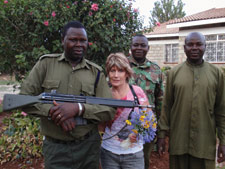 | | During a stressful trip back to Kitale, Kenya for the trial of men accused of attacking her, Eloise Bergen benefited from increased security. |
The Kenya trial of the several men accused in the
attacks is an important legal quiver in the attempts by Kenyan leaders to
bring to an end a ‘pandemic’ of gratuitous rape against women
in their nation.
That view came from Ralph Bromley, president of Hope
for the Nations, the Kelowna-based Christian organization under whose
auspices the Bergens have been working in Kenya.
Bromley explained the significance of the trial in
which they were testifying.
Attacks like this are rampant, in Kenya. Violence
following the 2008 election, he said, had created “a new acceptance
of violence and rape.”
He added: “If perpetrators are let off, the
message is that white people are up for grabs and rape is okay. It used to
be that the expatriate community was safe.”
However, he cautioned, a guilty verdict could have
repercussions. “If they hammer [the defendants], there will be
consequences for that.”
Bromley said that both the Netherlands government and
others in the international community are watching the Bergen case because,
in another setting, five young Dutch women volunteers at a school had been
raped and were left HIV positive.
Continue article >>
|
Providentially, Eloise Bergen was left HIV negative
from her attack – a situation Bromley described as “an answer
to prayer.”
Both Bromley and Bergen pointed out that, in the Kenyan
legal system, it was considered important that suspects – even those
accused of violent crimes – be permitted to aggressively question
those believed to be their victims. Bromley allowed that such a procedure
would seem foreign to people familiar with North American-style justice.
“The cross-examination was brutal,” he
observed, and thus “was quite traumatic” for Eloise. She
was able to identify two of the suspects. One, her husband said, was
recognizable because of his height and because he was “the only one
who spoke good English.”
Bromley declined to predict how long it would take for
a verdict in the case, but it could be months, at least. The next step, for
which the Bergens will not be present, would be the police testimony and
forensic evidence.
The Bergens are speaking in North American churches to
raise awareness for organic food-growing projects in Kenya. They are
also speaking on the subject of forgiveness.
Contact: www.bergensmission.com.
March 2009
|