|
By Steve Weatherbe
VATICAN sources have reportedly dismissed recent
rumours that it had decided on a mechanism to admit some 300,000
worldwide members of the Traditional Anglican Communion (TAC).
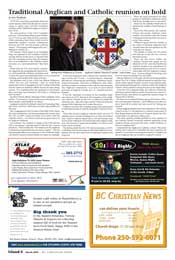
The metropolitan of the TAC’s Canadian province,
Victoria-based Bishop Peter Wilkinson of Victoria, also dismissed the
rumours, while expressing hope there would soon be significant progress
towards communion between the TAC and the Roman Catholic church.
“I’m hoping it will happen this year,” Wilkinson told BCCN.
 | | Bishop Peter Wilkinson of Victoria |
The rumour, which began as an Australian blog, was
repeated by the Canadian Catholic and the British secular press. It
reported that the TAC’s members in more than 40 countries were to be
readmitted to the Catholic church en masse, as a “personal
prelature” like Opus Dei.
While both the TAC and Catholic churches are organized
into geographically-based dioceses, each headed by a bishop, a prelature
such as Opus Dei spans international borders. It too is headed by a bishop,
and includes both clergy and laity.
The prelature story is just a story says Bishop
Wilkinson. “Rome has not said anything.” And an anonymous
spokesman for the Congregation for the Doctrine of the Faith told the
American National Catholic Register the same thing, stating: “It’s something
that has appeared on the blogosphere and then been reiterated. The truth
is, nothing has been decided.”
Another Vatican official, Monsignor Marc Langham, went
further. “Conversion is a personal process, and a group of so many
people could hardly be accepted.”
 | | Anglican Catholic Church of Canada - coat of arms |
Langham is with the Pontifical Council for Promoting
Christian Unity, however, which does not have responsibility for the issue.
The Congregation for the Doctrine of the Faith (CDF),
which does have jurisdiction, has been pondering the matter since the TAC,
in 2007, expressed desire for a union with the Catholic church – one
which would see the preservation of its Anglican traditions.
Last summer, the cardinal in charge of the CDF told the
TAC it was giving “corporate union” with the TAC “serious
attention,” while noting that “the situation in the Anglican
Communion in general has become more complex.” This has been
generally taken to be a reference to the worldwide Anglican church’s
recent doctrinal debates over same-sex marriage.
It was such departures from Catholic and Christian
teachings over the past 70 years – on ethical matters, remarriage
after divorce, women priests and bishops, ordination of practicing
homosexuals – that have, in Wilkinson’s view, eliminated any
chance for reunion of the Catholic with the mainline Anglican Communion, or
at least its more liberal provinces in England, Canada, the U.S., Australia
and New Zealand.
It was the “priesting” of women, by the
Canadian Anglican church in 1976, that led to the formation of the Anglican
Catholic Church (as the TAC is called in Canada) the following year –
after two Popes and the Orthodox churches pleaded with Anglicans not to
make this move.
Wilkinson became the Canadian group’s first
parish priest at what later became St. John the Evangelist Church in
Victoria.
Those who became Anglican Catholics (there are now 70
parishes across Canada, including two on Vancouver Island and a third on
Mayne Island) did so not just because such moves as the ordination of women
broke with Anglican tradition, but because it made the possibility of
reunion with Rome much less likely.
Continue article >>
|
The bishop added that the TAC did not presume, in 2007,
to tell Rome how its own reunion with Rome might be accomplished, but has
only asked that its legitimate traditions be respected.
There are many precedents for large groups of
Christians coming into union with Rome, though none is a precise fit.
Moreover, the Catholic Church did not question the
validity of their bishops or priests.
Late in the 19th century, the Catholic Church did
declare Anglican orders invalid – for in Rome’s view, the
Church of England lost the apostolic succession in the 16th century.
Wilkinson agrees that the validity of the orders of
mainline Anglicans have certainly been put into question by the ordination
of women.
The validity of orders for TAC priests and bishops
would also be a serious discussion point.
There are also forces within the Catholic Church who
might see the admission of TAC and other traditional Anglican bodies as an
impediment to ongoing relations and even to reunification talks with the
Anglican Communion – however liberal its theology, and however bleak
the prospect for such talks.
Bishop Wilkinson, for his part, sees few doctrinal
problems ahead. The TAC College of Bishops already accepts the Catechism of
the Catholic Church; it is heir to the Catholic tradition maintained
through the centuries within the Anglican Church, which includes a strong
devotion to the Virgin Mary.
As for the TAC’s married clergy, the Catholic
Church has admitted married Anglican priests in recent years (and
reordained them), and always accepted the married clergy of Eastern Rite
Catholics.
But there are no married bishops among the Eastern
Orthodox and Byzantine Catholics – and Wilkinson sees this as a
factor that will be worked out, since most TAC bishops are married.
Whole Anglican parishes have been admitted to the
Catholic Church in the U.S. and allowed to continue using much of their
liturgy based on the Book of Common Prayer; the TAC would wish to be
allowed to follow suit.
This raises another possible problem in some quarters
of the Catholic Church: would the aesthetic superiority of the Anglican
liturgy and music lure away ‘cradle’ Catholics to the new
Anglican rite?”
Commented one Anglican-to-Catholic convert: “The
music written since Vatican II is dreadful; but most Catholics are inured
to it, and aren’t even aware how bad it is. Probably just the
ex-Anglicans like me would be tempted to switch.”
March 2009
|