|
By Lloyd Mackey
MANY churches are increasingly emphasizing the arts
– music, drama, writing, poetry, painting and sculpture – in
their congregational life and worship.
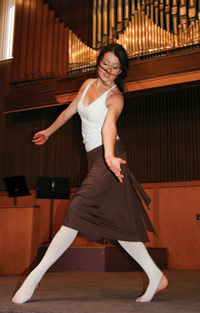 | | Photo by Craig Hiebert |
Some Vancouver Island churches are moving into such an
emphasis, sometimes with a particular project or lay initiative, and others
with the appointment of a staffer – such as a worship arts minister.
The latter is the case at Emmanuel Baptist, near the
University of Victoria, where Joan Dosso has been part of the pastoral team
for the past three years as associate pastor: worship arts.
More tentative worship arts emphases have been part of
the scenery at Lambrick Park Church, Oaklands Chapel and Saanich Community
Church.
In the recent past, at Lambrick, an
artist–in–residence has worked with the church’s pastoral
team. And, two years ago, when Ward Gasque was interim pastor at Oaklands,
one of his frequent sermon themes focused a biblical view of the arts.
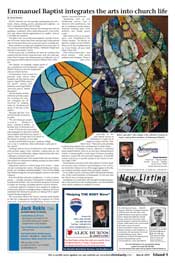
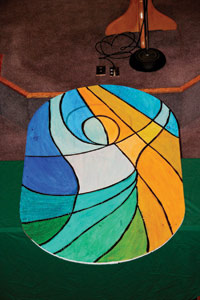
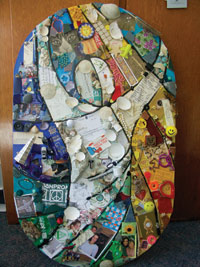 | | Before and after (below): This collage is the collective creation of many congregation members at Emmanuel Baptist. |
One Sunday, for example, Gasque spoke of the
contribution of John Bunyan’s classic Pilgrim’s
Progress to the role of great literature in
church history.
At Emmanuel, Dosso is part of a pastoral team whose
other members are Rob Fitterer (lead pastor), Ingrid White (associate
pastor: seniors and missions) and Craig Hiebert (associate pastor: family
ministries).
And she points out that, while her job title carries
the ‘worship arts’ title, her colleagues are all involved in
helping relate art, literature and music to the life of the church.
The goal, she says, “is to involve people as much
as possible.
“We are trying get people to look at . . .
glimpses of grace – natural or artistic – as another way
of knowing God.”
 Some of that involves encouraging congregants to take
their cameras and notepads with them into nature, to capture signs of hope
and God’s grace in the beauty of creation, Dosso adds. Some of that involves encouraging congregants to take
their cameras and notepads with them into nature, to capture signs of hope
and God’s grace in the beauty of creation, Dosso adds.
Another churchwide art project, creating a collage, was
a way to symbolize what individuals could give to the church.
“During a church service of dedication some came
forward with pictures, paper, rocks, jewellery, a guitar pick (in one case)
to form a multimedia collage, representing what they could give to church
and God.”
That particular project took several weeks over one
summer. The symbol of community building emerged as artists talked about
their processes.
Continue article >>
|
Emmanuel embraces a whole range of art forms –
“classical and contemporary music, liturgical writing and dance,
poetry, use of imagery and photography,” Dosso notes, adding that
Hiebert brings his own photography interest to the latter category.
How does all this work into a traditional – or
even a contemporary –– worship structure? Emmanuel’s
worship services include both formats. Part of it involves using the
Lectionary to shape the worship, including Fitterer’s sermon themes.
Lectionary–defined worship is more familiar to
Anglican, United and Lutheran worshippers than to Baptists, but Dosso
maintains that Emmanuel people are taking well to exploring this liturgical
approach.
The Lectionary follows the church calendar methodically
to take the congregation through the scriptures in a three year cycle. It
permits the highlighting of such events as Advent, Lent and Pentecost.
“Beginning with an Ash Wednesday service, Lent is
observed with meditations, the use of confession, poetic prayer, dramatic
readings, taize, choir anthems and simple prayer songs.”
That Lenten focus is on repentance and thankfulness for
Christ’s sacrifice. “In Advent, we light the candles. In
Lent we blow them out. In the Tenebrae service on Good Friday, all goes
dark when Christ dies.”
Then comes resurrection – and Easter Sunday
– with choral anthems and trumpets. There is also room,
especially at the early family service at Emmanuel to make use of puppets
to help to tell the “children’s story.” That service also
provides a relaxed atmosphere and contemporary worship music.
The church’s newspaper, E–News, edited by a volunteer
team headed Hiebert, serves as an arts and communication vehicle, to bring
together a wide range of themes, including, missions, church life and
personal experience. It includes features that focus on specific people in
the church at various stages of life.
Dosso has been involved with other artists in Victoria.
Readers can meet some of them at poasis.blogspot.com, a
Victoria–rooted site. Names to note, whose pages appear on the site,
are Christine Neufeld, Randy Hein and James Nesbitt.
Dosso makes a point of giving credit to Richard
Motchman, one of the board members at Emmanuel, for the fact that the
church has a worship arts pastor.
Motchman is a visual artist, who brought a broader
perspective to the search for a new worship pastor; one that included
other artistic mediums in addition to music.
March 2009
|