|
By Lloyd Mackey
WHEN some 350 people, most of them winter visitors from
the prairies, gathered in Centennial United Church February 22, they were
following a 63-year Victoria tradition.
Prairie Night was started in 1946, when the leadership
at Centennial recognized that many of the people living in their community,
especially in January and February, were residents at motels and hotels
just west of the church, along Gorge Road.
In fact, says Judy Rankin, who has been a part of
Centennial since she was a child, she and her family have usually been in a
minority in the congregation: people who have spent most of their lives in
Victoria.
“Between them, the transplants – those who
moved to Victoria from the prairies – and the people who come here
for two or three months in the winter, have traditionally made up more of
the congregation than those originating here,” she says.
She said the tradition started when it became clear
that many people attending the church in the winter were in Victoria for
just a couple of months, to escape the prairie cold. Many were grain
farmers who had time to spare, before returning to prepare for seeding.
Dian Strome, who has taken on the role of raising
awareness for Prairie Night, notes that, as the congregation ages, there is
a need to find ways of publicizing the links with the prairies.
Public and Christian media have both been important in
keeping the awareness high. And the hotels in the vicinity provide space in
their own communications systems and on their bulletin boards.
That is important, she maintains, because as a lot of
the older and smaller Gorge motels closed down, the downtown hotels took
over providing attractive winter rates for the winter visitors. While those
hotels are a bit of a long walk to Centennial, the parking situation at the
church is favourable, thanks to the availability of nearby lots
‘loaned’ to church patrons for the evening.
Prairie Night organizers like to keep track of which
prairie provinces are best represented “Each year we have a
‘count’,” Strome notes. “Usually Saskatchewan has
won it; but more recently, Manitoba has moved to the front.”
This year’s event included a concert. The evening
was rounded off with a refreshment time, when visitors from the various
provinces were able to catch up on their respective families, home churches
and community organizations.
Prairie Night is not a church service, per se, although
the fact that it is held in an architecturally and acoustically excellent
sanctuary, which can seat over 600, helps set a comfortable tone for the
event.
In 2001, the church was completely renovated and the
sanctuary and pipe organ were restored to their early glory.
Strome says Roy McCormick, Centennial’s organist
and choirmaster, puts the program together, with a heavy emphasis on music.
The featured group alternates each year, between the Orion and Victoria
Police choirs.
Continue article >>
|
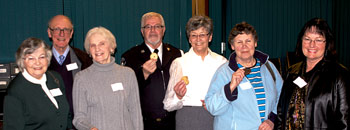 | | Refreshment time after the Prairie Night concert. Photo: Dr. W. Murray Strome |
In the earlier years, there was a strong emphasis on
speakers.
One of the more notable was Tommy Douglas, premier of
Saskatchewan, founder of the New Democratic Party and a Baptist minister.
In more recent years, Iona Campagnolo, who was
Lieutenant-Governor at the time, was remembered as an outstanding speaker.
Alanna Menu, Centennial’s minister for the past
couple of years, is a transplant of sorts, from Ontario (Her own
pilgrimage, available by clicking ‘bio’ at www.cucvictoria.com,
is worth inspecting).
Strome says Menu is a good champion for Prairie Night,
as well as for encouraging prairie winter visitors and transplants to feel
“at home” at Centennial.
In that sense, she says, it is important to “put
Centennial on the map.”
Rankin agrees. “Centennial is a family church. It
is family to look after each other,” she says, suggesting that this
seems to grow out of prairie traditions.
March 2009
|