|
By Lloyd Mackey
CONNECTING the dots between social justice and strong
families was a major exercise at a meeting staged March 12 in Ottawa.
Close to 150 people took in IMFC Conference 2009,
spearheaded by the Institute of Marriage and Family Canada, an Ottawa think
tank and research group.
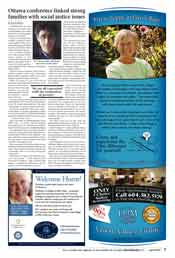
Two of the key speakers were Iain Duncan Smith, former
leader of the Conservative Party in Great Britain, and Gabor Maté, a
Vancouver physician who writes regularly for the Vancouver Sun and the Globe & Mail.
Both the topic and speaker choice were in marked
contrast to the social conservative links of IMFC’s initiator body,
Focus on the Family, founded by James Dobson.
Maté, who spoke to one of his areas of
speciality, parenting and attachment, is well known for his involvement in
Vancouver’s safe injection site and his stance against the federal
government’s opposition to the site.
Duncan Smith is presently known for his development of
the Centre for Social Justice (CSJ). He readily admitted that “the
term ‘social justice’ is seen to belong to the left.”
He told the group that “five issues: educational
failure, economic dependency, addictions, personal debt and family
breakdown have all contributed to an increase in poverty . . . in the
past few years.”
One of his tasks, in establishing the CSJ in 2004, was
to conduct public hearings throughout the U.K., exploring the implications
of the five issues in considerable depth.
The subsequent survey conclusions pointed to the role
non-government organizations – among them churches and charities
– can play. And there is great potential, he said, in moving many of
those options from state control to voluntary action.
Maté contrasted the relationship between
attachment and parenting with what he sees as the “stunting effect
and the undermining of learning” that occurs with strong peer
orientation.
Attachment, he said, is “the drive for closeness
and contact – both physical and emotional.” It helps to
“make a model of the parent . . . keeping the child close in, [so the
parent] can be the primary cue giver.”
By contrast, he suggested that peer orientation –
children looking to each other for values and direction – can lead to
“aggression . . . the making of bullies and victims [and]
unteachability.”
Continue article >>
|
In explaining the rationale of the conference theme,
IMFC executive director David Quist noted: “We are all concerned with
the eradication of poverty, minimizing and supporting the number of single
parent families, decreasing the level of youth and gang violence in our
inner cities, and addressing the substance abuse.”
And Andrea Mrozek, IMFC’s research and
communications manager, added that the conference was intended to bring
“a new vision and fresh vision for social justice,” along with
a recognition “that family structure matters when you think about
poverty and welfare.”
Two weeks before the Ottawa event, Mrozek wrote about
Duncan Smith’s upcoming visit, in an Ottawa
Citizen op-ed piece. She concluded:
“The vision presented by Duncan Smith and his fellow U.K.
Conservatives is one for a better community. There’s an opportunity
here for Canada’s Conservatives – understanding that strong
families are the way toward a smaller government and greater freedom. Who
knew social issues (properly understood) were the way toward fiscal
responsibility?”
The IMFC event was not the only one addressing the
influence of faith on society during the first two weeks of March.
John Redekop, B.C.-based political science professor
emeritus of Wilfrid Laurier University, lectured on ‘What does God
expect: of governments and of citizens?’ at Trinity Western
University’s Laurentian Leadership Centre in Ottawa.
Paul Bramadat, director of the Centre for Studies in
Religion and Society at the University of Victoria, spoke both to a few
dozen MPs and another 50 or so of their support staffers, at a Canadian
Federation for the Humanities and Social Sciences breakfast.
His topic was ‘Political Minefields: Religion in
Post-secular Society,’ and his main points grew out of a study he had
co-edited, entitled: ‘International migration and the governance of
religious diversity.’
April 2009
|