|
By Steve Weatherbe
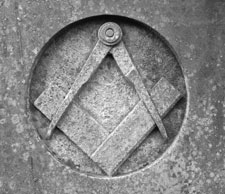 | | Freemason symbols: the square and compass. |
IF YOU extend a line along the central axis of
B.C.’s Legislature far enough north, it will pass through the Masonic
temple in North Vancouver – named after the Duke of Connaught who,
coincidentally, laid the cornerstone for the Provincial Library which abuts
the Legislature along the very same axis. And who, coincidentally, was a
senior member of the Freemasons.
If you believe in coincidences.
Victoria stonemason Chris Trenholm doesn’t. In a
March 21 presentation, Sacred Victoria, he argued that the positioning of many of the
capital’s century-old public buildings conform to a grand design
befitting the universalist pretensions of their architects and builders
– who were members of the Freemasons.
Freemasonry probably began as a medieval craft guild
for master masons, who traveled from city to city to work on great projects
such as cathedrals. When it was revived in the early modern period in
London, however, few of its members got their hands dirty. They were
leaders of society: lawyers, doctors, clergy and believers in Enlightenment
values of progress through industry, thrift and empirical science.
What set it apart from other men’s clubs or the
British Royal Society was its arcane rituals, its claims to ancient
lineage, and its vows of secrecy upon pain of death.
Some of this arcane flavour was conveyed at
Trenholm’s presentation by the setting, the darkened Alix Goolden
Hall – formerly the nave of a decommissioned United Church.
Before settling into the mundane job of lining up B.C.
buildings using Google Earth, Trenholm warmed up his small audience with a
video from Charles Gilchrist, an American promoter of the concept of sacred
architecture: that the physical universe is rational, and conforms on
different levels to geometric patterns that are expressions of ideas.
Trenholm next showed a BBC educational video about the
facades of medieval Gothic cathedrals: how hundreds of demonic,
human, saintly, angelic and divine figures taught the literate and
illiterate how all creation fit within a God-given disposition – with
everything in its place.
Trenholm leapt from there to the layout of the
Parliament Buildings – designed by Freemason Francis Rattenbury.
Rattenbury, says Trenholm, aligned his buildings in
accord with the “law of harmony,” as did other builders.
“Certain historic sites in most cities are arranged geometrically,
which is to say they are arranged to form predetermined patterns.”
Rattenbury may not have done so deliberately.
“The extension of these design elements beyond the buildings
themselves is perhaps the natural consequence of working within this
theme of universal harmony.”
For Freemasons, there is a design underlying the
universe – put there by the nondenominational Great Architect of the
Universe.
This idea of a generic, non-trinitarian deity
compatible with all religions is one reason why Freemasonry has been
condemned by a wide range of Christian denominations.
The Catholic church denounced Freemasonry from its
modern outset in the 1700s; American evangelicals got behind the
anti-Masonic movement in the early 1800s. By then, Masons were, for many
Americans, no more than a fraternal organization with pleasantly arcane
trappings, as well as a business networking organization.
Continue article >>
|
By the Civil War, anti-Masonism had died out and
Masonry had revived. James B. Twitchell, in Where
Men Hide, lumped Freemasonry rather innocently
in with other male hideaways (from women) such as fraternal organizations,
sporting clubs, military reserve units – and, lately, Bible studies.
Gary Bennett, pastor of Victoria’s Church of the
Nazarene, says his denomination’s rejection of Freemasonry is based
on the group’s secrecy.
“We believe, as Christians, that we are called to
open witness, to live lives of openness and transparency. The Masons are a
secret society bound by oaths of secrecy. And it is like a religion unto
itself, with its oaths and rituals and its own belief system. Some of those
beliefs get pretty dark.”
The anti-cult Christian Research Institute asserts that
it is “inconsistent for any Christian to swear the oaths of Masonry .
. . when Masonry’s own ritual, doctrines, and impact in history have
denied and opposed biblical teaching.”
A chief Catholic concern is that Masonry teaches the
notion that all religions are the basically the same, and therefore,
Christian revelation as found in the Bible is nothing special.
But Masons themselves insist that they seek merely to
prevent members from falling out over religion, and so express their views
on deity in as generic a manner as possible. Their B.C. website asserts
that they take no position on religion.
As a secret society, however, the Masons are bound to
be accused of much that they cannot disprove. While there are Islamic
chapters, many Muslims accuse them of being an instrument of Jewish
conspiracies to rule the world. Other critics see the Masons as a front for
the Jesuits, the once-powerful Catholic order, and its alleged conspiracy
to rule the world.
Trenholm, who is not a Freemason, dismissed the charges
against the group, saying: “Most Freemasons are Christians trying to
do good works, and don’t deserve all the bad press.”
Freemasons, he said, were “immensely important in
Victorian society.”
April 2009
|