|
By Lloyd Mackey
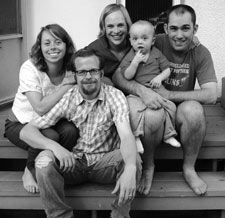 | | Katie & Andy Withrow (left) and Katie & Josh Wilton are neighbour-hood-based 'ancient-future' church planters. |
JOSH WILTON and Andy Withrow are working with
congregations in downtown Victoria and Langford, to develop a new cluster
of church plants in a blending of the liturgical, the evangelical and the
charismatic.
Wilton is working out of office space provided by
Church Of Our Lord (COOL) and Withrow is adding his church plant activity
to his part time pastoral role at St. Mary’s Open Gate in Langford.
COOL is an historic downtown Reformed Episcopal
congregation and St. Mary’s Open Gate is part of the Anglican Network
in Canada. And both are part of an Anglican-rooted coalition as an
alternative to the Anglican Church in Canada over such issues as biblical
authority and the definitions of same-sex blessings and marriage covenants.
Wilton credits Rod Ellis and Sharon Hayton, the
rectors, respectively at COOL and St. Mary’s, with a good deal of
encouragement for what they are trying to do.
The story of the church planting in this setting,
Wilton says, is more about reaching out in neighbourhoods than it is about
theological turbulence.
Island Insight interviewed
Wilton recently about the church plant project.
Both men come from Washington State, Wilton from the
Seattle area and Withrow from just across the Columbia River and state line
from Portland.
They and their wives did their undergrad work at
Western Washington University in Bellingham. They started to work out their
common vision of the future of the church while engaged as tour guides in
Alaska before beginning graduate studies at Regent College in Vancouver.
Both their wives are named Katie, and, as it happens,
are both in the final stages of pregnancy as this press deadline is
approaching. (The Wiltons already have one child. For the Withrows, this is
their first.)
While completing their Regent studies, both men worked
in Vancouver area churches.
Wilton was at St. John’s Shaughnessy – one
of the leaders in the Anglican Network movement. Withrow was in a
Presbyterian setting.
Following their Regent work, they sensed Victoria was a
good place to become involved in church planting, after passing up some
preliminary checks of the Comox Valley.
“It is a different model, more like a
pomegranate,” Wilton points out, explaining they are a bit like
“old school Jesuits, translating the faith to those burned by
Christianity or tired of the rhetoric.”
They want to avoid drawing people who are already well
established in the church into their clusters.
“Our intention is not to ‘steal
sheep’, not to create transfer growth. We need strong families who
can reach out to their neighbours, then become what we call ‘site
pastors’ in the clusters. Andy and I will concentrate on developing
new clusters.”
Their hope, Wilton says, is that “I would form a
downtown cluster – of twentysomethings – getting 20
people moving from house to house, developing it to a group of 30 or
40. Then launch a team, with the originals as the ‘bones’ of
the group.”
Continue article >>
|
There would be Sunday (evening) services, prefaced by a
meal, “a weekly get together and common training for two or three
clusters – and occasional common worship, with special services, say,
on Ash Wednesday.”
In effect, Withrow would do something similar in
Langford, but adapted to the dynamics of a suburban community.
Some people, Wilton says, might call this “a
house church on steroids, or some, a bottom up, small group model. This
way, it helps with the intimacy.”
Other proponents of church planting want to get a
service going, he says.
“Both are necessary. Our hope is to be able to
love our neighbours well. We are not aiming at a regional church, but one
that is neighbourhood-based.”
Wilton says they want to” do good in the setting
in which they are placed. One idea, downtown, would be to develop an urban
garden, do some marketplace ministry and maybe do a Wednesday service at
lunch.”
The garden concept would help to “give, out of
our abundance, to the poor.”
In Langford, the orientation will be more to
families.
They are encouraging the churches with which they are
connected to “vision cast” both as to working out the model and
finding a name for it.
One name being considered is ‘The Table.’
That, says Wilton, communicates both the “symbol of communion with
God and fellowship with one another.” And the garden idea adds to the
symbolism, because, figuratively, it brings something to the table.
People ask what the style will be, says Wilton.
“We answer: ancient-future. We want to be evangelical, charismatic
and catholic. There are three words beginning with ‘s’ that
reflect what we want to be about: the spirit, the scripture and the
sacred.
“We want the connection with history – but
not the same thing every week.”
April 2009
|