|
VANCOUVER SUN columnist Douglas Todd has received more than 50 journalism awards for his coverage of faith-related subjects. This was recently acknowledged by Church and Faith Trends (C&FT), an online publication of the Centre for Research on Canadian Evangelicalism -- which is an initiative affiliated with The Evangelical Fellowship of Canada. Following is an abridged version of the C&FT interview with Todd.
Church & Faith Trends:
How did you come to cover religion in a profession
where it isn’t common, outside of journals for religious
communities?
Douglas Todd: I was brought
up in an atheist family, kind of a strict one, where all religious
people were characterized as kooks.
And then of course I got older, into my late teens, and
started bumping into people who were Christians, were evangelical, were
religious. I realized, well, some of them are kooks, but many aren’t.
As a matter of fact, many of them had something going
for them that my family didn’t. Part of my attraction was to
religious people’s sense of hope. I think I wanted that and
needed it. You know how everyone of my generation rebelled against
the church; I rebelled against atheism. I’m glad I
[did].
C&FT: How did you come to write on religion for a major Canadian
daily?
DT: I studied world religions – that was my
bachelor’s degree – just because I was so fascinated by it all.
And then I went to postgraduate studies of
religion, and I realized I wasn’t really a philosopher type –
although now I wonder if I could have been – and I didn’t
want to be a minister, because the church still felt kind of unfamiliar for
me to make that kind of commitment.
So I went into journalism because I enjoyed writing for
the UBC student newspaper, and I’ve always been really
interested in how the world works.
C&FT: Has there been an editorial change in receptivity to stories
on religion?
DT: Yes, it has changed. About the mid-90s or late 90s the word
‘spirituality’ became kind of trendy. And that opened it up, so
that even hard-bitten journalists could think maybe there’s something
here that’s interesting, which is more than just writing about popes
and religious leaders and televangelists.
My first encounter with an evangelical was a
high-school counsellor-teacher named Ernestine Young, who was from Utah in
the United States. She was kind of square-looking, but she was really
dynamic and she took about a dozen of us Argyle high school students
under her wing. I think she saw us as young people who were intelligent and
had a lot of potential, but were maybe struggling a bit.
She was totally hopeful and into rattling the cages of
the school. She was also into psychology at the same time. Basically,
she wanted to change society for the better. She was an unusual mix
of Christian evangelicalism and kind of 60s radicalism. I had a huge
admiration for her. She was probably my first mentor, and she might
have saved me, a little bit, from my own upbringing.
C&FT: If you had to very succinctly define evangelical Christians
for your readers in a column how would you do that?
DT: I’d just say they represent 8 – 12 percent of the
Canadian population – and they’re similar to, but more moderate
than, their American counterparts.
C&FT: What are the two most common reoccurring storylines involving
Canadian evangelical Christians, and have these changed over the
course of your career?
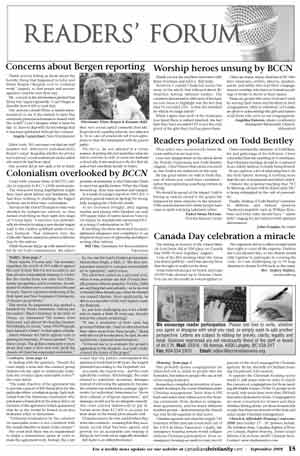
DT: Obviously the homosexuality storyline has been there strongly for a
long time. And it continues, especially now that
it’s manifesting itself in the Anglican church. It’s been
a long-term storyline that doesn’t seem to go away. I think
there are actually three storylines. The second would be evangelical
involvement in politics. The third storyline revolves around the claim
that evangelicals are being persecuted by the wider culture.
Continue article >>
|
C&FT: Is that a storyline that evangelicals are putting out there?
DT: Yes, definitely. And you know there’s even some truth
to it, in terms of evangelicals being somewhat stigmatized. But sometimes I
think it’s a bit overdone. In some instances, evangelicals’
vague sense of feeling persecuted can be manipulated to strengthen
support for the cause – and even in its worst manifestations, used as
a way to raise money.
I wonder that when I hear certain evangelical
leaders claim, “Here’s the bad liberal culture attacking us
again.” Andrew Grenville, a pollster who looks at Canadian
evangelicals, has reflected on this problem as well.
At the same time, I think it’s true that there is
some stigmatization of Christians in Canada, including both mainline and
evangelical Christians. Non-evangelical Canadians do not at all understand
the complexities of the evangelical movement.
For that matter, a lot of evangelicals don’t
understand the subtleties and diversity of their own religious community.
Too many have simplistic beliefs about what it means to be an
evangelical. Fortunately, evangelical groupthink is not nearly as strong in
Canada as in the U.S.
C&FT: If you could offer a piece of advice to Canadian evangelicals
on how to participate constructively in the public square, what would
it be?
DT: Two pieces of advice. The first would be to emphasize new
topics; get away from sex-related topics. Don’t ignore them, but
don’t emphasize them so much.
That is, don’t emphasize them unless you want to
create a wedge issue that divides conservative Christians from the rest of
the public – which, unfortunately, is how I think some religious
leaders use sex-related issues.
I would suggest toning down issues of abortion,
homosexuality, and even debates over age of consent.
I’m getting a bit theological and biblical here,
but I think John Stackhouse would confirm Jesus had 10 times more to say
about the economy and money than he did about sexuality. So the
emphasis on sexual issues seems a bit out of whack with what was going
on in early Christianity.
The other bit of advice to evangelicals would be to try
to find some common cause with other faith groups and even non-faith
groups. That’s starting to happen on the environment and other
things. There are people out there doing it.
I wrote a column a couple of years ago about the
‘crunchy conservatives,’ the
conservative-but-ethical-and-ecological types who don’t want to
shop at Wal-Mart and want to protect Creation.
Why not work with Buddhist groups on certain common
issues? I think it would be really creative for evangelicals, and the
public would definitely take notice.
They would see that evangelicals aren’t just
pitting their camp against all the others, and that evangelicals do care
about far more than just sex.
I know they do because of my work writing about
different religious groups – but evangelicals are not too good at
getting that message out to the wider public.
The complete Douglas Todd interview can be found here (pdf).
September 2008
|