|
By Mark Buchanan
THE WORLD is not dying for another article about rest.
But it is dying
for the rest of God.
I certainly was. I became a Sabbath-keeper the
hard way: either that, or die. Not die literally, but die in other ways.
It happened subtly, over time; but I noticed at some
point that the harder I worked, the less I accomplished. I was often a
whirligig of motion.
 My days were intricately fitted together like the old
game of Mousetrap – every piece precariously connected to every
other, the things needing to work together for it to work at all. But there
was little joy, and stunted fruit. My days were intricately fitted together like the old
game of Mousetrap – every piece precariously connected to every
other, the things needing to work together for it to work at all. But there
was little joy, and stunted fruit.
To justify myself, I’d tell others I was gripped
by a magnificent obsession, I was purpose-driven. It may have begun that
way. It wasn’t that way any longer.
Often I was just obsessed, merely driven, no
magnificence or purposefulness about it. I once went 40 days – an
ominously biblical number – without taking a single day off. And was
proud of it.
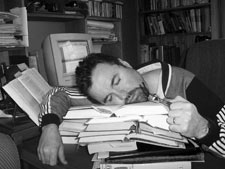
But things weren’t right. Through my work often
consumed me, I was losing my pleasure in it – and many other things
besides – and losing, too, my effectiveness in it. And here’s a
secret: for all my busyness, I was increasingly slothful.
I could wile away hours at a time in a masquerade of
working, a pantomime of toil – fiddling about on the computer,
leafing through old magazines, chatting up people in the hallways. But I
was squandering time, not redeeming it.
And whenever I stepped out for a vacation, I did just
that: vacated, evacuated, spilled myself empty. I folded in on myself like
a tent suddenly bereft of stakes and ropes and poles, clapped hard by the
wind. The air went out of me.
The inmost places suffered most. I was losing
perspective. Fissures in my character worked themselves into cracks. Some
widened into ruptures.
I grew easily irritable, paranoid, bitter,
self-righteous, gloomy. I was often argumentative: I preferred rightness to
intimacy. I avoided and I withdrew.
I had a few people I confided in, but few friends. I
didn’t understand friendship. I had a habit of turning people, good
people who genuinely cared for me, into extensions of myself: still water
for me to gaze at the way Narcissus did, dark caves for me to boom my voice
into and bask in the echoes. I didn’t let anyone get too near. And
then I came to my senses.
I wish I could say this happened in a dazzling vision
– a voice from heaven, a light that blinded and wounded and healed
– but it didn’t. It was more like a slow dawning.
I didn’t lose my marriage, or family, or
ministry, or health. I didn’t wallow in pigmuck, scavenging for husks
and rinds. But it became clear that, if I continued in the way I was
heading, I was going to do lasting damage.
And it became obvious that the pace and scale of my
striving were paying diminishing returns. My drivenness was doing no one
any favours. I couldn’t keep it up and had no good excuse to try.
I learned to keep Sabbath in the crucible of breaking
it.
God made us from dust. We’re never too far from
our origins. The apostle Paul says we’re only clay pots – dust
mixed with water, passed through fire. Hard, yes, but brittle too. Knowing
this, God gave us the gift of Sabbath – not just as a day, but as an
orientation, of seeing and knowing.
Continue article >>
|
Sabbath-keeping is a form of mending. It’s mortar
in the joints. Keep Sabbath, or else break too easily, and oversoon. Keep
it, otherwise our dustiness consumes us, becomes us, and we end up able to
hold exactly nothing.
In a culture where busyness is a fetish, stillness is
laziness. But without it, we miss the rest of God.
Stillness invites us to enter more fully so that we
might know him more deeply. “Be still, and know that I am God.”
Some knowing is never pursued, only received. And for that, you need to be
still.
Sabbath is both a day and an attitude to nurture such
stillness. It is both time on a calendar and a disposition of the heart. It
is a day we enter, but just as much a way we see. Sabbath imparts the rest
of God: the things of God’s nature and presence which we miss in our
busyness.
You might have grown up legalistic about Sabbath
– your principle memory of it is of stiff collars chafing at the neck
and a vast, stern silence that settled on the house like a grief. I hope to
invite you out of that rigidity and gloom.
You might have grown up indifferent about Sabbath. To
you, it is a musty, creaky thing about which only ancient rabbis and old
German Mennonites bother.
You tend to see Sabbath as something archaic and
arcane. Something from which you’re exempt. Something that, like
bloomers and corsets and top hats, went out of style long ago.
I hope to convince you that Sabbath, in the long run,
is as essential to your well-being as food and water, and as good as a wood
fire on a cold day. I hope to tune your ears to better hear, and gladly
accept, Jesus’ invitation: “Come to me, all who are weary and
heavy-laden, and I will give you rest.”
When I use the word Sabbath I mean two things.
First, I mean a day, the seventh day in particular. I
want to convince you that setting apart an entire day for feasting
and resting and worship and play is a gift and not a burden – and
neglecting the gift too long will make your soul, like soil never left
fallow, hard and dry and spent.
But when I say Sabbath I also mean an attitude. It is
perspective, and orientation. I mean a Sabbath heart, not just a Sabbath
day.
A Sabbath heart is restful even in the midst of unrest
and upheaval. It is attentive to the presence of God and others even in the
welter of much coming and going, rising and falling. It is still, and knows
God – even when mountains fall into the sea.
You’ll never enter the Sabbath day without a
Sabbath heart.
Reprinted by permission: ‘The Rest of God, Mark Buchanan, 2006, W.
Publishing, a division of Thomas Nelson, Inc., Nashville, Tennessee. All
rights reserved.’ Mark Buchanan is pastor of New Life Community
Baptist Church in Duncan.
October 2008
|