|
By Jim Coggins
BACK WHEN I was a staunch Mennonite, other staunch Mennonites used to ask me
profound theological questions.
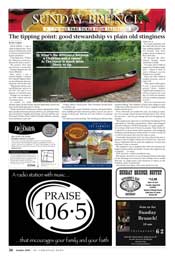
A favourite was: “What’s the difference between a Mennonite and a canoe?”
The answer, they said, was obvious. A canoe tips.
Perhaps Baptists are not much different.
Back when I was a staunch Baptist, I remember a staunch Baptist minister
describing his denominational cohorts this way:
“Baptists get all they can, can all they get, and sit on the lid.” He said it in a sermon, so it must be true.
Perhaps we can blame it on John Calvin and his ‘Protestant ethic.’
Or maybe it’s John Wesley’s fault. Wesley led the staunch Methodists, known for their methodical approach
to living.
Wesley preached a well-known sermon arguing that Christians should work hard and
earn all they can, and that Christians should live frugally and soberly, and
save all they can. The result, Wesley noted, is that Christians will have a
mysterious tendency to get rich.
Wesley added a third point: that Christians should then give all they can.
Unfortunately, many Christians, having exhausted themselves fulfilling Wesley’s first two points, seem to run out of energy at this point. After all, two out
of three is a passing grade.
We call it good stewardship. The watching world has other names for it.
Go to any restaurant, and the staff will tell you they hate working Sundays – but not because they have qualms about working on the Lord’s Day.
It’s because the after-church Sunday lunch crowd tip so badly.
Of course, there’s biblical support for Christian stinginess – which is okay, if you’re willing to use the Pharisees as a model.
There are other biblical models, however, such as Luke 6:38:
“Give, and it will be given to you. A good measure, pressed down, shaken together
and running over, will be poured into your lap. For with the measure you use,
it will be measured to you.”
The Old Testament law required tithing. The children of Israel were obliged to
give 10 percent of their incomes to the Lord, to support worship leaders and
the poor.
Continue article >>
|
We’re obviously not under law now. According to statistics, the average
church-going Christian gives only about two percent – and the percentage has been dropping for decades.
This ungenerous approach is sometimes transferred from individuals to Christian
organizations. Often, cash-strapped churches will pay a $100 honorarium to a
guest speaker – for a sermon that took 20 hours to prepare. That works out to about $5 an hour
before travel expenses. And struggling Christian periodicals pay writers about
10 cents a word, for a 1,000-word article that took two days to write.
I remember hearing the story of a man whose boss was so generous that he began
doing extra work for free. The boss was so impressed that he gave the employee
a bonus and told him to take a vacation.
The employee was so grateful that when he returned, he began working earlier and
harder. In turn, the employer was so grateful . . . et cetera.
Well, the story couldn’t possibly be true.
But maybe, next time we are at Sunday brunch reflecting on the blessings we
received at the worship service earlier that day, we might spare a few moments
to reflect on the Christian virtue of generosity.
And maybe even spare a few more bucks for a tip.
October 2009
|