|
By Jim Coggins
Preston Manning, John Stackhouse and other Canadians
assess the changing role of U.S. evangelicals in politics.
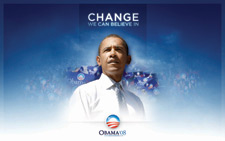 THE AMERICAN election may have constituted a victory
for president-elect Barack Obama, the Democratic Party, African-Americans
and racial harmony. THE AMERICAN election may have constituted a victory
for president-elect Barack Obama, the Democratic Party, African-Americans
and racial harmony.
But it represented “a very difficult choice for
conservative Christians,” according to one Canadian commentator.
The problem was that there was no candidate
evangelicals could feel totally comfortable with, said John G. Stackhouse,
professor of theology and culture at Regent College in Vancouver.
Republican John McCain, he maintained, is not an
evangelical, has been divorced and is not as strongly pro-life as many
evangelicals would like. Democrat Obama is a “church-going
Christian,” he noted, but is also pro-choice on the abortion
question.
As a result, many evangelical leaders “sat on
their hands” in this election, said Stackhouse.
The appointment of Sarah Palin as the Republican vice
presidential nominee galvanized some evangelicals, but she proved to be
“not as bright and pure as some evangelicals had hoped,” in
addition to coming across as overly ambitious – and out of her
depth.
White evangelical support was crucial to giving
Republican George W. Bush his narrow election victories in 2000 and 2004.
But while Bush won 79 percent of the white
evangelical vote in 2004, McCain won only 74 percent this year. That is not
a huge change, but it was significant because white evangelicals
represented 23 percent of voters this year.
Moreover, Obama did better among evangelicals in
‘swing states’ – states where the election was close
– and among young evangelicals, gaining 32 percent of the votes of
white evangelicals aged 18 – 29.
Church attendance
Obama won only 43 percent of the vote of weekly
churchgoers, but 75 percent of those affiliated with no religion.
He won 94 percent of the vote of those who attend black
churches and 54 percent of Roman Catholics – a figure that includes
47 percent of white Catholics and 72 percent of Hispanic Catholics.
Black churches in the U.S. have a “rich political
heritage,” said Brian Stiller, president of Tyndale University
College and Seminary in Toronto.
They are sometimes considered to be evangelical,
because they worship like evangelical and charismatic churches. However,
their theological tradition is quite different.
There have been widespread accusations that Obama is
not really a Christian because he doesn’t espouse evangelical values.
However, Obama is being “true to his religious tradition,” said
Paul Rowe, associate professor in political studies at Trinity Western
University.
He maintained that black churches have always had an
emphasis on ‘liberation theology’ – and the social
gospel, the application of the gospel in this world. They have an emphasis
on religious experience, he added; however, Rowe contended, they do not
have a well-developed theology.
Black churches have strongly supported the Democratic
Party in the past, but not in the overwhelming numbers they did this time.
Roman Catholics represent about the same percentage of
the U.S. population as evangelicals, but have not tended to vote as a bloc.
Changes in
evangelicalism
For Republicans to assume that evangelicals would
automatically vote for them because of the hot button issues of abortion
and homosexuality was a big mistake, said Stiller.
There may still be “pockets of single-issue
Christians” in the U.S., but evangelical concerns are generally
broader than that, he said. Young evangelicals in both the U.S. and Canada
are increasingly interested in issues such as poverty and the environment.
“U.S. evangelicals are also human beings and
Americans,” said Stackhouse, suggesting that their voting decisions
were influenced by issues such as the economic crisis, just like other
Americans. “Evangelicals don’t vote just on religious
considerations.”
“The issues evangelicals feel are important are
diversifying,” Rowe said, noting a widespread sense that the
Republicans have mismanaged foreign policy and economic policy.
“Young evangelical voters are still not
pro-abortion – but may feel that issue has been settled for now. They
want a more progressive foreign policy.”
Stiller added: “The Religious Right is highly
fragmented over the failure of the Bush administration in many areas,
including the lack of progress [to limit] abortion and gay
rights.”
Conservative salvos
In the last days of the election campaign, ideological
salvos were fired at the Obama campaign from a number of conservative
Christian sources.
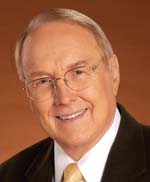 | | Evangelicals in conflict: an anti-Obama polemic by James Dobson (above) sparked a ferocious response from social activist Jim Wallis (below). |
The most high profile such message came from Focus on
the Family founder James Dobson. He released a ‘Letter from
2012,’ which predicted dire consequences from an Obama victory.
These consequences included the entrenchment of
abortion rights, the legalization of same-sex marriage, the silencing of
Christians, the prohibition of gun ownership, nationalized medicine (a
medicare system similar to Canada’s), economic disaster in the U.S.,
military gains by militant Islam and Russia, and the dropping of a nuclear
bomb on an Israeli city.
The letter’s introduction asserted: “Every
future ‘event’ described here is based on established legal and
political trends that can be abundantly documented, and that only need a
‘tipping point’ – such as the election of Senator Obama
and a Democratic House and Senate – to begin to put them into
place.”
The letter exemplified Dobson’s position as the
most prominent remaining leader of the Religious Right, which is now an
unorganized movement – but is the successor to the Moral Majority
organization formed by televangelist Jerry Falwell to elect Ronald Reagan
president in 1980.
It was this same evangelical bloc that helped elect
Republican George W. Bush in 2000 and 2004.
Dobson’s letter was castigated by some other
Christians, most notably Jim Wallis, founder of the evangelical social
action group Call to Renewal, and editor of Sojourners magazine. Wallis declared:
“James Dobson, you owe America an apology. The
fictional letter . . . crosses all lines of decent public discourse.
In a time of utter political incivility, it shows the kind of negative
Christian leadership that has become so embarrassing to so many of your
fellow Christians in America. We are weary of this kind of Christian
leadership, and that is why so many are forsaking the Religious Right in
this election.”
Leadership changing
The leadership of the U.S. evangelical movement is
changing, said Stiller. Falwell and James Kennedy have died, and Pat
Robertson is pretty much “a spent force.”
Continue article >>
|
Stackhouse noted that the “most prominent
evangelical spokespeople” in the U.S. – those with TV shows and
big book contracts – have almost always been on the extreme right
wing.
It is not clear whether this is because people with
other outlooks don’t watch religious television or because there is
something about the medium of television that “leans toward dramatic,
extreme and simple” presentations.
He suggested televangelists have never been
representative of the full spectrum of the evangelical movement.
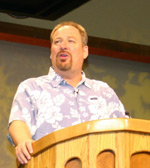 | | Rick Warren, considered by some to represent the new face of American evangelicalism. |
Rowe, Stiller and Stackhouse all suggested that the new
face of U.S. evangelicalism may be Rick Warren of Saddleback Church in Lake
Forest, California.
Warren is pro-life, but has also supported ministry to
AIDS victims in Africa and other social causes. Warren invited both McCain
and Obama to his church to talk about their personal faith and the issues
in mid-August.
Stiller said Warren is “more reflective of the
evangelical community than the Religious Right has ever been.”
Impact on issues
Because of the election, “there will be a decline
in the significance of religion in terms of public importance,” Rowe
suggested, adding that the Democrats “will try to pull religion out
of public life.” However, he added, it would be a mistake to
overstate that. “America is a deeply religious country, and nothing
has changed about that.”
Rowe pointed out that a proposition banning same-sex
marriage passed in California, even though the state voted strongly for
Obama. Arizona and Florida passed similar propositions. Therefore, the
Democratic Party should not think it has “a blank cheque,” he
warned. “The Democratic Party does not represent the broad scope of
Christian or American culture on issues such as abortion.” He added
that the Democratic Party’s move to the left in the 1960s sowed the
seeds for the rise of the Religious Right in the 1980s.
On the other hand, “Just because you are paranoid
doesn’t mean they aren’t out to get you,” Stackhouse
quipped.
Both Stackhouse and Rowe stated Dobson’s
strongest argument was that Obama will have the power to make appointments
to the Supreme Court. That could lead to decisions in favour of abortion
and same-sex marriage and even to restrictions on the freedom of Christians
to talk about those issues. Dobson cited instances from Canada on the
latter point.
However, “even well vetted justices don’t
do what you thought they would do,” as has been proven by the
conservative justices appointed by Republicans, said Stackhouse.
“Judges have a habit of thinking for
themselves.” As well, there are numerous “checks and
balances” in the U.S. system, and “things take a long
time.”
Stackhouse considered it “very likely”
that, if present trends continue, same-sex marriage will be approved in the
U.S. and other English-speaking democracies – because it will be
“framed as a matter of individual human rights.”
However, he added that “history doesn’t
always move in one direction.” In particular, there is an axiom that
“hemlines fall with the stock market” – that is, economic
hard times tend to push society in a more conservative direction.
Political pendulum
 | | Former opposition leader Preston Manning, Canada's champion of the interface between politics and Christianity. |
Preston Manning, founder of the Reform Party in Canada
and now president and CEO of the Manning Centre for Building Democracy,
said there is a pendulum in American politics – and in the next
election, it could swing back the other way.
While there is “room for concern” about
current trends, it would be a mistake to keep fighting the same battles in
the same ways, he said. For instance, because of the discovery that DNA
contains the entire genetic code of a person, “it is increasingly
difficult to maintain that personhood only begins at birth,” said
Manning. “Science is changing the framework.”
Christians are not changing the nature of their
concerns, but “getting wiser in what political action to take,”
said Manning.
“Christians are called to be as wise as serpents
and as gracious as doves – and more believers are learning what that
means.”
Application to Canada
What happens in the U.S. usually has some impact in
Canada.
The Roman Catholic Church has expressed some concern
that an ‘assisted suicide’ proposition that passed in
Washington state – and which is similar to a proposition passed in
Oregon a few years ago – may encourage assisted suicide proponents
here.
However, all the experts BCCN spoke to said there is no direct political connection.
“These countries run separately on social and moral issues,”
said Stackhouse. Manning noted Canadians elected a conservative government
about the same time as Americans elected a liberal one.
Evangelicals don’t have the same critical mass in
Canada, said Stiller. There are three million evangelicals in Canada,
compared to 90 million in the U.S., and Canadian evangelicals have
therefore been less tempted to seek political power.
Canadian televangelists David Mainse of 100 Huntley Street and Willard
Thiessen of It’s a New Day have deliberately chosen not to be politically
partisan, he noted.
Manning said the same thing about Stiller’s
earlier leadership of the Evangelical Fellowship of Canada. The approach
taken by Canadian evangelicals is “fundamentally different”
from that taken by many American evangelicals, he said, “and
beneficially so.”
Toward fairness
Stiller added that Canadians, including Canadian
evangelicals, have a cultural bent toward fairness that recoils at the
kinds of extremes sometimes evident in the U.S.
The weakening of the connection between American
evangelicals and the Republican Party is “a healthy
development,” said Manning.
“It is dangerous for faith communities to
get identified exclusively with one party . . . A faith perspective should
transcend party politics.” He added that there should be Christian
people on both sides subjecting policy to scrutiny.
Stiller agreed. “The lesson for us is that it is
a huge mistake when politicians or voters get trapped into believing that
faith and a party are, by nature of their doctrine, in lockstep,” he
said.
“For me, it is a good sign that the partisan
evangelical connection no longer seems to rule [in U.S. politics]. When
faith becomes captured by an ideological and partisan focus, it sells its
inheritance for a mess of political pottage.”
December 2008
|