|
By Peter T. Chattaway
 THE CHRONICLES of Narnia may
be coming to a premature end. THE CHRONICLES of Narnia may
be coming to a premature end.
The movie series, based on C.S. Lewis’ seven-part
series of books, began three years ago with Andrew Adamson’s
enormously successful adaptation of The Lion,
the Witch and the Wardrobe. But it stalled this
year with Prince Caspian, which earned only a little more than half as much money at box
offices around the world.
Several reasons have been proposed for the film’s
disappointing performance at the multiplex, including: a script that
abandoned too many of Lewis’ themes; serious competition from other
summer releases, such as Iron Man and Indiana Jones 4; and a shift in demographics, as the ‘echo
boomers’ – the children of the original baby boom
– grow up and move on to grittier fare like The Dark Knight.
Whatever the reason, we are now beginning to hear
reports that Walden Media and Walt Disney Studios, the companies that made
the first two films, have not yet been able to agree on a budget for the
next one, The Voyage of the Dawn Treader.
 The film is currently slated for a May 2010 release,
but the start date has been put off repeatedly. At one point, the cameras
were going to start rolling last summer; then, in April, producer Mark
Johnson said they would start shooting in October; and then, in October,
one of the actors stated they might start in April 2009. The film is currently slated for a May 2010 release,
but the start date has been put off repeatedly. At one point, the cameras
were going to start rolling last summer; then, in April, producer Mark
Johnson said they would start shooting in October; and then, in October,
one of the actors stated they might start in April 2009.
Meanwhile, Walden Media – a movie
production company created several years ago by Christian billionaire
Philip Anschutz – has undergone a massive upheaval, as
many of its top staff have left the firm. This includes Walden co-founder
Cary Granat, though he will reportedly stay as a “creative
consultant” on Dawn Treader.
Whether The Voyage of the
Dawn Treader itself will ever be made
– and, if so, under what sorts of budget constraints
– will depend, it is said, on the home-video sales for Prince Caspian, which comes to
DVD and Blu-Ray December 2.
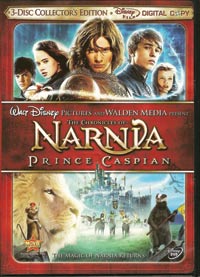
The disc is available by itself, or in a three-disc
package that includes a bunch of bonus features and a digital copy of the
movie. The bonus features are fun enough, though trivial – looking at
everything from the weather problems that plagued the set to how the
children who play the Pevensies have grown up since the last film.
The best featurette is probably one that looks at how
an entire town in Slovenia was taken over by the filmmakers, as they filmed
several scenes at a nearby river in which a bridge is built and then
destroyed.
Curiously, a featurette on Warwick Davis, who plays the
dwarf Nikabrik, neglects to mention that he played the mouse Reepicheep in
a BBC-TV version of Prince Caspian nearly 20 years ago.
The set also includes just a few seconds of the
pre-production that has been done for Dawn
Treader. We will just have to wait and see if
the film itself ever gets made.
* * *
Talk about irony. Last month, I caught a press
screening of Milk,
the movie that stars Sean Penn as Harvey Milk, an activist who became one
of the first openly gay men elected to public office when he became a San
Francisco city councillor in 1977.
Continue article >>
|
And then I came home and discovered a video on YouTube, showing Christians being
hounded out of the very same neighbourhood that Milk had worked in 30 years
ago.
Among other things, the movie makes the point that gay
men in the Castro district did not trust the police to look after them, so
they carried whistles with them and called for help whenever they came
across gay-bashers.
The YouTube clip, however, shows the men there using their whistles
almost as a form of intimidation, as the Christians are carefully escorted
out of the district by a group of policemen.
Other parallels abound. The movie shows how, in 1978,
Milk campaigned against a proposition that would have required schools to
fire gay teachers – and of course, the movie is coming
out only weeks after Californians voted in favour of Proposition 8, which
explicitly denies marriage rights to same-sex couples in that state.
So does the movie show how nothing has changed, or does it show how everything has changed?
Do gay people face the same stigma now that they did in
Milk’s day? Or do they have enough power now, that they have to be
careful not to abuse it?
For the most part, the movie is an exercise in
hagiography, showing how Milk saved people from shame and suicide –
before a fellow councillor shot both him and the mayor with whom they had
worked. However, the film offers just a hint of a warning to the attentive
viewer who might sympathize with Milk’s agenda.
In one scene, after Milk has been elected, a friend
remarks that he has now become part of the “machine” that he
once decried. And in another, the mayor draws an ambivalent comparison
between Milk and ruthless politicians such as the Daleys in Chicago
– prompting Milk to marvel that he has become “a
homosexual with power.”
For the character, it’s a point of pride. But the
challenge is still there, for both gays and Christians, to speak the truth
in love and grace – and to not get carried away with the sorts of
power games that would make the streets unsafe for anybody.
– filmchatblog.blogspot.com
December 2008
|