|
By Greg J. Edwards
 I DIDN’T set out to dig up the fleur-de-lis roots
of Victoria’s Union Jack image – but dig them up, I did. I DIDN’T set out to dig up the fleur-de-lis roots
of Victoria’s Union Jack image – but dig them up, I did.
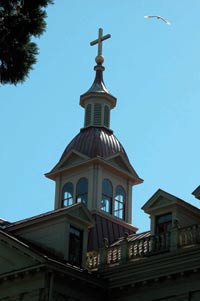
Some glitter had caught my eye: it came from a gold
cross atop a building that shifted my sense of place from the Protestant
Victoria of 2008 to the French Catholic Canada of the 1800s –
Montreal, St. Hyacinthe or Quebec City. But I was in Victoria –
wasn’t I?
The building was St. Ann’s Academy, three blocks
east of the Empress Hotel, at Quadra and Humboldt. Passing locals that I
quizzed knew nought, so I did some digging. I learned that St. Ann’s
– celebrating its 150th anniversary this year – has roots
leading right back to Wolfe’s victory over Montcalm, on the Plains of
Abraham in 1759.
From 1759 until 1846, education in Quebec had been
sporadic at best. In fact, in 1836, Quebec cut off funding, denying
education to 30,000 children. The Sisters of Ann, a teaching and nursing
order, was born out of this crisis.
Before B.C. joined Canada, in 1871, Bishop Modeste
Demers trekked back to French Canada in 1857, to get help for his young
diocese centred at the Hudson’s Bay Company’s trading post on
the southern tip of Vancouver Island.
Demers recruited four Sisters of St. Ann, their
laywoman, three priests and two monks. They sailed from Montreal for the
Panama Isthmus, which was then crossed by rail; they set sail on a second
boat, up the Pacific Coast, anchoring at Victoria June 5, 1858.
But Victoria was no longer a French-speaking trading
post. The 20 bark-roofed shacks the bishop had left behind were lost in
mass of tents, and 200 new houses. The Cariboo Gold Rush of ’57 and
’58 had lured English-speaking miners, most from California’s
spent gold fields.
Sister Valois served as the first Superior of St.
Ann’s Academy, a log cabin – and led her nuns through their
first crisis. Although the convents forbade girls from attending dances and
the theatre, three students accompanied their father Governor Douglas
– a Protestant and a close friend of the bishop – to a ball
aboard a man o’ war.
Governor Douglas asked Mother Superior to be lenient,
but she expelled his daughters anyway. Eleven other ‘upper social
class’ girls left, too.
In 1859, English-speaking Irish immigrant Sister Mary
Providence McTucker replaced Sister Valois. Racism and class distinction
tested Sister McTucker and Bishop Demers, when she established a select
school for those who could afford to pay fees – and a free school for
which minimal, if any, tuition was expected.
Black parents demanded their children be enrolled in
the select school, and Bishop Demers insisted that they be admitted; but
then the whites protested, and so the bishop rescinded his integration
order. And, much to the blacks’ sorrow, McTucker reverted to her
original plan.
In 1861, the Mother Superior began putting her students
through public examinations. The press reported on them annually, adding
that Victoria was lucky to have the sisters, their schools and their
medical care.
Even so, the Sisters’ schools were hotly debated:
“Are we to have sectarian schools?”asked the British Colonist and the Evening Examiner.
A reporter commented: “If I know the bishop well,
he will carry out his objective [a convent] regardless of all opposition,
as it has originated from no other foreign cause, but from a pure motive of
doing an actual and real good.”
By 1871, enrollment had outgrown the academy’s
three temporary sites. One of Bishop Demers’ priests, Fr. Michaud,
was an architect. He designed the first section of St. Ann’s, as it
stands today.
Continue article >>
|
The same year also saw Fr. Michaud move his wooden
cathedral, built in 1858, across Humboldt Street, to the rear of St.
Ann’s – where a brick shell tied it to the Academy.
In 1910, Thomas Hooper designed and built the third and
final section, which includes the auditorium. By 1973, a lack of nuns and
sufficient funds, turn-over of lay teachers and decreasing enrollment
closed St. Ann’s Academy. The sisters sold it to the provincial
government in 1974.
Government agencies and charities rented space in it
until 1985, when the fire marshal limited occupancy to 100, ordered the
east wing abandoned and demanded upgrading be complete by 1992. Vandals had
their kick at it, too. Graffiti disgraced its interior.
Academy Gardens, a private developer, won a lease
allowing conversion of St. Ann’s to a licensed tourist attraction.
Many protested, demanding that the gold cross be removed from the cupola:
“It would be outrageous to have that cross on top of a building when
600 people are getting drunk below it.”
However the developer refused to take down the cross.
“To put a development of this nature on this site,” another
opponent argued, “is akin to putting an amusement park on the Plains
of Abraham.”
U Vic’s chancellor William Gibson wanted St.
Ann’s for his junior students; others wanted it to be an arts centre.
The provincial government offered St. Ann’s to greater Victoria for
$1; the city and its neighbours said “no thanks.”
Catholic artist Gregory Hartnell got press attention
with tales of Emily Carr’s ghost having been seen stalking the
Academy, “bewailing the historic building’s fate.”
Carr, Victoria’s most lauded artist, was born the
year St. Ann’s Academy was built; she’d sketched the area; and
the sisters had nursed her at St. Joseph’s hospital, just across the
street.
Hartnell claimed that a white bird alit on the gold
cross atop the cupola at dusk, and Emily Carr appeared, turning slowly in
the cupola, looking at the panorama, her monkey Woo stroking “her
face consolingly.”
Eventually, Academy Gardens’ $21 million scheme
went broke. Some talked of demolishing St. Ann’s, but sanity
prevailed: St. Ann’s re-opened in 1997 after a $16-million
restoration. Today it is a national heritage site that includes a
French-Canadian chapel, which is used for weddings and other events; an
interpretive centre where visitors learn of the sisters’ work; and
government office space.
December 2008
|