|
By Lloyd Mackey
IN the interests of providing some insight into the
October 14 federal election, BCCN sought to interview candidates for three parties, in
three different Vancouver Island ridings.
We were only able to directly interview one of the
chosen three.
In soliciting the interviews, we sensed substantial
caution – based, it would seem fair to say, on the candidates’
perceived need to keep a sharp focus in an intensely fought contest, rather
than being drawn off by the interests of one particular faith perspective.
Reed Elley (Conservative), Keith Martin (Liberal) and
John Cooper (Christian Heritage) were the three candidates chosen. Elley
provided a short interview.
BCCN was unable to
contact the other two by press time. Information regarding them was drawn
from websites, news stories, and other public sources.
Reed Elley
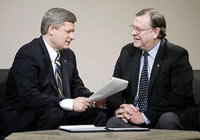 | Reed Elley with Prime Minister Stephen Harper. |
A Baptist minister by profession, Reed Elley was first
elected to the House of Commons for the Reform Party in 1997, in the
Nanaimo-Cowichan riding.
He retired in 2004, citing family responsibilities. (He
and his wife have fostered many kids, in addition to raising their own
children, on their acreage near Nanaimo.)
Since then, he has engaged in organic farming and
served an interim pastorate in First Baptist Church, Port Alberni.
At the urging of Conservative leadership –
including a call from the prime minister – Elley decided to try
regaining the seat, which went to the NDP when he left politics.
The argument which persuaded him was that there was a
pretty good chance the riding could have representation on the government
side, if he was elected. Such a situation had not prevailed for 24 years,
when Ted Schellenberg served as a Mulroney MP.
There were a couple of steps necessary to make running
a reality. He and his wife, Louise, prayed about it. And he had to
terminate, after just two weeks, an interim pastorate he had arranged with
West Vancouver Baptist Church.
Intriguingly, Elley has enjoyed a fair amount of
support among unionized forestry workers through the years – in part,
because of the Reform populist tradition which is arguably a part of the
new Conservative party.
“The economy is the overarching concern of
people, involving what’s happening in the United States, the forest
industry struggle, world economic forces, and the need for Canada’s
workforce to become more specialized,” Elley told BCCN.
He would like to start a local debate (and become a
national voice, if appropriate) growing out of a “huge concern on
affordable housing – the difficulty in getting rental accommodation
with a one percent vacancy rate. All that – not to mention the
$300,000 to $400,000 cost for housing often required for young
families.”
Keith Martin
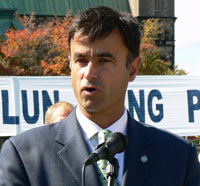 Keith Martin, who is running in the riding of
Esquimalt-Juan de Fuca, began his political career as a Reform MP,
but later switched to the Liberals – after running unsuccessfully for
the Canadian Alliance leadership, which was a precursor to the merged
Conservative party. Keith Martin, who is running in the riding of
Esquimalt-Juan de Fuca, began his political career as a Reform MP,
but later switched to the Liberals – after running unsuccessfully for
the Canadian Alliance leadership, which was a precursor to the merged
Conservative party.
Martin was one of the more ‘liberal’ of the
Reformers. A physician in the western communities before entering politics,
he had a reputation for compassion in his own practice, and a keen
awareness of international and national health issues.
Continue article >>
|
Essentially a fiscal conservative, Martin favours some
privatization of health care within the provisions of the Canada Health
Act. On social issues, he is more liberal, not opposing either abortion or
gay marriage.
He has periodically reminded faith-based people that he
has written often for Catholic publications, on such issues as the HIV/AIDS
pandemic and the Sudanese government’s treatment of Darfur.
The Wikipedia online encyclopedia points out that, as an MP, Martin
has worked with the Canadian Medical Association to get more Canadian
doctors into sub-Saharan Africa and rural parts of Southeast Asia.
He has said this parliament will be his last if he is
re-elected. When he leaves politics, Martin plans on going to Africa
– where he will combine his medical training with international aid,
to more effectively help people.
John Cooper
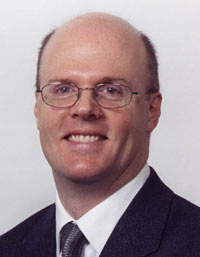 John Cooper is a physician specializing in obstetrics
and gynecology. John Cooper is a physician specializing in obstetrics
and gynecology.
A member of the Christian Medical-Dental Society, he is
running for the Christian Heritage Party (CHP) in the Victoria riding,
against incumbent NDPer Denise Savoie.
Before Savoie was elected in 2006, David Anderson, a
devout Anglican who held several cabinet posts in Jean Chretien’s
Liberal government, represented the riding.
Cooper lists his professional interests as: early
pregnancy assessment and management, moderate and high risk obstetrics,
reproductive genetics and genetic counselling.
He is one of 61 CHP candidates across Canada. The party
bills itself as operating on Judeo-Christian principles, and maintains that
it is the only Canadian political entity clearly opposing abortion.
Cooper is a clinical assistant professor at both the
University of Victoria and the University of British Columbia. He is also a
Brother of the Order of St. John of Jerusalem.
Earlier in his career, he practiced medicine within the
Canadian Forces, and was awarded a Canadian Peacekeepers Service Medal. He
also served at various times with United Nations forces from 1983 to 1990
– in Israel, Lebanon and Iran. He thus became a Nobel Peace
Prize co-recipient, when United Nations Missions were honoured in 1988.
Cooper is 45; he and his spouse, Leigh Anne, have
twin children.
October 2008
|